

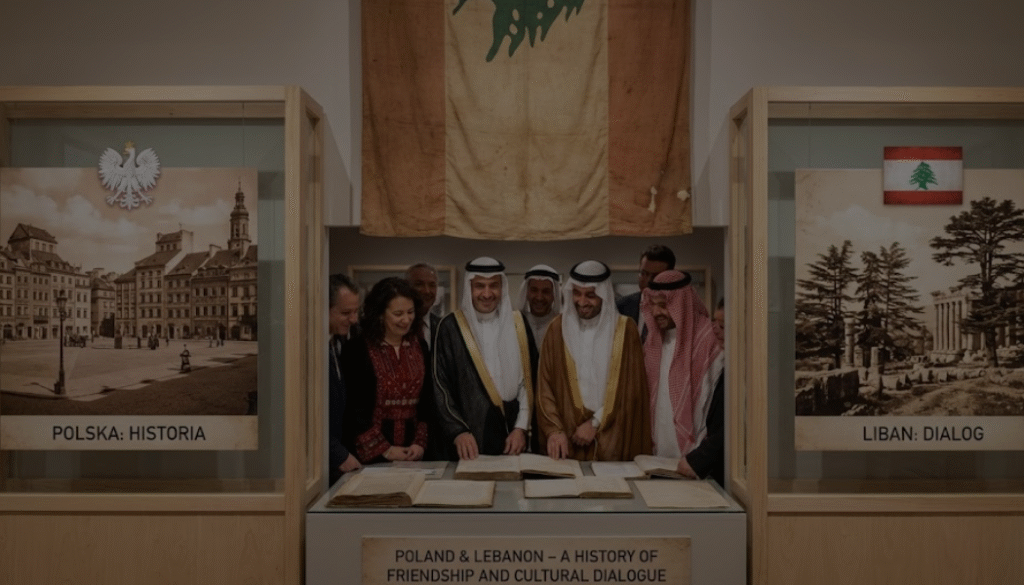
Poland and Lebanon share a surprisingly rich history of contacts. Over the centuries, spiritual, artistic and social ties have deepened, creating an inspiring picture of mutual cultural interpenetration. From medieval pilgrims, through Romantic poets, missionaries and wartime refugees, to the contemporary Polish community in Lebanon, these histories form a narrative of hospitality, shared values and friendship between the two nations.
Historical encounters: from pilgrims to Romantics
The first mentions of Poles in Lebanon date back to the time of the Crusades. Although Polish knights did not take part in the crusades on a large scale, we know that already in the 13th and 14th centuries Polish nobles and pilgrims reached Lebanese lands on their way to the Holy Land. One of the pilgrims whose valuable notes describe his journey through Lebanon was Prince Mikołaj Krzysztof Radziwiłł “Sierotka”, who travelled to the Holy Land in 1582–1584, recording his passage through Tripoli, the cedar forests and the snow-covered peaks of Lebanon.
Another important chapter in cultural relations between the two countries was the journey of Juliusz Słowacki. In 1837 the great Polish poet visited Beirut, Tripoli, and the Maronite mountain monastery of St. Anthony in Ghazir. It was there, “in the land of cedars”, that the poet sketched the first version of Anhelli, one of the masterpieces of Polish Romanticism. In letters to his mother Słowacki expressed his admiration for Lebanon, writing about its astonishing landscapes and the spiritual atmosphere of the place. Years later he even confessed in his diary: “I would like to find myself in Lebanon again.” His stay in the Lebanese monastery proved transformative both as an artist and as a person. It was in Ghazir that Słowacki experienced a profound spiritual renewal and, influenced by a Polish Jesuit he met there, made a confession that lasted all night (on Holy Saturday in 1837) and reconciled himself with God. This mystical experience in Lebanon forever marked the poet’s work and became a bridge between cultures.
The Jesuit who influenced Słowacki’s fate was Father Maksymilian Stanisław Ryłło, a Polish Jesuit, traveller and papal emissary. Born in 1802 in the eastern territories of the Polish–Lithuanian Commonwealth, Father Ryłło travelled widely in the Middle East and acquired deep knowledge of the Arabic language and Arab customs. For this reason, in 1836 he was sent by the Vatican on a mission to establish contact with the Eastern Christian Churches and to found a school in the Middle East. Through his efforts the Asiatic College (Collegium Asiaticum) was established in Beirut in 1839. This institution played a pioneering role in higher education in the Middle East. In 1875 the College was transformed into Saint Joseph University (Université Saint-Joseph, USJ), which today is one of the oldest and most prestigious universities in the region. Significantly, USJ continues to remember its Polish founder: on the 100th anniversary of Father Ryłło’s death, in 1948, a commemorative plaque was unveiled in the university building in his honour. Father Ryłło also made contributions to the local community, as in 1839 he donated to the Church of Our Lady of Deliverance in Bikfaya an icon of the Virgin Mary painted at his request by an Italian artist. The painting still hangs in the church today, serving as a living monument to the interweaving of cultures in Lebanon.
Poles in the spiritual and social service of Lebanon
Polish–Lebanese cultural relations are not only the individual stories of poets and clergy, but also a broader involvement of Poles in the life of the land of cedars. In the 19th century, many Polish patriots, after the fall of national uprisings, sought refuge and opportunities to continue their struggle for freedom alongside allies in the Ottoman Empire. Turkey readily accepted experienced Polish officers into its army, and some, such as General Józef Bem, even converted to Islam to be able to serve in the Sultan’s forces.
In this context, one particularly significant episode was the mission of Michał Czajkowski, known as Sadyk Pasha. This Polish émigré in the service of the Sultan in 1860 took command of units sent to Lebanon to protect the local Christians (mainly Maronites) from persecution during the violent clashes with the Druze. In the years that followed, additional Polish military formations composed of Christian soldiers were deployed to Lebanon. In 1865 an entire cavalry regiment, consisting largely of Poles, was established. In recognition of its merits, it was incorporated into the Sultan’s Guard and assigned to service in Lebanon, where it operated for 24 years. All the officers of these units were Poles, and their uniforms and banners referred to Polish colours. Poles safeguarded the security of Lebanon’s Christian population, which, as a result, could more actively restore trade routes along the Mediterranean coast.
It is also worth mentioning the son of Michał Czajkowski – Władysław Czajkowski, who served as the governor of Lebanon under Ottoman rule between 1902 and 1907. During that time he bore the title Muzaffar Pasha. Although his administration did not introduce spectacular reforms, the very fact that such a high administrative function was entrusted to a Polish émigré testifies to the trust that Poles enjoyed in the region.
Wartime fates: Polish refugees welcomed by Lebanese hospitality (1943–1950)
One of the most moving chapters in Polish–Lebanese relations is the story of Polish refugees during the Second World War. After the signing of the Sikorski–Majski Agreement, thousands of Poles, including women and children, travelled south in search of refuge alongside the Allies. Between 1943 and 1946, around 6,000 Poles evacuated from the Soviet Union reached Lebanon via Persia. The Lebanese government, despite its own difficulties, recognised the Polish newcomers as official allies and agreed that the Polish diplomatic mission would assume care for the refugees. Thus began a remarkable period of Polish presence in Lebanon, one whose defining elements included vibrant cultural life.
The refugees were initially housed in a temporary camp in Beirut, but soon many were settled in hospitable mountain towns whose names still evoke deep emotion among Polish families. In these places, Polish schools (as many as 15 educational institutions of various levels) were established, along with hospitals and orphanages, and in Ghazir even a Polish church and chapel were created. Libraries (one of them containing around 500 books) and cultural centres operated within the settlements, organising performances, lectures and concerts. From November 1941, the Beirut radio station “Levant” broadcast Polish-language programmes for the Polish Armed Forces in the Middle East, and from February 1942 the broadcasts aired twice a day. In the mountain towns of Bahamdun and Bhannes, Polish sanatoria were opened, where soldiers and civilians recovered their health in the welcoming surroundings of the Lebanese landscape.
Lebanese hospitality made it possible for Polish exiles to lead a relatively normal life. Children and young people continued their education (in 1947, 1,286 pupils attended Polish schools across the 15 institutions in the country). Older students and soldiers could pursue studies at local universities (between 1942 and 1950 as many as 400 people did so), and roughly half later obtained academic degrees.
Artistic and religious activity also flourished. Polish youth founded scouting groups, choirs and music ensembles. Beirut also welcomed the famous Polish singer and actress Hanka Ordonówna, who organised performances and ran a home for orphaned Polish children (she had arrived with an orphanage evacuated from the USSR via Bombay). Sadly, Ordonówna fell ill with tuberculosis and died in Beirut in 1950, where she was buried. Her ashes returned to Poland only in 1990.
Many Poles who found refuge in Lebanon during the war made significant contributions to the country’s development. They were mostly well-educated people, often with professional experience from the Second Polish Republic. Without Lebanese citizenship, they formed an organised community loyal to Poland while at the same time engaging actively in the life of their new home.
Engineer Edward Romański lectured at the American University of Beirut and served as a government expert on water management and irrigation projects, including on the Litani River. Karol Flecker, a specialist in paints and varnishes, contributed to the modernisation of Lebanon’s industrial sector. Karol Schayer, a modernist architect, left a lasting mark on Beirut as the designer of many contemporary buildings, including the Carlton Hotel and the headquarters of the Dar Assayad publishing house. Dr Stanisław Zaremba collaborated with Lebanese academic institutions, publishing mathematical research.
Most of the approximately six thousand Polish refugees left Lebanon in 1950–1951, some moving on to Western Europe and the Americas. Around two hundred Poles remained permanently, founding families and contributing to the social, cultural and academic life of the country. Their presence and achievements became a lasting symbol of Polish–Lebanese friendship, which endures to this day.
Contemporary Polish community and joint initiatives
After the wartime emigration, a small but active community remained in Lebanon. Following the end of the civil war in 1991, the Polish Club was established and transformed a year later into the Polish Community Association in Lebanon, bringing together several dozen Polish-Lebanese families as well as clergy and professionals. The organisation safeguards language, tradition and national memory, while also promoting Polish culture among the Lebanese. In 1992, the School of Polish Language and Culture in Beirut was founded, giving children from mixed families the opportunity to learn Polish and become familiar with the country’s history. In 1997, the first issue of the monthly Polskie Cedry appeared, documenting the life of the diaspora and presenting Poland to Lebanese readers.
The Embassy of the Republic of Poland in Beirut organises Polish Culture Days, Chopin music concerts, exhibitions and film screenings, while in Poland Lebanese Culture Weeks are held. The Polish community celebrates national and religious holidays, bringing Poles and Lebanese together for joint ceremonies, from the solemn mass on 3 May to Christmas Eve gatherings.
Summary
The history of Polish-Lebanese relations shows that the ties between both nations have a lasting and natural character, as they grow out of shared historical experience, mutual goodwill and cooperation. From the times of pilgrims and poets, through missionaries, wartime refugees and scholars, to the contemporary Polish community and cultural initiatives, these contacts have consistently been built on dialogue and mutual respect. This cooperation continues today, despite the small number of Poles living in Lebanon. Its continuity is maintained not by declarations, but by generations of people who knew how to connect two distant worlds. The centuries-long cooperation between Poland and Lebanon, bound by shared cultural heritage and mutual inspiration, remains one of the most enduring examples of friendship across borders.