

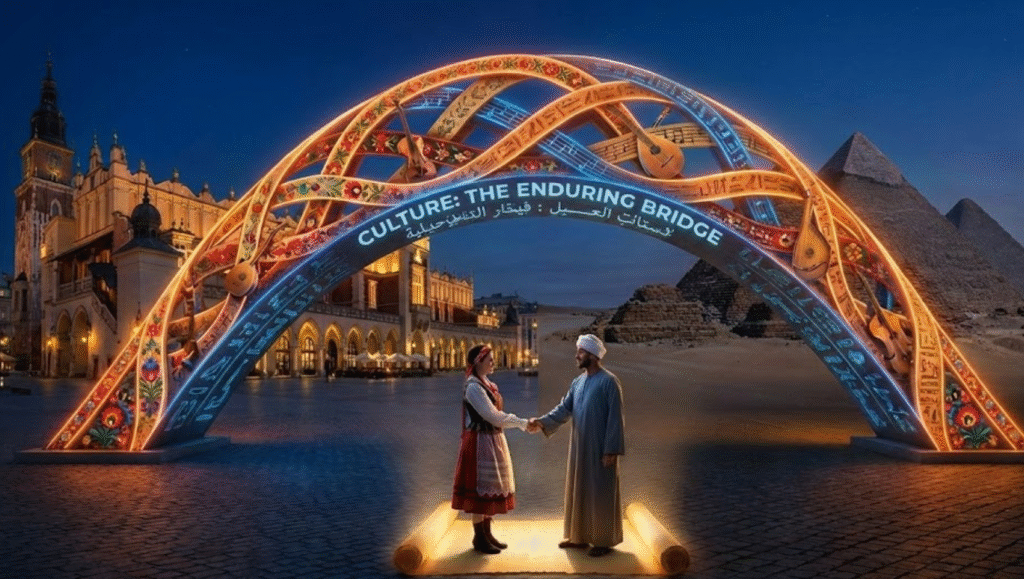
The history of Polish-Egyptian relations has roots deeper than it may appear. Long before the signing of the first diplomatic agreements, before the visits of official delegations and contemporary academic exchanges, the bond between the two nations was culture: the language of art, science and shared admiration for the heritage of the civilization on the Nile. From the romantic journeys of Juliusz Słowacki, through the fascination with the Orient in Polish painting and literature, to the scientific expeditions of Kazimierz Michałowski and the work of modern institutions, Egypt holds a special place in the Polish imagination.
It is precisely through culture that Poles and Egyptians have been able to get to know, understand and inspire one another. Art, science and education have proved more durable than borders, ideologies or political systems. The encounter between Europe and Egypt – two different yet complementary worlds – resulted in a dialogue in which fascination with history, spirituality and art replaced political divides. Upon this foundation grew a bridge of mutual understanding that has endured across eras and systems.
Romantic beginnings – Słowacki on the Nile
Before the artists and scholars of the nineteenth century arrived on the Nile, Poles whose presence had religious, military and humanistic dimensions had already reached Egypt. Among the earliest Poles to arrive were missionaries and pilgrims who, by leaving accounts of their journeys to the holy places, opened the first pages of the shared cultural history of Poland and Egypt. Another significant group of Poles who appeared on the Nile and left their mark on history were the legionnaires who reached Egypt with Napoleon. Among them stands out Salomon Horowitz, a Jew probably from Lublin, an intellectual who served in Napoleon’s army, including as a translator. He was also involved in arranging collections, copying Arabic and Hebrew texts, and cooperating with scholars who later created the famous Description de l’Égypte. Horowitz symbolically represents the presence of Poles in the intellectual culture of the Napoleonic era, people of knowledge and letters, not only arms. His activity constitutes the first example of a Pole participating in the documentation and popularisation of Egyptian heritage in Europe.
At the same time, soldiers such as Józef Szumlański left memoirs describing Cairo, Alexandria and the pyramids. In their accounts, Egypt appears as a land astonishing and different, yet evoking respect and admiration. Together with the notes of pilgrims and missionaries, they created the first circle of Polish testimonies about Egypt, documenting not only the country but also the process of encounter between two cultural worlds.
On this foundation, in the mid-nineteenth century, a new type of Polish presence in Egypt emerged which had a great influence on Polish literature: the romantic journey, combining the curiosity of a scholar with the spiritual reflection of an artist. Juliusz Słowacki, who visited Alexandria and Cairo in 1836–1837, belonged to the first generation of Polish creators for whom Egypt was not only an exotic destination but a space for philosophical reflection on time, memory and the endurance of nations. In the poem Piramidy, the poet described the moment of climbing to the top of the Great Pyramid of Cheops, an experience that became for him a symbol of spiritual elevation. In his gaze upon the desert and the Nile he saw not only the beauty of nature, but also a metaphor of human immortality and national survival. For Słowacki, Egypt was a place where history becomes eternity and stone becomes a prayer.
Artists and scholars on the Nile
In the second half of the nineteenth century, Egypt became for Poles not only a destination for spiritual journeys but also a scientific laboratory and a source of artistic inspiration. Doctors, botanists, painters, photographers and writers arrived on the Nile, driven not by the desire merely to observe but to understand—to study the history, nature and culture of the country and incorporate it into the European circulation of knowledge. Among the best known were:
Ignacy Żagiell (1826–1891), a physician and traveller from the Vilnius region who studied in Kyiv, is among the pioneers of Polish Egyptology. He spent several years in Egypt, reaching as far as Nubia and Ethiopia. His extensive Historia starożytnego Egiptu (History of Ancient Egypt, 1880) was one of the first attempts to popularise knowledge of the pharaohs in the Polish language. It combined erudition with the romantic passion of an explorer and for many years served as a primary source of knowledge about Egypt for Polish readers.
A little earlier, Leon Cienkowski (1822–1887), a botanist and microbiologist, was invited by the Egyptian authorities to collaborate on research into the flora of the Nile Delta. In his reports he described vegetation, climatic conditions and issues related to Egypt’s water management.
Meanwhile, Łukasz Dobrzański (1864–1909), a photographer and illustrator, was one of the first Poles who attempted to capture Egypt through the lens. His photographs of the Nile, Giza and Thebes constitute today an invaluable iconographic source and at the same time evidence that fascination with the Orient had moved from literature into a new medium—photography.
On the same foundation developed the work of painters who gave Egypt an artistic and spiritual dimension. Franciszek Tepa (1828–1889), a graduate of the Kraków Academy, travelled to Egypt and Syria in the 1860s. His watercolours from Giza, Cairo and the Nile Valley, depicting pyramids, mosques and the daily life of Egyptians, combined realism with a lyrical atmosphere and were among the first works on Oriental themes in Polish painting. For Tepa, Egypt was not an exotic backdrop but a living world in which history and the present meet.
A similar spirit accompanied Izydor Jabłoński (1835–1905), a friend and biographer of Jan Matejko, who painted genre scenes from Cairo and the desert, and Stanisław Chlebowski (1835–1884), court painter to Sultan Abdülaziz in Constantinople, who visited Egypt many times.
At the turn of the century, a new quality was introduced by Edward Okuń (1872–1945), a modernist painter who travelled to the Nile to create illustrations for Pharaoh by Bolesław Prus. This project was more than an artistic commission; it was an attempt to recreate the spirit of ancient Egypt from a Polish intellectual perspective. Pharaoh, a novel about power, responsibility and the spiritual strength of a nation, linked reflection on Egypt with questions about the fate of Poland. Okuń and Prus demonstrated that dialogue with Egypt is not an exotic adventure but a conversation about the universal mechanisms of history. Although this jubilee edition of Pharaoh was never published, the journey left behind numerous drawings of Egyptian scenes as well as the painting Goddess Hathor, created around 1916.
Sienkiewicz and the spirit of travel
When Henryk Sienkiewicz set out for Egypt in 1890, the world along the Nile was already well known from the accounts of his predecessors: poets, travellers and scholars. Yet the Letters from Africa, which he published after his return, opened a new chapter in Polish travel writing. They combined meticulous observation with literary flair and became a record of the meeting of civilizations: European, Arab and African. For Sienkiewicz, Egypt was not merely a stop on the way to East Africa but a space for reflection on the coexistence of past and modernity. In his descriptions of Cairo, Giza and Port Said he perceived both the monumentality of the pyramids and the dynamism of contemporary life. He was captivated by the energy of the city, its openness, its mixture of languages and religions, and at the same time the profound continuity of tradition. Unlike the Romantics, he did not seek mystical signs in Egypt; he looked through the eyes of a reporter who understood that spirituality and modernisation can coexist.
It was from this journey that one of Sienkiewicz’s best-known works later emerged: the novel In Desert and Wilderness (1911). The book’s plot begins in Egypt, during the construction of the Suez Canal, and constitutes a literary record of the author’s fascination with the Arab and African worlds. The novel introduced into Polish culture a rich image of Egypt and presented it as a place where three continents meet. In the novel, Egypt became a gateway to Africa, but also a metaphor for a world in which a person can learn humility in the face of nature and different cultures. Thanks to both the Letters from Africa and In Desert and Wilderness, the Polish reader saw Egypt not as an exotic backdrop but as a living social organism in which history, religion and everyday life form a coherent whole.
Music, theatre, engineering
From the mid-nineteenth century, Egypt attracted not only travellers and artists but also musicians, architects and engineers who brought elements of European modernity into the country’s cultural and technical life. In Alexandria and Cairo numerous theatres, orchestras and musical societies were active, becoming natural meeting points of cultures. It was there that Poles began to appear, valued for their artistic skill, reliability and European education.
In the second half of the nineteenth century Antoni Kątski, a well-known pianist and composer, a student of John Field and a contemporary of Chopin, arrived in Egypt. During his travels he performed together with his brother Apolinary also in Cairo, introducing audiences to the repertoire of European piano music. At the turn of the nineteenth and twentieth centuries other Polish artists also appeared there: singers and musicians associated with European opera stages, including the distinguished bass Władysław Miller, and the conductor Jadwiga Rozwadowska, who conducted Isolde at the Cairo Opera. In 1879 the violinist Władysław Górski stayed in Cairo for several months. It is noteworthy that he was accompanied on the journey by his wife Helena, who later married Ignacy Paderewski. The violin virtuoso Paweł Kochański also performed in Egypt, appearing on the Nile around 1907.
There is also evidence of many musicians of Jewish origin who came from the territories of Poland, such as Schulim Bergrun from Lviv, Jeyka Freimann from Zhovkva, Hersz Leszcz from Chortkiv, or Adolf Rosenkranz from Sniatyn. In Cairo’s cafés Mirze Huss Brunwasser from Horodenka and Betty Meth from Lviv performed, while Anna Stein and Lei Schilling from Stanisławów played in Feiges’s orchestra.
War, emigration, solidarity
During the Second World War, Egypt became one of the main centres of the Polish wartime diaspora and a refuge for thousands of Poles evacuated from the Soviet Union in 1942 together with General Władysław Anders’s Army. For many of them Alexandria, Cairo and Ismailia were the first places where they could regain a sense of safety after the dramatic experiences of Siberia and Persia. Not only the military command was located there, but also social and cultural institutions. Meetings were held, radio broadcasts were aired, and newspapers and books in Polish were published. Among the best-known Polish publications printed on the Nile were: Dziennik Żołnierza Armii Polskiej na Wschodzie, Głos Karpacki, Nasze Drogi and Parada. Youth magazines, such as Junak, Kadet and Ochotniczka, which was distributed in Palestine, were also printed in Egypt.
Archaeology and cultural diplomacy
After 1956, cooperation between Poland and Egypt entered a new stage. The cultural agreement signed in Cairo in 1957 made Egypt the first Arab country with which the People’s Republic of Poland established such extensive relations. Their symbol became the work of Prof. Kazimierz Michałowski and the Polish archaeological mission in Faras, whose discoveries, including unique Christian frescoes, were transferred to the National Museum in Warsaw and to the museum in Khartoum.
Cooperation also included the exchange of scholars, concerts, exhibitions and joint artistic projects. In 1960 a Chopin concert was held in Cairo for the Egyptian elite, and in the following decades Polish-Arab and Polish-Egyptian friendship associations operated, supporting artistic, scientific and social contacts.
Polonia and new generations
After the end of the war, several-thousand-strong Polish communities remained in Egypt, especially those connected with the army. However, once it became clear in which sphere of influence Poland had found itself, social life based on the existing military structures was gradually dismantled. A Repatriation Mission was established in Cairo, through which around 700 people returned to the country. A small number of people of Polish nationality remained in Egypt, including Polish women who had married Egyptians and settled on the Nile, as well as a small diaspora of Polish citizens of Jewish origin, descended from the pre-war emigration. For this reason, already in 1946 the Union of Poles in Egypt was established, with Julian Suski as its president.
The present Polish community is composed mainly of Polish men and women who entered into marriages with Egyptian citizens, as well as descendants of earlier emigrants. The largest influx of Polish women to Egypt occurred in the 1970s, when they worked as teachers of English and science subjects. The largest Polish communities exist in Cairo and Alexandria, but Poles can also be found in Ismailia, Bani Suwayf, Minya and Shibin al-Kawm. In 1995 the Union of Polish-Egyptian Families was founded in Egypt, an organisation promoting education and the Polish language, supporting mixed families and organising cultural events at the Embassy of the Republic of Poland in Cairo. Joint celebrations of national holidays, concerts, workshops and charity actions have become an important element of the Polish-Egyptian social calendar.
Culture – a space of understanding
For more than two hundred years of mutual contact, culture has been a field of encounter, not rivalry. A shared fascination with antiquity, a love of science and art, and a respect for the spiritual heritage of the other nation made Polish-Egyptian relations acquire a unique character, combining tradition with modernity, emotion with reflection, and knowledge with empathy. For Poles, Egypt was a space of wonder and inspiration, a place where they could find an echo of their own historical and spiritual experiences. For Egyptians, Poland became an example of a country with a rich culture, boldly seeking dialogue and cooperation. From these two perspectives arose a relationship based on trust and mutual recognition, in which the importance of culture extends far beyond the artistic dimension and becomes a tool of diplomacy, education and the joint building of the future.