

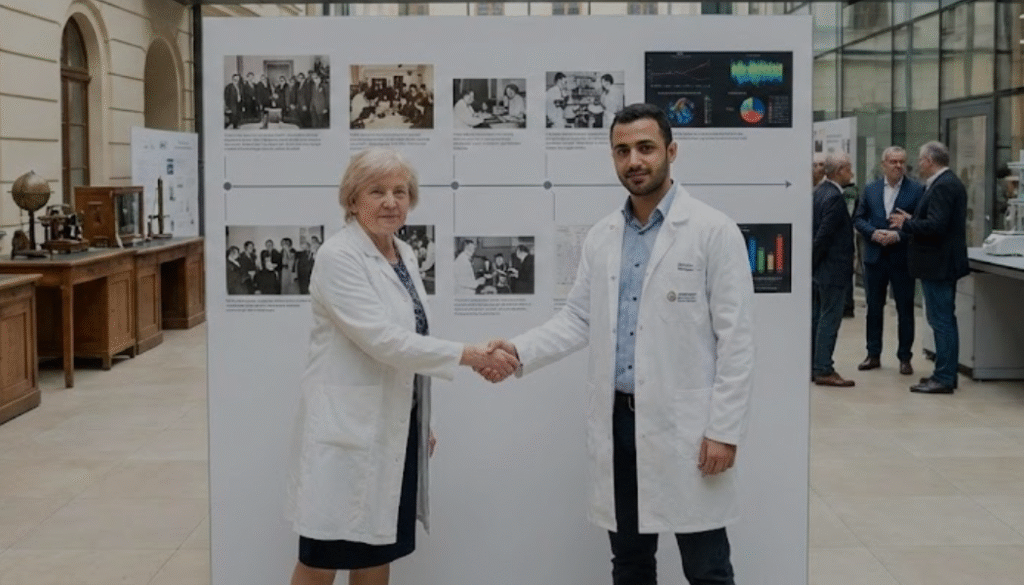
The scientific traditions linking Poland and Lebanon have a long history, dating back to the first half of the nineteenth century. Their beginning was the work of the Polish Jesuit Father Maksymilian Stanisław Ryłło, an outstanding missionary and scholar who played a key role in the development of education in the Middle East. In 1839, on his initiative, the Asiatic College (Collegium Asiaticum), a Jesuit school, was established in Beirut, which in 1875 was transformed into Saint Joseph University (Université Saint-Joseph, USJ). It was the first modern institution of higher education in the region and at the same time a symbolic beginning of the presence of Polish educational thought in Lebanon.
The work of Father Ryłło, who knew the Arabic language and the culture of the Middle East, left its mark not only on the history of education but also in the memory of the local community. USJ still commemorates its Polish founder, and one hundred years after his death, a memorial plaque dedicated to him was unveiled in Beirut. From the same period dates another thread of Polish-Lebanese intellectual ties: the visit of Juliusz Słowacki in 1837. In the monastery in Ghazir, the poet created the first version of Anhelli, a work inspired by the spiritual atmosphere of Lebanon. This meeting of cultures and ideas became one of the first links from which a lasting tradition of scientific and cultural dialogue between the two countries would eventually grow.
Archaeology and heritage protection
Since the 1990s, Polish-Lebanese archaeological cooperation has been developing dynamically. Since 1996, archaeologists from the University of Warsaw, in cooperation with Lebanese partners, have been conducting regular excavations in the ancient settlements of Khirbet Chim and Jiyeh (Porphyreon) on the Phoenician coast. Over more than twenty research seasons, the Polish mission has uncovered the remains of two well-preserved settlements from the Roman and Byzantine periods, including houses, a Roman temple, early Christian churches with mosaics, and an olive press. These discoveries have provided valuable knowledge about daily life and the economy of ancient Lebanon.
In parallel, conservators from the Academy of Fine Arts in Warsaw restored hundreds of square meters of mosaics and wall paintings, saving many monuments from destruction. The achievements of this cooperation were honored with the exhibition “People, Places, Monuments. 20 Years of Polish-Lebanese Cooperation in Archaeology and Conservation (1996–2016)”, organized in Beirut by the Polish Centre of Mediterranean Archaeology of the University of Warsaw, the Embassy of the Republic of Poland in Lebanon, and the French Institute.
Support for education and scientific infrastructure
Contemporary scientific cooperation between Poland and Lebanon includes not only research but also concrete development activities. Lebanon is one of the priority countries of the Polish Aid program, under which projects supporting education, school infrastructure and public safety have been implemented for several years. One of the key areas is the modernization of educational institutions. In many schools, solar panels have been installed to ensure a stable supply of energy despite the ongoing energy crisis. At the Saint Sauveur School in Jeita, solar batteries were installed on the roof, and a modern science laboratory equipped with professional experimental tools was created at the same institution. As a result, older students can learn through practice and develop skills needed in a modern economy.
An important component is also counteracting digital exclusion. At the Foyer de la Providence educational center in Beirut, which cares for orphaned and vulnerable children, both mobile and stationary computer labs were created. They gave students access to modern technologies and improved the quality of education.
Poland also supports infrastructure and public safety. At civil defense stations in Beirut, water, sewage and electrical systems were modernized, and solar lighting was installed. In cooperation with the Polish foundation IHelp Institute, personnel of the Civil Defense, the Red Cross and the fire department were trained, receiving equipment and improving their operational readiness.
As part of inclusive education projects in northern Lebanon, in the town of Zagharta, a culinary workshop was created for children and adults with autism, helping them develop practical life skills. Meanwhile, in cooperation with Polish Humanitarian Action, a training center in Beirut’s Tajjune district was supported, offering vocational courses for women and youth.
Such broad initiatives show that Poland actively supports the development of human and scientific capital in Lebanon. Improving learning conditions—from providing energy and equipping schools to vocational training—translates into real opportunities for the young generation of Lebanese citizens.
Academic partnerships and student exchange
One of the most important pillars of scientific cooperation between Poland and Lebanon is the direct academic and research contacts. Polish universities are increasingly establishing partnerships with Lebanese institutions, which supports the exchange of knowledge, experience and best practices.
An example of such cooperation is the agreement between the Faculty of Architecture of the Cracow University of Technology and the Lebanese American University. Joint architectural projects allow students and lecturers from both universities to benefit from different experiences and engineering traditions, creating modern design solutions inspired by both European and Middle Eastern heritage.
In the field of social and political sciences, cooperation between the Polish Institute of International Affairs (PISM) and the Issam Fares Institute for Public Policy and International Affairs at the American University of Beirut is becoming closer. Joint research, seminars and expert exchanges focus on the analysis of international politics and security in the Middle East region.
At the same time, the number of Lebanese students taking advantage of educational opportunities in Poland is growing. The Polish government offers young people from Lebanon participation in prestigious scholarship programs, especially in technical, natural and IT fields. One of the most important is the Stefan Banach Scholarship Programme, implemented by the Polish National Agency for Academic Exchange (NAWA), which enables outstanding students from Lebanon to undertake free master’s studies in Polish or English at Polish universities.
Thanks to such initiatives, successive generations of Lebanese graduates of Polish universities become natural ambassadors of Polish science and culture in their country, strengthening academic ties and building lasting bridges of cooperation for the future.
Joint action for the environment
The protection of nature has become one of the important areas of cooperation between Poland and Lebanon, linking science, education and environmental diplomacy. Of particular importance is the shared concern for migratory birds, which each year travel from Europe to Africa across the Lebanese sky. Among them are white storks, a symbol of Polish fauna, which are threatened by illegal hunting. The Embassy of the Republic of Poland in Beirut has for years carried out information campaigns and ecological projects aimed at increasing public awareness of nature conservation and biodiversity. One example of this cooperation was the study visit to Poland in late September and early October 2025, organised for members of the Lebanese Association for Migratory Birds under the leadership of Dr Michel Sawan.
During their stay in Poland, Lebanese ornithologists met with leading Polish researchers – Prof. Przemysław Busse, founder of the bird migration research programme Operation Baltic, and Prof. Magdalena Remisiewicz, head of the Bird Migration Research Station at the University of Gdańsk. The guests took part in field observations at the Baltic bird ringing station and received training at the Protected Birds Rehabilitation Centre of the Warsaw Zoo. As part of the visit, they also visited the commune of Zbuczyn in Mazovia, where the educational project Stork Centre is planned, intended to integrate the local community around pro-ecological activities.
The joint efforts of Poland and Lebanon in this area confirm that care for the natural environment has become an element of modern diplomacy and scientific cooperation. Both countries share the conviction that the protection of nature and the exchange of knowledge are not only duties towards future generations, but also an effective way of building dialogue between nations.
Promotion of Polish scientific achievements in Lebanon
Scientific cooperation between Poland and Lebanon includes not only research and academic projects, but also the popularisation of Polish achievements and figures who have played a significant role in the development of world science. The Polish diplomatic corps actively introduces Lebanese youth to the profiles of outstanding Polish scholars, inspiring them towards discovery and innovation. An example of such initiatives is the event dedicated to Maria Skłodowska-Curie, organised in May 2025 at the SSCC Sioufi secondary school in Beirut by the Embassy of the Republic of Poland in cooperation with the Curie Museum in Paris. Such initiatives not only popularise science, but also build a positive image of Poland as a country of discoverers, researchers and innovators.
Summary
Scientific relations between Poland and Lebanon have an exceptionally long and consistent history, reflecting the broader character of the ties connecting both nations. Their origins date back to the 19th century, when Polish Jesuits, led by Father Maksymilian Ryłło, contributed to the development of higher education in Lebanon by establishing the Asiatic College in Beirut, the predecessor of Saint Joseph University. It was there that a tradition of cooperation based on mutual trust, shared values and respect for knowledge was born.
In the following decades this cooperation took various forms, from archaeological and conservation research to educational, ecological and social projects. Polish scholars and conservators left a lasting mark on Lebanese archaeology and the protection of cultural heritage, while contemporary activities under the Polish Aid programme and the National Agency for Academic Exchange give this cooperation a modern dimension. Today, academic contacts, student exchanges, joint research and ecological initiatives create a dense network of collaboration in which science becomes a bridge between societies. Poland’s presence in Lebanon, from educational projects to nature conservation, reflects a consistent strategy of building relations based on knowledge, culture and joint action.
In this multifaceted dialogue, science acts as a binding force connecting tradition with modernity, creating a space for mutual understanding and inspiration. Thanks to the efforts of institutions, researchers and diplomats of both countries, Polish-Lebanese relations remain vibrant and dynamic, illustrating how intellectual cooperation can transcend geographical and cultural boundaries.