

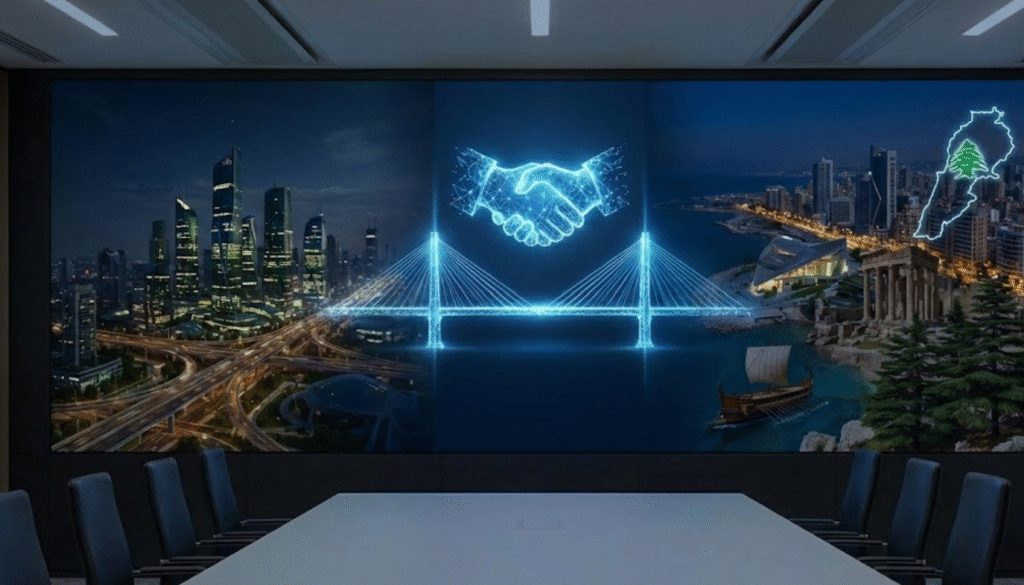
The positive experience from the ongoing Polish-Lebanese cooperation is a good prognosis for the future. Current areas of cooperation, such as humanitarian and development aid and security, should be deepened, and cooperation should also be extended to new areas. As the leader of Central and Eastern Europe, Poland has a lot to offer Lebanon on many levels. Currently, Poland is the 20th largest economy in the world, which is the result of a successful political and economic transformation.
Thanks to dynamic development over the last two decades, Poland has become a key European Union country, possessing modern road and rail infrastructure, enjoying the reputation of being one of the safest countries in Europe, and attracting investors from around the world. Polish cities, including provincial ones, have undergone a metamorphosis, renovating homes, roads, and public utility buildings. The non-governmental organization sector is also thriving, which is evidence of a well-developed civil society. Lebanon needs similar reforms, and Poland can help it, especially since it shares similar experiences of foreign occupation and the fight for sovereignty and democracy. Therefore, Poland, which has no colonial baggage, is an ideal partner for Lebanon in terms of scientific and civil cooperation, as well as in the security and economic-development dimensions.
Political Transformation and Scientific-Academic Cooperation
Lebanon needs reforms similar to those that Poland successfully introduced as part of its systemic transformation. While Lebanon has institutions of a democratic state, elections are held, and there is no authoritarian system like in Poland before 1989, it is necessary to strengthen civic awareness, national cohesion, sovereignty, and good governance, as well as to strengthen state institutions and combat corruption. Poland has rich experience in this area that it can share. This concerns both the institutional improvement of bodies responsible for fighting corruption, organized crime, banking supervision, or the judiciary, as well as cooperation between non-governmental organizations, including those working for good governance, civil society, digital education, combating disinformation, election monitoring, and media freedom. In this regard, it is necessary to intensify expert-level cooperation, including joint workshops and training, as well as the organization and participation in conferences (e.g., participation of Lebanese experts and politicians in the Warsaw Security Forum, organized by the Casimir Pulaski Foundation). One platform for cooperation could be the Shaffafiya portal as a place for the exchange of opinions and analyses by experts from Poland, Lebanon and other countries in Eastern Europe and the Middle East.
Expert and institutional cooperation should be accompanied by the intensification of academic relations and the development of joint research projects. In this area, Poland can offer Lebanese students attractive study conditions at Polish universities using instruments such as Erasmus+, the Ignacy Łukasiewicz Scholarship Program for engineering students, and the Stefan Banach Scholarship Program for medical students. All these instruments are already available to Lebanese students. It would also be advisable to stimulate lecturer mobility between Lebanon and Poland, which would also foster the development of joint research projects and scientific publications. Furthermore, Polish specialists, particularly archaeologists, can play an important role in the protection of historical monuments in Lebanon. In this regard, Poland offers Lebanon unique knowledge in the field of historical monument conservation, which is crucial for Lebanese tourism.
Infrastructure and Transport
Poland has vast and recent experience in the expansion and modernization of railway infrastructure and public transport (metro, bus, and tram networks). Lebanon, on the other hand, faces problems with traffic jams, a lack of railways, and a poor and unintegrated public transport system. The old Lebanese railway line has been out of service for a long time, although its reconstruction is an urgent necessity. Intercity connections are provided exclusively by taxis and minibuses, which are also the only means of public transport in perpetually congested Beirut. Poland has both the know-how in urban transport planning and the capabilities and experience in the construction of rolling stock and transport infrastructure.
Poland can therefore play a key role in reforming the transport system in Beirut, including the design of a tram and metro network. The experience of the company Metroprojekt, which was the main designer of the Warsaw Metro, can be crucial, as it is recent and was associated with complex underground conditions and implementation in a highly built-up area with heavy traffic. This is precisely what Beirut needs. Poland can also offer advice on creating modern public transport authorities responsible for fare and timetable integration (buses, trams, metro). The offer may also include training for engineers and planners on optimizing the transport network and implementing passenger information systems (display boards, applications), as well as launching student and engineer exchange programs with the Warsaw University of Technology and the Cracow University of Technology to train local specialists in metro construction, tunneling, and traffic management.
Poland can also present a broad offer for the supply of modern rolling stock that is competitively priced and adapted to difficult conditions. Poland is a leader in this field. This includes, among others, Solaris buses, which is a leading city bus manufacturer in Europe and has introduced low-floor buses to cities in Poland and Europe. Solaris is also a leader in the segment of electric and hydrogen buses, which corresponds to global trends. The Polish bus offer includes both city and intercity buses, with other manufacturers being Autosan and NesoBus. The former, besides city buses, also offers medium-sized intercity buses, ideal for short routes. NesoBus, in turn, offers modern hydrogen buses.
Beirut should also consider introducing trams to its streets, and Poland also has recent and rich experience in this case. After a period of liquidating tram lines, as part of a mistaken trend at the end of the 20th century, Poland has recently embarked on the dynamic expansion and modernization of tram lines. Currently, their total length in Poland is over 2400 km, and the tram networks in Warsaw and the Katowice agglomeration are among the largest and most modern in Europe. Polish companies Modertrans and Pesa can offer the most modern tram rolling stock, which can now be seen in many European cities, including Germany, Romania, Bulgaria, Hungary, Ukraine, Estonia, and Slovakia. Polish companies also have extensive experience in the construction of tram trackage and accompanying infrastructure and have carried out contracts in this regard in Germany, Lithuania, Slovakia, and Latvia, among others.
Poland also has vast experience in modernizing railway lines and capabilities in the production of railway rolling stock and infrastructure construction, including traction and trackage, as well as modern railway stations. Over the last 10 years, Poland has allocated about $25 billion to the modernization of approximately 9,000 km of tracks, resulting in reduced travel times, e.g., the 320-kilometer route from Gdańsk to Warsaw from 3.5 hours to 2.5 hours. Further stages of modernization, related to the High-Speed Rail project, are expected to shorten the 350-kilometer route from Warsaw to Wrocław to 96 minutes, for example. Two Polish companies, Pesa and Newag, are giants in the railway rolling stock market and are increasingly expanding into foreign markets. Pesa, based in Bydgoszcz, produces, among others, the elegant Pesa Dart long-distance trains, often called the “Polish Pendolino,” as well as Elf trains (Electric Multiple Units), which are popular in regional transport. Pesa is a pioneer of hydrogen technology in this part of Europe, producing a hydrogen locomotive (SM42-6Dn). Pesa has supplied Link trains to the German Deutsche Bahn, and has also won gigantic contracts in Romania (for over 60 trains) and the Czech Republic. Newag, from Nowy Sącz, focuses on reliability, engineering, and high availability of rolling stock. For years, this company has built a leading position in the electric locomotive segment. Among its flagship products are: Impuls regional trains; the heavy, 6-axle Dragon freight locomotive – a Polish export and technical hit, ideal for hauling heavy coal or aggregate trains; and the fast Griffin passenger locomotive (reaching 200 km/h).
Polish construction companies have also carried out many orders in recent years for laying tracks and setting up traction networks, both in Poland and abroad. For example, Cracow-based ZUE S.A. is active in the German (Deutsche Bahn) and Slovak markets, and Trakcja S.A. is very active in Lithuania, where it carries out huge contracts as part of the Rail Baltica project (construction of new railway lines that will connect Poland with the Baltic countries in the future). Meanwhile, the Polish construction giant Budimex won a prestigious contract for the construction of the Rail Baltica section in Latvia/Estonia. This company is also increasingly entering the Czech, Slovak, and German markets, targeting large infrastructural projects. In turn, Polska Grupa Zbrojeniowa (PGZ), as the owner of H. Cegielski – FPS, can supply railway carriages.
Security and Technology
Poland has long contributed to the security of Lebanon through its military contingent in the UNIFIL mission. This creates the opportunity to deepen cooperation and commence training for the military, police forces, and border guard. Poland can present Lebanon with an offer based on its experience in the protection of the EU’s external borders and its dynamically developing modern defense technology industry. Cooperation in these sectors can prove crucial for Lebanon’s stability. Due to the long and porous border with Syria and the problem of illegal migration and smuggling, Lebanon needs Integrated Surveillance Systems (ISS). Poland can offer the implementation of a modern, multi-layered ISS, consisting of thermal imaging and optoelectronic cameras, as well as ground radars. Poland can also offer specialized training for Lebanese border services in: patrolling techniques, the use of modern equipment, and crisis management in case of high migratory pressure. Talks regarding Polish support for the Lebanese Border Control Committee have already begun – a discussion on this topic took place on October 13, 2025, between the Polish Ambassador, Aleksandra Bukowska McCabe, and Brigadier General Elias Aad.
Poland can also offer unmanned aerial vehicles (UAVs). The Polish defense industry is a leader in the production of light, tactical unmanned systems that are ideal for reconnaissance and patrol missions in Lebanon’s difficult, mountainous terrain. The offer may include the provision of mini and short-range tactical reconnaissance systems (e.g., in the FlyEye class), which could be used by the Lebanese army to monitor the “Blue Line” and areas along the Syrian border, as well as to control infrastructure and forest areas (e.g., to detect fires). Furthermore, Poland can also offer the supply of patrol drones for maritime surveillance, capable of launching from patrol units to monitor the Lebanese coast and Exclusive Economic Zone, which is crucial for combating smuggling and illegal fishing. The offer may also include comprehensive training for operators and technicians in operation, maintenance, and the utilization of data collected by drones.
Lebanon, with its damaged infrastructure and unstable banking sector, is particularly vulnerable to cyberattacks. In this area, Poland can offer institutional and technological support, including sharing expert knowledge and assisting in the establishment and organization of a Lebanese Computer Emergency Response Team (CERT/CSIRT) – modeled after structures such as CERT Polska. The offer may also include training for personnel of the Lebanese Armed Forces (LAF) and government officials in basic cyber hygiene, as well as advanced techniques for defense against Advanced Persistent Threat (APT) attacks. Poland can also supply solutions and software for monitoring and securing key state sectors: energy, telecommunications, and finance, which are currently very sensitive in Lebanon.