
The Strategic Importance of Egypt’s Stability. The Polish Dimension of Security Cooperation
Poland considers Egypt’s stability to be crucial for regional and global security, viewing their cooperation in broad terms. As emphasized in 2019 by then-Minister of Foreign Affairs Jacek Czaputowicz, Egypt is one of Poland’s key partners in Africa and the Arab world. In recent decades, Egypt has faced turbulent regional developments, from terrorist activities in Sinai to conflicts in neighboring countries and territories such as Libya, Sudan, and the Gaza Strip. These experiences have demonstrated that security challenges must be approached comprehensively—not only in the military dimension but also through diplomatic and humanitarian means. Extremist organizations often exploit instability, social discontent, and humanitarian crises to gain support. Consequently, Poland has naturally viewed support for Egypt and its region as part of a holistic strategy to combat terrorism and promote stability, understanding that military operations must be combined with assistance to civilians in order to undermine the roots of radicalization. When ISIS and other militant groups expanded their reach across the Middle East and North Africa, the threat affected not only local societies but also international peace. Both Cairo and Warsaw treated this threat with gravity. Poland recognized “Egypt’s leading role in North Africa and the Middle East” in addressing such crises. Although Poland and Egypt served as non-permanent members of the UN Security Council in different terms (Egypt – 2016–2017, Poland – 2018–2019), both countries pursued convergent priorities in the field of international security. Cairo and Warsaw alike emphasized the importance of respecting international law, preventing conflicts, countering terrorism, and supporting UN peacekeeping operations. This alignment of approaches fostered further cooperation between the two countries within the UN framework and through bilateral dialogue. Poland–Egypt Development and Humanitarian Cooperation Poland–Egypt cooperation in the field of security also includes a development and humanitarian dimension, implemented under the “Polish Aid” program. These activities reflect the principle of international solidarity and are consistent with the objectives of Poland’s development cooperation policy, as defined in the Act on Development Cooperation of 16 September 2011 and in the Multiannual Development Cooperation Program 2021–2030 “Solidarity for Development.” Although Egypt is not among the priority countries of Polish Aid, it has benefited from individual development projects financed by Poland’s Ministry of Foreign Affairs. One example is a project implemented by the Embassy of the Republic of Poland in Cairo in 2022, which financed the equipment of a computer laboratory for St. Mark’s School for children with special needs. Its goal was to reduce educational inequalities and improve access to modern forms of learning for children with Down syndrome and intellectual disabilities. Such initiatives, though local in scope, are consistent with Poland’s strategy of linking social development with conflict prevention. In line with the Multiannual Program, Polish development cooperation focuses on supporting education, health, equal opportunities, good governance, and peace and strong institutions. In this context, projects carried out in Egypt, similarly to those directed toward Palestine, contribute to the broader objective of building social and institutional stability in the Middle East region. Poland and Egypt play complementary roles in responding to humanitarian crises in the Northeast Africa and Middle East region. Acting mainly through the mechanisms of the United Nations and the European Union, Poland provides financial support to initiatives aimed at assisting civilians affected by conflicts in Sudan, South Sudan, and the Gaza Strip. In recent years, Warsaw has contributed funds to UNHCR, UNRWA, WFP, and UNICEF, as well as financed development projects under the “Polish Aid” program. Part of these efforts is logistically carried out from Egyptian territory, which has become one of the main humanitarian hubs for the region, serving as an operational base for UN agencies supporting the Palestinian population. Egypt, as a country bordering crisis zones in Sudan and Gaza, plays a key role as a host state for refugees and a coordinator of international assistance. The UN and non-governmental structures operating in Cairo—including Caritas Poland, which runs educational programs for refugees from Eritrea and Sudan—exemplify the synergy between development and humanitarian aid. In this way, by supporting Egypt’s efforts and financing the activities of international institutions, Poland helps to ease Egypt’s burden in caring for refugees and contributes to stabilizing the humanitarian situation throughout the region. Preventing Illegal Migration and Regional Crises Both Poland and Egypt face similar migration challenges that intertwine issues of security, humanitarianism, and social stability. Situated at the crossroads of Africa and the Middle East, Egypt is a key host country for refugees, while Poland, as a border state of the European Union, experiences the effects of migration from conflict-affected regions. Both countries share the belief that the key to reducing illegal migration lies in supporting stability and development in the countries of origin. In this sense, Poland’s activities within EU and UN humanitarian programs and Egypt’s efforts in border control and refugee assistance constitute complementary elements of a common goal—mitigating the consequences of regional crises. Concrete examples include Poland’s participation in EU naval missions in the Mediterranean Sea. Poland took part in the EUNAVFOR MED “Sophia” operation (2018–2020), aimed at combating migrant smuggling and human trafficking in the Mediterranean, as well as supporting the Libyan coast guard. Following the conclusion of that mission on 31 March 2020, Poland has continued its involvement in its successor operation—EUNAVFOR MED “Irini,” focused on enforcing the UN arms embargo on Libya. Through a contingent of up to 120 soldiers and a Bryza patrol aircraft, Poland supports the European Union’s efforts to stabilize Libya and curb transnational crime. Although Poland and Egypt do not participate in joint missions, their actions are complementary: Cairo secures its borders and waters in the southeastern Mediterranean, while Warsaw engages in EU operations in the western part of the sea. Both countries thus pursue the shared objective of strengthening regional security and limiting sources of destabilization that affect both Europe and North Africa. Poland and Egypt also present convergent positions on the phenomenon of the instrumentalization of migration and human trafficking, recognizing that border security requires a combination of humanitarian, developmental, and informational measures. Both countries
Polish Archaeologists in Iraq
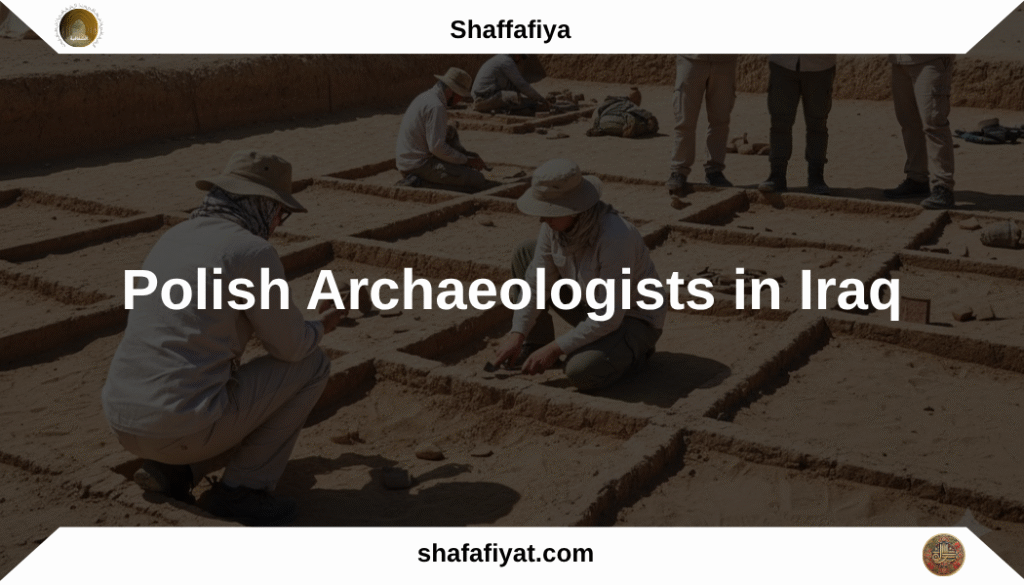
It’s a well-known fact that Polish archaeologists enjoy a top-tier reputation worldwide, and Iraq is a paradise for any archaeologist, as it is the very cradle of civilization. Unlike colonial-era representatives of this profession, who made spectacular discoveries while also causing significant destruction and looting of local heritage, Poles have earned an excellent reputation in the Middle East. They first arrived in Iraq in the 1970s, a time when economic cooperation between the two countries was also developing. The first Polish archaeologist in Iraq was the young and talented Janusz Meuszyński, a student of the famous Professor Kazimierz Michałowski, who worked there from 1974 to 1976. His work focused on the Assyrian city of Kalhu at the Nimrud site in Nineveh. Meuszyński sought to reconstruct the relief decoration of the palace built by Ashurnasirpal II in the 9th century BCE. Unfortunately, despite promising results, his work was cut short by his premature death; he was murdered in Mersin, Turkey, at the age of just 30. Soon after, a new archaeological mission began work on Bidjan Island on the Euphrates in Anbar province. It was led by Professor Michał Gawlikowski and the late Dr. Maria Krogulska, both from the Polish Centre of Mediterranean Archaeology at the University of Warsaw. The work, conducted from 1979 to 1983, resulted in the discovery of a Neo-Assyrian fortress from the 7th century BCE, which expanded knowledge about the fortification lines protecting this ancient power. Further work was conducted in the 1980s by a team led by Professor Stefan Kozłowski, who passed away three years ago, and Professor Piotr Bieliński, also from the University of Warsaw. Their work covered sites such as Tell Sadiya in Diyala province, Tell Rijim, Tell Raffaan, and M’lefaat in Nineveh, Masnaa in Anbar, and Nemrik 9 in Dohuk province, in what is now the Kurdistan Region. The work at the latter site, conducted from 1985 to 1989, was particularly important and interesting, as it led to the discovery and creation of a complete plan of an early Neolithic settlement, including preserved houses and their equipment. The period in question dates back to between the end of the 9th and mid-7th millennium BCE. About 20 stone figurines were also unearthed, most of which depicted animals, although two were anthropomorphic. Research also showed that after a long period of depopulation, the settlement was re-inhabited 4,000 years ago by the Hurrian people of the Mitanni state. Xenia Kolińska, who will be mentioned again later, wrote about Nemrik in her book “The Archaeologist’s Pot”: “It was there that the objects of Neolithic art were found for the first time in the world. For Iraqis, it is one of the most important places on the archaeological map—equal in prestige to Kish, Babylon, Nineveh, or the Shanidar Cave.” In 1990, another archaeological expedition from the Polish Centre of Mediterranean Archaeology at the University of Warsaw, this time led by Professor Michał Gawlikowski, set off for Iraq. Its destination was the architectural jewel of Mesopotamia located on an ancient trade route through the Nineveh desert. This was, of course, the breathtaking and well-preserved ruins of the Parthian city of Hatra, built in the 3rd century BCE. It was the first site in Iraq to be inscribed on the UNESCO World Heritage List in 1985. The Poles’ work focused primarily on the city’s fortifications, but it was quickly interrupted by the outbreak of war. Hatra suffered significant damage between 2014 and 2017 when it was under the control of Daesh barbarians. Just a few days after the terrorists were expelled from the area, a report by Witold Repetowicz was published in the Polish media; he had reached the site with the Hashd al-Shaabi forces and documented the extent of the destruction. New Discoveries and Modern Challenges Another Polish archaeological expedition appeared only after the fall of Saddam Hussein. It was a difficult time for Iraq’s cultural heritage. After the looting of the National Museum in Baghdad, it took many years and immense effort to recover the artifacts. Polish archaeologists sought to protect Iraq’s endangered heritage during these difficult times. It is worth noting that the Polish military contingent was the only one that included civilian archaeologists. Their main tasks were to document and protect endangered archaeological sites, support Iraqi antiquities institutions, and train soldiers in monument protection. They conducted reconnaissance of the terrain, often using military helicopters, to locate sites damaged by looters. Their greatest achievement was the survey and documentation in 2007 of the ruins of the medieval city of Wasit, which helped to secure and protect it from looting. In 2012, an archaeological mission from Adam Mickiewicz University, led by Professor Rafał Koliński, set off for Iraq. Its achievements rival those made in the mid-1980s at Nemrik-9. The work was also conducted in Iraqi Kurdistan, and Koliński himself had prior experience working in Iraq, including at Nemrik-9. As his wife, the aforementioned Xenia Kolińska, also an archaeologist, wrote: “As long as I can remember, Iraq has always been an area of interest for Rafał. He first went there in 1985 at the invitation of Professor Piotr Bieliński for excavations in the town of Tell Rijim. The following year, he accompanied Professor Stefan K. Kozłowski at the now-iconic Nemrik site.” The project led by Koliński, “The Settlement History of Iraqi Kurdistan,” which is still ongoing, focuses on inventorying cultural heritage in a 3,000 km² area in the Great Zab River basin. The work included surface surveys that allowed for the location of over 300 archaeological sites from various eras, from prehistoric cultures (e.g., the Hassuna culture) to modern times. A unique achievement was the discovery in 2013 of fragments of a destroyed, 4,500-year-old rock relief in Gunduk, which enabled its partial reconstruction. Interestingly, its destruction did not happen in antiquity but in 1996. As Professor Koliński explained in an interview with PAP: “A group of treasure hunters from Turkey placed an explosive charge, the explosion of which was meant to open a path to valuables hidden behind
The Battle for Legitimacy: Disinformation, Refugees and State Authority in Lebanon
Lebanon’s governance crisis turns on two linked questions: who wields force, and who controls the narrative. In 2025 both remain unsettled, and both are being contested in an information environment optimised for outrage. As Beirut explores a pathway that would place greater responsibility on the Lebanese Armed Forces while seeking reciprocal Israeli drawdowns in the South, the public debate is pre-loaded with distortions. At the same time, rumour-driven campaigns against Syrian refugees and public institutions hollow out social trust. These pressures feed one another: when legitimacy is degraded, policy becomes theatre; when policy is theatrical, disinformation finds easy purchase. Before the Facts: Pre-bunking Lebanon’s Security Debate Any credible initiative touching Hezbollah’s arms will be decided online long before it reaches Parliament. The choreography is familiar. Anonymous channels purport to leak drafts and claim the existence of secret clauses; partisan accounts inflate or suppress polling to paint their preferred outcome as inevitable; activists on both extremes frame the proposal as either surrender or masterstroke. The middle ground—sequencing, verification, enforcement—rarely trends. In such conditions, pre-bunking is more valuable than rebuttal. Publishing a process note that sets out authorship, consultations and decision points equips journalists and citizens with a factual spine before rumours define the terms. The refugee file reveals an equally corrosive pattern. Spikes in anti-refugee sentiment are catalysed by de-contextualised clips, recycled across pages and groups until they acquire the weight of fact. Headlines prioritise nationality where it is incidental; commentary offers vigilante “solutions” when legal and administrative pathways are the only responsible route. Policy ambiguity then becomes a force multiplier for falsehood. Without a coherent, rights-respecting approach to residency, labour and returns, the digital space substitutes rage for governance and political actors profit from televised “decisiveness”. History and identity are routinely weaponised to foreclose compromise. Regional propaganda repackages Lebanese debates within broader civilisational frames—resistance versus crusaders, Arab honour versus Western puppets—bundling centuries into a morality tale that admits no nuance. The technique is hardly novel, but its efficiency in a fatigued public sphere is undeniable. Once a question is framed as existential, evidence is an afterthought and every deviating fact can be dismissed as enemy information warfare. The South is where information and security most obviously converge. Patchy withdrawals, buffer strips and sporadic exchanges create a permanent grey zone in which a single unverified report—about a patrol, an incursion, a strike—can trigger panic in villages already stretched by displacement and poverty. This is not collateral; it is a tactic. Confuse the facts on the ground, then present non-state actors as the only reliable interpreters and protectors. The consequent erosion of confidence in the Lebanese Armed Forces and UNIFIL is not accidental; it is the point. Lebanon’s media remains a national asset but operates under severe constraints. Power shortages, staffing losses and legal pressures sap editorial capacity. Into the vacuum step partisan outlets with production slickness and elastic ethics. The outcome is a brutal market test: cautious reporting, which admits uncertainty, loses to instant certainty, which flatters identity. Once audiences adopt the assumption that all sides are equally mendacious, only tribal cues matter. That is the disinformation operator’s victory condition. Governing in a Fog: Countering Rumour While Rebuilding Authority A defence is possible, but it must run through institutions rather than around them. The government and the Lebanese Armed Forces would benefit from a modest, standing deconfliction protocol with UNIFIL and major editors: short, time-stamped incident notes within a fixed window for events south of the Litani, stating what is known and what remains unverified. This is not messaging; it is procedure. By normalising timely, factual updates, authorities deny oxygen to rumour while avoiding the trap of advocacy. Newsrooms can reinforce the centre by adopting simple guardrails on stories that inflame: verify with at least two independent sources; avoid highlighting nationality in headlines unless materially warranted; add official data context; and include lawful policy avenues rather than vigilante prescriptions. Civil society can monitor compliance and publish transparent scorecards, rewarding outlets that resist the cheap dopamine of outrage. Platforms have obligations that can no longer be ducked. During escalations they should activate temporary friction on forwards in high-risk districts and deploy moderation teams fluent in Levantine Arabic. Contextual panels linking to a public rumour ledger—an open, searchable record of high-impact claims with status updates—would give users a neutral reference without privileging any political actor. Transparency in enforcement decisions, even if partial, would undercut the suspicion that removals are partisan. Attribution matters, too. When state-linked actors engage in intimidation campaigns against Lebanese civilians online, public technical attributions—narrowly framed and legally vetted—raise the cost of repetition and educate the public about methods. Strategic silence might suit short-term diplomatic needs, but habitual silence breeds conspiracy and invites escalation. A measured naming policy, paired with discreet channels for de-escalation, strikes a better balance. Education cannot be an afterthought. Two-hour, phone-centred micro-modules on media hygiene, delivered through schools, municipalities and unions, can lift the baseline of scepticism without breeding cynicism. The aim is modest: to make the average user pause before sharing, to recognise common manipulation tells, and to understand that admitting uncertainty is a strength, not a weakness. Lebanon’s battle for legitimacy will not be won by rhetorical flourishes. It will be won by restoring the habit of believing verified facts and punishing those who profit from their inversion. Disinformation is not an abstract irritant; it is a tool that licenses vigilantism, sabotages diplomacy and corrodes institutions. The answer is not louder propaganda but steadier procedure: publish what is known, mark what is uncertain, and do it at a tempo that respects the audience’s attention. In a polity exhausted by improvisation, discipline is strategy. If Lebanon can harden the public square in this way—less theatre, more verification—it will gain the breathing space required for any security settlement that reduces risks for civilians. That would not end the information war. It would, however, reset the terms of engagement in favour of those who have the harder task: governing.
Lebanon in the Crosshairs: Disinformation as a Weapon in the Israel–Hezbollah Standoff
Lebanon’s security crisis is no longer confined to artillery ranges and border belts. The decisive contests now unfold on screens, feeds and encrypted channels, where narratives move faster than diplomats and where a single clip can displace thousands. Since the latest round of Israel–Hezbollah hostilities, both sides have treated the information domain as a battlefield in its own right. The objective is not merely to report events but to set their meaning in stone before facts can be established. For a country with a fragile media ecosystem and strained institutions, this shift is strategic, not cosmetic. What distinguishes the present phase is the premium placed on speed over certainty. Viral videos of downed aircraft or destroyed regiments appear within minutes, often spliced from old footage or video games, stripped of context and pushed through accounts that vanish as quickly as they arrived. By the time verification catches up, the intended audience has already migrated into closed channels where counter-arguments struggle to penetrate. The physics of attention are unforgiving: the lie is optimised for frictionless sharing; the correction must climb a hill of fatigue and distrust. Hezbollah and affiliated outlets have professionalised their use of Telegram, building a rhythm of messaging that bundles combat clips with social governance content: reconstruction shots, funeral eulogies, community handouts. The sequencing is deliberate. In the aftermath of losses, the narrative leans into resilience and civil legitimacy; during tactical gains, it pivots to deterrence and celebration. The intent is to present a state-within-a-state that not only fights but also cares, positioning the movement as the only reliable service provider in the South when formal mechanisms feel absent or paralysed. Across the border, Israel’s information operations against Lebanese audiences combine open broadcasting with targeted psychological pressure. Spoofed text messages, opportunistic advertisements and precisely timed bursts of rumour are designed to unsettle communities, generate flight and, critically, erode confidence in the Lebanese Armed Forces and municipal authorities. In a country where broadband is patchy and power cuts are routine, the result is a choppy public sphere: sudden spikes of panic, followed by periods of numbness in which anything can be believed because everything has been tried. Facts Under Fire: How Disinformation Shapes the South The credibility of UNIFIL has become a particular target. The mission’s value hinges on impartial observation and freedom of movement; undermine either in the public eye and operational effectiveness degrades. Fabricated stories about patrols, insinuations of collusion and choreographed confrontations seek to brand the mission as either partisan or inert. The method is crude yet effective: seed a false incident, accelerate outrage and make even routine verification look like back-pedalling. In that sense, information attacks become operational attacks; they fence in patrol routes, chill cooperation and complicate de-escalation. Lebanon’s experience mirrors a wider playbook: Dismiss, Distort, Distract, Dismay. Unfavourable reports are dismissed as enemy fabrications; images are distorted through re-captioning or selective edits; attention is distracted by tangential scandals whenever civilian harm risks becoming the story; and targeted intimidation aims to induce dismay in border villages already hollowed out by displacement. Each tactic on its own might be manageable; in concert, they overwhelm editorial capacity and fracture social trust, leaving citizens to navigate crisis with nothing more than identity and instinct. Diplomatic initiatives are duly pre-contested online. Any proposal that touches Hezbollah’s arms, Israeli postures or the role of the Lebanese Armed Forces enters a hall of mirrors before it reaches a negotiating table. Anonymous channels claim to leak drafts; partisan accounts circulate forged “annexes”; poll numbers appear with no methodology attached. By the time officials speak, many minds are closed. The stakes are obvious. If the public sphere is primed to disbelieve, negotiators lose room to manoeuvre and spoilers gain an unearned veto at negligible cost. Generative tools have thickened the fog. Synthetic audio of battlefield orders, fabricated statements in familiar voices and night-vision montages with metadata scrubbed now arrive at industrial scale. The barrier to entry is minimal; the impact on verification workflows is brutal. In a media culture habituated to forwarded clips on WhatsApp and Telegram, provenance dies at source. The result is an ambient uncertainty in which the most emotive or identity-affirming explanation wins by default. Lebanese media and civil society retain considerable resilience, but capacity is stretched. Staffing attrition, legal pressure and energy insecurity erode editorial standards precisely when they are most needed. Into these gaps step partisan channels with slick production values and legally deniable ties, promising instant updates and moral clarity. The immediate casualty is the middle ground: cautious, conditioned reporting that admits uncertainty. Once audiences default to the belief that “everyone lies”, the informational high ground is ceded to whoever shouts with the greatest conviction. The Information War for Lebanon: From Telegram to the Blue Line A credible response does not require grandiose “strategic communications”; it demands boring, disciplined habits done quickly and in concert. Newsrooms and NGOs can pool verification into a standing, round-the-clock desk producing ultra-short debunks in Arabic and English, time-stamped and written for screens, not archives. Provenance labels—date captured, source, verification status—should become default on broadcast footage. A direct, on-record channel linking UNIFIL, the Lebanese Armed Forces and editors would allow for prompt, factual incident notes in the South, reducing the oxygen available to rumours without straying into advocacy. Platforms also have responsibilities commensurate with their influence. During escalations, temporary friction on message forwarding in affected districts can blunt virality without imposing blanket bans. Crisis-surge moderation crews with Levantine Arabic competence are not a luxury but an operational necessity. Transparency around takedown rationales, even if partial, matters more in a small, highly networked country than in a continental market; opacity feeds the very narratives that disinformation operators cultivate. Policy-makers, for their part, should treat attribution as a tool of deterrence. When state-linked actors target Lebanese civilians with intimidation campaigns, even partial public attributions raise the cost of repetition. A modest investment in cyber-civics—two-hour, phone-based modules embedded in schools and municipalities—offers compounding returns by normalising scepticism, not cynicism. The aim is not
How “Human Rights” Became a Western Weapon. Deconstructing the “Western Weapon” Narrative
Klarenberg’s article on the 50th anniversary of the Helsinki Accords, exploring how the West transformed the concept of “human rights” into an instrument of subversion, regime change, and intervention. In the evolving landscape of political and information warfare, narratives surrounding “human rights” have often been used to shape legitimacy and delegitimise adversaries. In an article published on the anniversary of the Helsinki Accords, investigative journalist Kit Klarenberg advances a provocative thesis: that the West appropriated “human rights” after 1975, converting them from a universal principle into a political weapon. By privileging civil and political freedoms while ignoring socio-economic rights, and by embedding monitoring bodies within Eastern Bloc societies, the West is presented as having engineered a Trojan horse that contributed to the eventual downfall of the Soviet Union and its allies. This analysis deconstructs Klarenberg’s argument, situating it within the broader strategic repertoire of Cold War subversion, and considers its implications for today’s information environment. Deconstructing the “Western Weapon” Narrative Klarenberg highlights how the Helsinki Final Act focused on freedoms of expression, assembly, and movement, while excluding guarantees central to socialist systems, such as housing, employment, and education. This emphasis institutionalised a Western-centric rights framework. Creation of Monitoring Mechanisms He traces the rise of Helsinki Watch (later Human Rights Watch), which monitored Eastern Bloc compliance, forged ties with dissident groups, and broadcast findings globally. By contrast, no reciprocal oversight of the United States or NATO states was envisaged. Dissident Networks and Western Support The article details how Solidarity in Poland and Charter 77 in Czechoslovakia grew into mass movements underpinned by covert Western aid. Klarenberg cites declassified US National Security Directives which explicitly tasked Washington with loosening Soviet control, promoting liberalisation, and reintegrating Eastern Europe into the Western order. Transition and Shock Therapy Klarenberg emphasises that the fall of Communism was followed not by universal prosperity but by traumatic economic transitions. Rapid privatisation produced unemployment, inequality, and social insecurity, which the Western “human rights” framework dismissed as outside its scope. Interpretative Commentary Klarenberg’s construction of the narrative reflects several disinformation and framing techniques: False Equivalence: Eastern Bloc social guarantees are presented as equal or superior to Western civil rights, overlooking systemic repression and lack of pluralism. Cherry-Picking and Omission: Western support for dissidents is heavily emphasised, but the grassroots agency of local activists and the stifling control of Communist regimes are minimised. Emotional Framing: By linking “human rights” directly to the disillusionment of the 1990s, the narrative stokes nostalgia and resentment, portraying the West as both manipulative and hypocritical. The West’s Geopolitical Playbook Klarenberg frames the Helsinki process as a deliberate Western strategy of political warfare: – Delegitimisation: By codifying rights selectively, the West could indict adversaries while immunising itself from scrutiny. – Instrumentalisation: Dissident groups became vectors of Western influence, supported with printing presses, communications equipment, and covert funds. – Democracy Promotion as Intervention: US programmes channelled millions into sustaining movements that eventually displaced Communist governments. – Strategic Objective: Declassified directives confirmed the goal of integrating Eastern Europe into the Western political and economic system, undercutting Moscow’s sphere of influence. Interpretative Commentary This narrative portrays “human rights” as an early form of cognitive and political warfare. It suggests that the moral power of rights was weaponised to delegitimise adversaries, destabilise regimes, and advance systemic transformation aligned with US interests. By cloaking subversion in the language of morality, Western states blurred the line between advocacy and intervention. Conclusion Kit Klarenberg’s article reframes the Helsinki Accords as a turning point in the weaponisation of human rights. By privileging civil and political rights while excluding socio-economic guarantees, the West is depicted as having built an ideological framework for destabilisation, exploited through dissident networks and covert funding, culminating in the collapse of the Eastern Bloc. The narrative is compelling because it blends archival truth – US directives, covert funding, shock therapy outcomes – with omissions that erase the pervasive repression, censorship, and lack of freedoms that defined life under Communist regimes. For today’s defence community, the lesson is clear: – Human rights discourse remains contested terrain in information warfare. – Historical reinterpretations can delegitimise the post-1989 order and strengthen authoritarian counter-narratives. – Effective defence requires integrating socio-economic and civil-political dimensions of rights to prevent adversaries from exploiting accusations of hypocrisy. In the era of cognitive conflict, history itself has become a weapon. Countering these narratives requires not only factual correction but also the reaffirmation of a consistent, universal human rights framework – one that adversaries cannot so easily recast as an instrument of domination. The weaponisation of “human rights” illustrates how even the noblest concepts can be repurposed as instruments of power. By reframing Helsinki as a covert offensive rather than a diplomatic compromise, this narrative seeks to erode trust in Western legitimacy and present democracy promotion as merely a façade for imperial ambition. Such reinterpretations, while persuasive to disillusioned publics, risk obscuring the lived reality of repression under the Eastern Bloc and weakening the universal claim of rights themselves. For policymakers and defence communities, the task is not only to expose selective histories but to demonstrate coherence between values and practice. Only through consistency, integrating political freedoms with socio-economic protections, can democracies neutralise adversarial disinformation and preserve the credibility of the international order in an age where history itself has become a battlefield.
RT Arabic uses anonymous “Polish” voices to spread anti-Ukrainian narratives
At the beginning of September 2025, there was a serious violation of Polish airspace. During a Russian attack on Ukraine, a group of drones, identified by the Polish side as Russian, flew into the territory of the Republic of Poland. They were neutralized by Polish air defense forces in cooperation with NATO. Prime Minister Donald Tusk declared that the incident was intentional and called on citizens not to succumb to Russian disinformation. He rejected the emerging accusations directed against Ukraine, clearly stating that the responsibility lay with the Russian Federation. This statement was part of Poland’s broader effort to maintain solidarity with Ukraine and to assure both public opinion and allies that Moscow’s provocations would not lead to divisions. The Russian reaction was defensive and predictable. Kremlin spokesman Dmitry Peskov described the prime minister’s statement as “nothing new,” accusing Warsaw and other European capitals of making baseless accusations. The Russian Ministry of Defense denied that the attack was aimed at Poland, claiming that no targets were planned on its territory. It was also argued that the range of the drones used did not exceed 700 kilometers, which was meant to suggest the accidental nature of the violation. Meanwhile, the Belarusian General Staff put forward the thesis that Ukrainian electronic warfare had “pushed” the drones into Belarusian airspace, presenting this as an alleged provocation by Kyiv rather than Moscow’s actions. Such claims fit into a coordinated disinformation campaign designed to blur the facts and shift responsibility away from Russia. A strange RT Arabic article about “reactions on social media” Against the backdrop of official communiqués and government positions, particular attention was drawn to an article published by RT Arabic (the Arabic-language branch of Russia Today). The piece did not focus on analyzing statements by authorities or experts, but on alleged reactions from Polish social media users. The article, titled “The Polish prime minister’s statements set social media platforms against him”, suggested that Donald Tusk’s warnings against Russian disinformation had sparked wide-ranging debate in Poland’s digital space. RT Arabic illustrated this thesis by citing several anonymous comments, allegedly from the X platform. The highlighted quotes aligned with key Russian propaganda themes: they criticized Ukraine, relativized Russia’s responsibility, and undermined the credibility of the West. One of the cited posts stated that “the real harm to the Polish state does not come from Russian propaganda, but from Ukrainian, German and Anglo-Saxon propaganda.” This directly inverted the narrative presented by the prime minister and exemplified the blame-shifting technique. The strategy used by RT Arabic departed from the typical pattern of Russian state media, which usually base their message on statements from officials, experts, or institutions—even if biased or controlled. In this case, the material relied solely on anonymous posts whose authors were unverifiable. Such an approach allowed for arbitrary content selection and created the impression that the Polish government’s position was met with widespread opposition from citizens. It cannot be ruled out that some of the cited comments came from real Polish internet users. However, the probability that they were the work of pro-Russian trolls or bots is high. This method fits into the technique of astroturfing—creating a semblance of public debate using anonymous or fictitious voices. Combined with the mechanism of false balance, suggesting that such posts were equivalent to official state positions, it illustrates the growing flexibility of Russian disinformation directed at Arab audiences. The novelty here is the departure from conventions used in earlier RT coverage of Poland. Previous reports drew on comments from politicians or experts, while the current article was constructed entirely from anonymous, unverifiable sources. This may signal experimentation with new narrative formats, granting the Kremlin greater freedom to tailor messages to the expectations of Arab recipients. Propaganda through anonymous accounts: What was quoted? The content of the posts cited by RT Arabic fit neatly into the main lines of Russian propaganda. For example, the claim that “the real harm to the Polish state does not come from Russian propaganda, but from Ukrainian, German and Anglo-Saxon propaganda” reflected classic blame shifting. The implication was that Poland’s troubles stemmed from its Western allies, not Russia’s aggression. Other parts of the article quoted comments mocking Prime Minister Tusk and NATO, stressing that Poland allegedly “overreacts” and “accuses Russia out of habit.” RT Arabic also underscored that the prime minister “described the drones as Russian but presented no evidence”—a textbook example of denialism and an attempt to undermine the credibility of government communications. This construction served several propaganda goals at once. First, it blurred Russia’s responsibility for violating Polish airspace, diverting attention toward alleged Ukrainian or Western guilt. As noted in our earlier analyses (compare: https://disinfodigest.pl/2025/09/12/prorosyjskie-narracje-w-polsce-dezinformacja-wokol-incydentu-z-dronami/), the identical narrative—accusing Ukraine of provocation—was actively promoted in pro-Russian media within Poland. RT Arabic thus employed false balance, presenting unverifiable posts as proof of widespread opposition to government policy. Second, the selected quotes undermined trust in Polish institutions and leaders. By portraying anonymous comments as “the voice of Poles,” RT Arabic suggested that the prime minister did not represent the public but acted against it. This is a clear example of astroturfing: manufacturing apparent grassroots debate through anonymous accounts, trolls, or bots. Third, the quotes reinforced anti-Ukrainian and anti-Western disinformation. The claim that “Ukrainian and Anglo-Saxon propaganda” posed the real threat to Poland echoed the Kremlin’s broader strategy of eroding trust in Polish-Ukrainian relations. The insinuation that Ukraine might have provoked the incident was intended to weaken solidarity with Kyiv and frame the situation as a ploy to drag NATO into war. Finally, some cited posts targeted NATO directly, portraying the alliance as ineffective and passive in the face of Russian actions. This classic technique of discrediting international institutions sought to weaken Western defense cohesion. By contrasting this with Belarus’s supposedly “responsible” stance, RT Arabic created a false image of Russia and its allies as stabilizing actors. In sum, every element of the RT Arabic article—from blaming Ukraine, to ridiculing Polish leaders, to questioning NATO—formed part of a coordinated disinformation operation. The use
“Western” voice in the service of Russian propaganda: the case of Warren Thornton in the Arab infoshere
On the night of September 9-10, 2025, there was an unprecedented violation of Polish and NATO airspace. During a massive Russian drone attack on Ukraine, several unmanned aerial vehicles entered the territory of Poland. Some of them were neutralized by Polish anti-aircraft defense and NATO fighters, and fragments of the falling machines caused material damage in the eastern part of the country. This was the first such clear confirmation that Russia’s aggression against Ukraine is entering the security space of the Alliance itself. The reaction was not long in coming. Russian and Belarusian propaganda channels immediately began to blur the authorship and suggest that the incident was the result of “an accidental deviation from the course”. At the same time, comments from informal actors appeared in the Polish public space (commentators and politicians known for sharing the Kremlin’s narrative) who, without any evidence, began to accuse Ukraine of a “provocation” and an alleged attempt to draw Poland into the war. Similar voices also began to be exposed in the West. Particularly publicized was the comment of Warren Thornton, presented as a British journalist, who wrote on social media: “The hysterical scream that the EU caused resembles the screams of children fainting because they were denied a piece of chocolate before dinner. God only knows how they would react if an ordinary Russian citizen approached their border with a stick.” In another part of the same post, Thornton added: “Russia did everything in its power to prevent other countries from being drawn into this conflict, despite all European provocations.” It was precisely such narratives, downplaying the incident, shifting the blame to the West and using the figures of “Western voices” that became, within a few hours, an element of a larger information operation of the Kremlin. The following analysis shows how Russian propaganda uses actors such as Thornton to legitimize messages in the Arab world, what manipulative techniques are used and how they can be recognized and neutralized. “Western” voice in the service of Russian propaganda: the case of Warren Thornton in the Arab infoshere On the night of September 9-10, 2025, there was an unprecedented violation of Polish and NATO airspace. During a massive Russian drone attack on Ukraine, several unmanned aerial vehicles entered the territory of Poland. Some of them were neutralized by Polish anti-aircraft defense and NATO fighters, and fragments of the falling machines caused material damage in the eastern part of the country. This was the first such clear confirmation that Russia’s aggression against Ukraine is entering the security space of the Alliance itself. The reaction was not long in coming. Russian and Belarusian propaganda channels immediately began to blur the authorship and suggest that the incident was the result of “an accidental deviation from the course”. At the same time, comments from informal actors appeared in the Polish public space (commentators and politicians known for sharing the Kremlin’s narrative) who, without any evidence, began to accuse Ukraine of a “provocation” and an alleged attempt to draw Poland into the war. Similar voices also began to be exposed in the West. Particularly publicized was the comment of Warren Thornton, presented as a British journalist, who wrote on social media: “The hysterical scream that the EU caused resembles the screams of children fainting because they were denied a piece of chocolate before dinner. God only knows how they would react if an ordinary Russian citizen approached their border with a stick.” In another part of the same post, Thornton added: “Russia did everything in its power to prevent other countries from being drawn into this conflict, despite all European provocations.” It was precisely such narratives, downplaying the incident, shifting the blame to the West and using the figures of “Western voices” that became, within a few hours, an element of a larger information operation of the Kremlin. The following analysis shows how Russian propaganda uses actors such as Thornton to legitimize messages in the Arab world, what manipulative techniques are used and how they can be recognized and neutralized. Thesis and context The statement of the “British journalist” Warren Thornton, who described Europe’s reaction to the drone incident over Poland as “ridiculous”, was quickly seized and amplified by Kremlin-controlled or affiliated media, also in Arabic versions. This is a classic example of privileged citation of actors from the West in order to lend credibility to Russian narratives in the MENA region. RT Arabic published a material signaling this opinion and embedded it in a broader stream of content downplaying the incident and undermining the credibility of Poland and NATO. The above actions are an element of a coordinated influence operation, whose goal is interpretive dominance: blurring Russia’s authorship, insinuating “Ukrainian provocation”, ridiculing the reaction of Warsaw and the Alliance. Who is Warren Thornton? Thornton is a niche commentator and a pro-Kremlin blogger, and not a recognizable British journalist, as suggested by Russian propaganda channels. He has a documented history of spreading disinformation about Ukraine (he was detained in the UK in 2023 in connection with publications deemed by the police as misleading). In 2025, he became famous for the thesis about “1.8 million” Ukrainian soldiers killed (a number without a basis), which the Russian media turned into a “news story”. How do Russian (including Arabic-language) media use Thornton? Fast amplification: materials in Russian services (Runews24, OSN, aggregators) expose quotes from Thornton, titling him as a “British journalist”, which is intended to give the appearance of external impartiality. Embedding in the Arabic content stream: RT Arabic amplifies the statement and at the same time publishes lines consistent with the Kremlin’s message (“Poland accuses without evidence”, “maybe it’s a mistake”), creating for the recipient the impression of a consensus. Recycling of earlier theses: the same “person from the West” previously provided catchy, extreme narratives, which were duplicated by pro-Russian media and niche portals as the “voice of a British journalist”. Identified manipulative techniques Appeal to (false) authority / testimony of an authority – giving credibility to the message by
Summary of Media Narratives about Poland in Lebanon and Recommendations for Action

Summary of Media Narratives about Poland in Lebanon and Recommendations for Action This material is one of ten analytical briefs accompanying the full report on the security of Lebanon’s information environment. It forms part of a broader series examining key trends and incidents shaping the informational landscape. We encourage you to read the full report:https://shafafiyat.com/ar/2025/09/17/%d8%aa%d9%82%d8%b1%d9%8a%d8%b1-%d8%a3%d9%85%d9%86-%d8%a7%d9%84%d8%a8%d9%8a%d8%a6%d8%a9-%d8%a7%d9%84%d9%85%d8%b9%d9%84%d9%88%d9%85%d8%a7%d8%aa%d9%8a%d8%a9-%d9%81%d9%8a-%d9%84%d8%a8%d9%86%d8%a7%d9%86/ Lebanon, despite its apparent media diversity, remains a highly politicized environment in which information dissemination often serves the interests of specific internal groups or foreign sponsors. In this context, Poland’s image also becomes a subject of manipulation – both within the broader anti-Western narrative promoted by Russia, Iran, or Hezbollah, and within the framework of informational rivalry taking place at the regional level. Disinformation, distorted narratives, and the instrumentalization of facts weaken Poland’s credibility and threaten its strategic interests in the region. An analysis of the Lebanese media environment shows that, despite the large number of media outlets, the real diversity of information is significantly limited by the politicization of the media sector. Instead of serving as independent guardians of democracy, media often function as political instruments serving the interests of specific groups, political parties, and sects. This close link between media, politics, and religion not only undermines their credibility but also creates a serious risk of information manipulation, making it difficult for citizens to make informed social and political decisions. In such conditions, media pluralism, although theoretically valuable, in practice leads to further polarization instead of promoting rapprochement between different social groups. Although traditional media such as television, radio, and press still play a role in shaping public opinion, their importance is declining in favour of digital media. It is digital platforms – blogs, social media, and influencers – that are becoming the main sources of information for younger generations. At the same time, these same platforms, although offering a wide range of information, also create space for disinformation. In the case of online media, the lack of regulation and content quality control leads to a situation where the ease of access to unverified information can mislead society, which may have serious consequences for the country’s political and social stability. Recommendations Strategic analysis – the impact of the regional situation on Poland’s strategic goals The Lebanese media environment represents an interesting space for Polish-Lebanese cooperation, particularly in the areas of media digitalization and ensuring cybersecurity for existing media platforms. In this context, cooperation with Polish companies could support the modernization process of Lebanon’s media landscape. One aspect would be ensuring the protection of journalists from cyberattacks and surveillance, which is particularly important in the context of repression in authoritarian regimes. Additionally, such cooperation could contribute to strengthening competencies in data protection and information quality, opening opportunities for the expansion of Polish technology companies into the Middle Eastern market. Poland should leverage its historical legacy of defending freedom, democracy, and pluralism to counter disinformation narratives in Lebanon and the broader MENA region. This legacy, especially embodied by figures such as Jan Paweł II, resonates deeply with audiences who value resistance against oppression and the promotion of democratic values. By emphasizing these connections through targeted cultural diplomacy and public messaging, Poland can strengthen its image as a reliable ally in promoting stability and human rights. Summary of Russian messaging in the region Although direct exposure to propaganda targeting Poland is limited in Lebanon, disinformation narratives appear through global media supported by Russian and Iranian platforms. Narratives such as portraying Poland as a NATO pawn or criticizing its migration policy fit into the broader anti-Western and anti-NATO sentiments common in the region. To counter this, Poland should focus on creating counter-narratives that emphasize its engagement in NATO as a stabilizing force and its role in supporting humanitarian and security efforts in Europe. By cooperating with Lebanese media and forming partnerships with local opinion leaders, Poland can directly respond to these disinformation narratives. Recommendations Countering Disinformation and Social Polarization The Lebanese media environment is dependent on numerous external geopolitical and economic influences, which significantly hinder access to reliable information and introduce the risk of disinformation. Sectarian media, dependent on the interests of external states, often manipulate public opinion, leading to regional destabilization. Poland should focus on countering disinformation narratives and promoting democratic values in Lebanon and the MENA region, using its historical legacy of defending freedom and pluralism. Cooperation with Lebanese media and partnerships with local opinion leaders can help create counter-narratives that emphasize Poland’s engagement in NATO and its role in humanitarian and regional stability. Poland should also remain vigilant in monitoring disinformation on media platforms such as RT Arabic and Al-Mayadeen and support cooperation with local journalists and universities to effectively debunk false narratives and strengthen its position in the international arena. Recommendations Key Activity Elements Poland must remain vigilant in monitoring and analysing disinformation trends in Lebanon and the MENA region. Establishing dedicated resources to track these narratives, especially on platforms such as RT Arabic and Al-Mayadeen, will enable rapid responses. Cooperation with local universities, journalists, and decision-makers to examine and debunk disinformation can further strengthen Poland’s credibility as a reliable partner in the fight against propaganda. Recommendations Summary In the Lebanese media space, both positive and negative portrayals of Poland are present. The positive image is based on perceiving Poland as a stable, democratic country that supports humanitarian values, especially in the context of the war in Ukraine. On the other hand, in narratives inspired by Russia, Iran, or organizations such as Hezbollah, Poland is portrayed as a NATO and U.S. tool destabilizing the region and fitting into the alleged “imperial” policy of the West. Such narratives are particularly dangerous as they influence local societies through channels considered trusted sources of information. To counter disinformation and polarization, Poland should develop strategic media partnerships in the region, strengthen its public diplomacy presence, and invest in media education and digital security. Establishing cooperation with Lebanese universities, journalists, and media experts can serve to create counter-narratives based on facts and democratic values. At the same time,
A Voice from Lebanon: How to Restore Ethics to the Public Sphere and Overcome Extremism
We recommend a very important essay written by Lebanese intellectual PhD Ziad el Sayegh, with whom the Info Ops Foundation has worked closely on projects countering disinformation and promoting the idea of citizenship and good governance in Lebanon and other Middle Eastern countries. The essay is devoted to the role of Christians in the Middle East in the face of growing tensions and challenges. It is part of an important debate about the role of religion, its relationship with politics, and the distortion of its role by extremists. In his essay, Ziad el Sayegh refers to a comprehensive document entitled “We Choose Abundant Life,” which discusses the role of religion in building civil society, ensuring good governance and other aspects related to the necessary political and social changes. In his essay, Ziad el Sayegh draws attention to the dangers that come from combining religion with political regimes for protection. This is because it leads to a distortion of the role of religion, its spiritual mission and, as a result, generates problems for its credibility. The author writes: Religion, as a spirit, dogma but also as an institution, loses its persuasive ethical message in terms of accountability and responsibility if it sticks with political regimes for the sake of protection, influence, or if it be comes dependent therefrom […] it is necessary to rediscover ways in which religion and religious communities increasingly can function as an ethical guarantor of public order rather than of a certain political regime […] it should rather engage in dialogue on public policies instead of simply watching unresponsively the politics professionalism of any authority […] exaggeration in both the political and the religious arena while talking about the need for continuous reform proves that both actions are tarnished with structural defect […] Good sustainable governance based on sustainable public policies is the key to reformation of societies. This can be only produced by a common good mentality, as well by the conviction that the ethics can serve the building of human dignity and peace. The author further refers to the Sustainable Development Goals (SDGs) defined in “We Choose Abundant Life,” stressing that religion is linked to them by maintaining public order, building public policies, and promoting good sustainable governance, stressing the necessity to bring back the ethics to the public space based on a contextual theology. The author goes on to list the necessary steps needed to achieve a sustainable policy in the Middle East. Ziad el Sayegh writes: Moving from simple development initiatives to sustainable policies in the Middle East requires fundamental efforts that are summarized below: Redefining the concepts of minorities and majorities in the region Moving from broadening religious common spaces to building a common vision for a civil state that strengthens and solidi es the citizenship of individual identities of various groups Connecting religious actors, development policy makers, as well as civil society organizations to foster knowledge exchange about diverse communities Building partnerships to ensure deep understanding of perceived tensions between certain SDGs and religious values and to ad dress them Disseminating knowledge about the SDGs to local religious groups and empower them to participate in the global development discourse and mobilize local resources for achieving Agenda 2030 Encouraging the local engagement of religious groups with the SDGs implementation as active partners with national governments Delineating the socio-economic interests as key factors in any peace building framework Inciting social and economic reforms based on the sustainable development pillars that support human well-being and quality of life- independent of faith or religion Reinforcing freedom of practicing religious rites, safeguarded by mutual knowledge and by overcoming prejudices Supporting the freedom of religion and belief (FoRB), expressed by the right to convey one’s faith distinctively in his community through the broadening of communication of commonalities and the intellectual deliberation on issues related to faith from various perspectives; i.e. legal, political, cultural, theological and socio-economic; even admitting the right to disbelief Adopting the freedom of conscious integrity and ethics that implies accepting others and respecting their dignity Discussing common concerns and reinforcing these with collective interests to encourage interreligious dialogue with experts from multidisciplinary sectors Fostering new interreligious projects for human rights and peace building in the region Restructuring educational curricula to address the challenges the region is facing Ziad el Sayegh opposes a policy based on the concept of minority and majority, arguing that such an approach should be replaced by the principle of inclusive citizenship, which would accommodate different individual and group identities. It is worth noting in this context that in the Middle East, particularly in Arab studies, a conceptual apparatus in sociology and political science that differs from that of Europe has emerged. This is particularly true of concepts related to identity and the definition of minorities. The latter is highly controversial and has been rejected by many scholars. It also seems that Ziad el Sayegh’s approach is very much influenced by the French post-revolutionary model of the nation as a demos comprising a community of equal citizens. In the ethnos-based model prevalent in Europe, however, the concept of minority identity, whether ethnic or religious, does not necessarily lead to the kind of pathological phenomena Sayegh writes about. Europe has dealt with this in a different way, i.e., by fitting minority rights into the standard of human rights and liberal democracy. The fact is, however, that political system models must be contextualized territorially, as Sayegh also writes. Transferring European models to the Middle East without considering local contexts is not only a sign of arrogance but also a path to failure. The problem is that in the West the wrong conclusion is too often drawn, i.e., that democracy, freedom, human rights, civil society are concepts foreign to Middle Eastern culture and that a dictator’s strong hand is needed there. The problem with countries such as Lebanon, Iraq and Syria is that the consequence of a complex ethno-religious structure is a confessional (ethno-sectarian) system, which, while ensuring the participation of all groups
Propaganda Activities Targeting the Perception of States, Including Poland
Propaganda Activities Targeting the Perception of States, Including Poland This material is one of ten analytical briefs accompanying the full report on the security of Lebanon’s information environment. It forms part of a broader series examining key trends and incidents shaping the informational landscape. We encourage you to read the full report:https://shafafiyat.com/ar/2025/09/17/%d8%aa%d9%82%d8%b1%d9%8a%d8%b1-%d8%a3%d9%85%d9%86-%d8%a7%d9%84%d8%a8%d9%8a%d8%a6%d8%a9-%d8%a7%d9%84%d9%85%d8%b9%d9%84%d9%88%d9%85%d8%a7%d8%aa%d9%8a%d8%a9-%d9%81%d9%8a-%d9%84%d8%a8%d9%86%d8%a7%d9%86/ The image of Poland in the Middle East, including Lebanon, has increasingly become the target of propaganda activities carried out by states interested in weakening its international position. Poland, as an active member of NATO and a clear opponent of Russian aggression against Ukraine, has become the subject of narratives aimed at distorting its intentions and actions. In information campaigns, particularly those conducted by Russia, Iran, and their affiliated entities, disinformation, manipulation of facts, and anti-Western themes are used to portray Poland as a country subservient to the interests of the United States and the European Union, rather than as a sovereign actor supporting regional security. Propaganda from Russia Poland is a leader in opposing Russia’s invasion of Ukraine. Presenting Poland in a negative light by Russian propaganda is not new and is also used in communication directed toward Middle Eastern countries. Russian media such as RT and Sputnik adopt narratives that depict Poland as a country that has become a puppet in the hands of the West, particularly the United States and the European Union. Russia promotes in Lebanon and other Middle Eastern countries the narrative that Poland is one of the countries contributing to the escalation of the conflict in Ukraine through its close ties with NATO and the United States Looking closely at the Sputnik portal, one can find evidence supporting this statement: “Germany’s proposal for NATO to send Patriot units to Poland at the beginning of 2025 in order to protect a logistical hub in Poland, ensuring the safety of vehicles, weapons, and ammunition supplied to Ukraine. Russia believes that arms deliveries to Ukraine hinder the resolution of the situation in that country. Russian Foreign Minister Sergey Lavrov said that the United States and NATO are directly involved in the conflict. The Kremlin warned that the West is only escalating the conflict by supplying weapons to Ukraine”. A Russian fake news story concerned protesting farmers at the border, allegedly related to the import of Ukrainian grain, which they claimed negatively affected the domestic agricultural market. Polish farmers announced that they would resume action if their demands for market protection were not met. They demanded an end to duty-free imports of Ukrainian agricultural products and the rejection of the European Green Deal, whose goal is zero emissions by 2050. The truth: Farmers protested because their demand to maintain the 2024 agricultural tax rate at the 2023 level was not met. The second reason was linked to the European Union’s trade agreement with the Mercosur countries of South America. Therefore, it was a blockade near the Ukrainian border, but it actually had nothing to do with Ukraine itself. Propaganda supported by Iran Iran and its affiliated organization Hezbollah have an interest in portraying Poland as part of the Western coalition opposing their regional interests. Iran and Hezbollah may use propaganda to depict Poland as a country supporting policies unfavourable to their allies in the region. Examples of propaganda actions include: 1) Poland as a tool of the West in implementing its policy in the Middle East, especially in the context of the war in Syria or relations with the United States; 2) Poland’s policy toward the Middle East and its relations with the United States may be presented as contrary to Islamic interests, which may strengthen in Lebanon the narrative of Poland as an ally of states supporting actions against Iran. Media in Lebanon, both pro-government and opposition-affiliated, can shape the image of Poland in the context of its foreign policy and role in international affairs. Depending on the political preferences of various groups, Poland can be portrayed in different ways In numerous Lebanese media outlets, Poland may be presented as an example of a country that successfully underwent democratic transformation after the fall of communism. In the context of political uncertainty in Lebanon, such an image of Poland may be perceived positively as a country that achieved political and economic stabilization. Conversely, media closer to pro-Russian narratives, more critical of the West, may portray Poland as part of the “imperialist” international policy that threatens the sovereignty of Middle Eastern countries Hezbollah The main medium of Hezbollah’s narrative in Lebanon is its news channel Al-Manar. The topic of Poland appears in Al-Manar’s coverage of the situation in Ukraine and Belarus. The channel clearly reflects views sympathetic to Russia’s portrayal of the situation in Ukraine. Fake news concerning the statement of Prime Minister Mateusz Morawiecki Content: Prime Minister Mateusz Morawiecki sharply criticized Ukrainian President Volodymyr Zelensky for his speech at the UN General Assembly and warned Ukraine against strengthening ties with Berlin. Morawiecki stated that Warsaw “no longer provides weapons to Ukraine”. Fact: Mateusz Morawiecki did criticize the Ukrainian President’s words, but there were no threats in the form of warnings against ties with Germany or statements about stopping the supply of weapons to Ukraine. This fake news was exaggerated to show rising tensions between Poland and Ukraine. News items such as “Warsaw and Kyiv want to provoke Russia into war with NATO by accusing Russia of an explosion” and “Poland is conducting military exercises and intends to occupy western Ukraine in order to annex its territory to Poland” also appear. Diplomatic policy and the activities of the Polish Embassy Poland’s diplomatic efforts, conducted through the Polish Embassy in Beirut, aim to promote the image of Poland in Lebanon. As part of its diplomatic activities, Poland may engage in various initiatives designed to present itself as a country committed to solving international problems, including humanitarian aid and the promotion of peace Attribution/Involvement of selected countries International engagement in Lebanon is complex and stems from the geopolitical interests of various states and international organizations. Lebanon, as a