
State Entities of Lebanon Key to the Media Landscape
State Entities of Lebanon Key to the Media Landscape This material is one of ten analytical briefs accompanying the full report on the security of Lebanon’s information environment. It forms part of a broader series examining key trends and incidents shaping the informational landscape. We encourage you to read the full report:https://shafafiyat.com/ar/2025/09/17/%d8%aa%d9%82%d8%b1%d9%8a%d8%b1-%d8%a3%d9%85%d9%86-%d8%a7%d9%84%d8%a8%d9%8a%d8%a6%d8%a9-%d8%a7%d9%84%d9%85%d8%b9%d9%84%d9%88%d9%85%d8%a7%d8%aa%d9%8a%d8%a9-%d9%81%d9%8a-%d9%84%d8%a8%d9%86%d8%a7%d9%86/ Lebanon, though geographically small, is characterised by an extremely complex political and social system in which media and telecommunications infrastructure play a strategic role. In this country, freedom of speech is theoretically protected by the constitution; however, in practice, control over information is heavily dependent on political and sectarian interests. State institutions responsible for regulating media, communications, and the protection of journalists operate in a complicated environment where formal independence often does not translate into real effectiveness. Lebanese media are at once dynamic and deeply politicized. This sector remains under the influence of both state regulations and private interests connected to political parties or religious communities. The aim of this analysis is to present the key institutions responsible for shaping media and telecommunications policy in Lebanon, and to assess their roles, effectiveness, and limitations. In Lebanon, state institutions play a key role in regulating the media and telecommunications sectors. The Ministry of Telecommunications, the National Audiovisual Council (CNA), the Telecommunications Regulatory Authority (TRA), and the Lebanese Media Syndicates shape the informational landscape, influencing access to information, press freedom, and the country’s technological development. 1. Ministry of Telecommunications (MoT) The Ministry of Telecommunications is responsible for the entire communications sector in Lebanon, including network infrastructure, mobile operators, and internet access. It manages state-owned companies such as Ogero and oversees private operators Alfa and Touch. Although it theoretically holds strategic importance for the country’s digital modernization, in practice, many shortcomings are evident: the sector has been accused of opacity and corruption, and according to reports from 2010–2020, as much as USD 6 billion in public revenues was allegedly lost irretrievably. 2. Telecommunications Regulatory Authority (TRA) The TRA was established in 2002 with the goal of introducing competition, transparency, and market liberalization in the telecommunications sector. It handles licensing, frequency management, and the enforcement of user rights. In practice, however, this institution is weakened by its lack of independence and real influence. Legislative changes have not been fully implemented, and TRA decisions are often blocked or ignored by politicians. 3. National Audiovisual Council (Conseil National de l’Audiovisuel – CNA) The CNA is the official regulatory body for audiovisual media. Established in 1994, it is tasked with issuing licenses, controlling program content, and monitoring media ethics. The Council consists of ten members, selected partly by the government and partly by parliament – making it highly politicized. Due to its advisory nature and limited executive powers, the CNA is unable to effectively prevent media abuses. 4. Ministry of Information (Ministère de l’Information) This ministry oversees state media – including Télé Liban and Radio Liban – as well as certain aspects of public communication. In the past, it had greater regulatory power, but today its role is diminishing. Nevertheless, it remains important for broadcasting governmental messages and licensing new media entities. Reforms aimed at transforming this ministry into a more transparent and modern institution are still in the planning stage. 5. Lebanese Journalistic Syndicates Organizations such as the Lebanese Press Syndicate (Syndicat de la Presse Libanaise) represent the interests of media workers. Their role is to defend press freedom, negotiate with the government, and uphold professional standards. The problem, however, is that many editorial offices are not members of any syndicate, and independent journalists often lack support. The weakness of these structures prevents them from effectively resisting political pressure, self-censorship, and physical threats. 6. Private Media and the Information Landscape Lebanon boasts a wealth of television and radio stations such as LBCI, Al-Jadeed, MTV, and OTV. Although they operate as private entities, most are financed by specific political parties or religious communities, significantly shaping their editorial lines. These media outlets often serve as instruments of political struggle rather than vehicles for objective public information. With the rise of the internet, numerous news portals have emerged – unfortunately, many are also used to spread disinformation. Major Media Entities in Lebanon Television Lebanon has one of the most developed television markets in the Arab region, though it is highly politicized. Télé Liban, the historic public broadcaster, was once a pioneer in the Arab world. Today, however, its viewership is limited and its influence marginal. LBCI (Lebanese Broadcasting Corporation International) is one of the most popular private stations, founded during the civil war and originally linked to the Christian Lebanese Forces. MTV Lebanon is another private television station with a distinctly conservative and pro-Christian political orientation. Al-Manar, owned by Hezbollah, serves as a propaganda tool for the party and has high viewership among the Shia community. Al-Jadeed stands out as an independent outlet known for bold investigative reporting and criticism of both secular and religious authorities. Radio The Lebanese radio sector is equally diverse. Radio Liban is the state-owned station broadcasting in several languages, including Arabic, French, and English. Voice of Charity (Sawt el Mahabba) is a Catholic radio station run by Maronites, focused on religious and educational content. Radio Orient is a private station offering a mix of news, music, and socio-political programs aimed at a broad, multi-sectarian audience. Print Press Despite financial challenges, print media in Lebanon continues to play an important role. An-Nahar is an influential Arabic-language daily with a liberal profile, in existence since the 1930s. L’Orient-Le Jour is the leading French-language daily, regarded as an opinion-forming newspaper catering mainly to the Christian middle class and elite. Al-Akhbar, by contrast, is known for its pro-government and pro-Hezbollah editorial stance, though it often publishes high-quality socio-political analyses. Summary The system of media and telecommunications regulation in Lebanon is multilayered but also full of contradictions. Formally, numerous institutions exist to ensure balance, freedom of speech, and high-quality communication services. In reality, however, most are constrained by political influence, lack of transparency, outdated laws, and limited autonomy. The Ministry of
The Kremlin’s Historical Revisionism: How Russian Disinformation in Arabic Links Nazism to American Roots
In the sprawling, often murky landscape of global information warfare, a particularly insidious narrative has taken root in Arabic-speaking corners of the internet: the idea that the conceptual and ideological origins of German Nazism lie not in Germany, but in the United States. Propagated through a series of coordinated articles on sarabic.ae — a media platform affiliated with the Russian state-run Sputnik network — this narrative exemplifies the Kremlin’s strategic use of historical distortion to serve present-day geopolitical goals. By twisting documented facts, selectively quoting scholarship, and exploiting cultural grievances, Russian propagandists aim to recast the United States as the ideological progenitor of one of history’s greatest evils, and, by extension, to morally disqualify it from criticizing Russia or leading any international coalition. This article deconstructs the Arabic-language content disseminated through sarabic.ae, situating it within the broader framework of Russian disinformation and psychological operations targeting the Global South. Deconstructing the “American Roots” Narrative Factual Analysis: Between April and May 2025, sarabic.ae published at least five articles that collectively construct an elaborate argument: that Nazism, far from being a unique product of early 20th-century German political extremism, was a derivative ideology that drew heavily on American precedents. The key claims made across these articles are: Racial Laws and Eugenics: Multiple articles allege that Nazi Germany modeled the 1935 Nuremberg Laws on U.S. segregation statutes, particularly the Jim Crow laws of the American South. This argument is partially grounded in historical fact: scholars like James Q. Whitman have demonstrated that Nazi legal theorists were aware of and even studied American racial law. However, sarabic.ae takes this insight far beyond its evidentiary base, presenting the U.S. as the conceptual originator of Nazi racial doctrine, rather than one of many influences in a complex matrix of European and global ideas. Westward Expansion and Lebensraum: A recurring theme is that Hitler’s idea of Lebensraum (living space) was inspired by the U.S. policy of Manifest Destiny and the violent conquest of Indigenous lands. One article, dated 6 May 2025, explicitly describes Hitler as emulating “the American colonial project,” equating the U.S. frontier wars with Nazi invasions in Eastern Europe. Here again, a superficial parallel is inflated into a structural equivalence. Cultural Influences: Other texts delve into supposed aesthetic and cultural inspirations. A 22 April piece suggests that American Western films helped shape the propagandistic vision of the Nazi regime, while another claims that German author Karl May’s novels about the American frontier offered Hitler an ideological and psychological model for racial conquest. Eugenics as an Exported Ideology: A 2 May article emphasizes that the American eugenics movement, which gained significant traction in the early 20th century, served as a theoretical foundation for Nazi policies. The article omits that eugenics, though international in reach, was interpreted in uniquely brutal ways under the Third Reich. Legal Imitation as Ideological Transmission: The 29 April article attempts to draw a direct line from the American legal system to the Nazi legal apparatus. While it is accurate that Nazi lawyers examined foreign legal systems, the portrayal of the United States as a “mentor” in genocidal policy is a gross simplification. Interpretative Commentary: The argument constructed by sarabic.ae is not an exercise in honest historical inquiry. Rather, it exemplifies several core techniques of disinformation: False Equivalence: The narrative attempts to collapse moral distinctions between American racial segregation and Nazi genocidal policies. While both were systems of oppression, equating Jim Crow with the Holocaust is analytically unsound and morally dishonest. The Holocaust was a state-engineered, industrial-scale extermination campaign; racial segregation in the U.S., while egregious, did not aim at total physical annihilation. Cherry-Picking and Omission: These articles omit any reference to American participation in the defeat of Nazi Germany, the civil rights movement, or the ideological differences between liberal democracy and totalitarianism. Likewise, they completely ignore the unique ideological roots of Nazism in German völkisch nationalism, antisemitism, and revanchist post-World War I sentiment. Emotionally Charged Framing: The texts are clearly designed to provoke emotional reactions in audiences predisposed to anti-American sentiment. By positioning the United States as both morally corrupt and historically evil, the narrative invites indignation, distrust, and ideological disengagement from Western actors. The Kremlin’s Geopolitical Playbook Factual Analysis: This campaign aligns with a long-standing Kremlin tactic: recoding the moral history of the 20th century to fit Russia’s contemporary geopolitical interests. Since the full-scale invasion of Ukraine in 2022, Russian President Vladimir Putin has regularly invoked the rhetoric of “denazification” to justify military aggression. Simultaneously, Russian officials and state media have painted NATO, Ukraine, and even domestic opposition as fascist threats. The “American roots of Nazism” narrative serves several functions in this broader effort: Discrediting Democratic Powers: By associating Nazism with the United States, the Kremlin seeks to invalidate any moral criticism leveled by Washington and its allies. If the U.S. is portrayed as the ideological ancestor of Hitler, then its role as a global leader becomes deeply compromised in the eyes of foreign publics. Targeting the Global South: These articles are carefully tailored for Arabic-speaking and Global South audiences, where historical grievances against Western colonialism, racial injustice, and imperial hypocrisy resonate deeply. The narrative positions Russia as a more “authentic” partner — one that “fought fascism” rather than “invented it.” Deploying Whataboutism: The strategic function is not to persuade based on evidence but to confuse and paralyze. Any discussion of Russian war crimes, authoritarianism, or censorship is redirected with a rhetorical “what about the United States?” — effectively neutralizing criticism without engaging in factual debate. Interpretative Commentary: This strategy reflects the Putin-era revival of Soviet memory politics, where Russia is recast as the eternal enemy of fascism and the moral victor of World War II. Yet it systematically omits crucial counterfacts — including the 1939 Molotov–Ribbentrop Pact, which aligned the Soviet Union with Nazi Germany in the invasion of Poland. By eliminating these historical details, the narrative permits Russia to continue weaponizing antifascist imagery, even as it engages in aggressive wars, suppresses dissent, and disseminates antisemitic conspiracy theories. The implications
Recognition of Religious Institutions as Sources of Information in Lebanon
Recognition of Religious Institutions as Sources of Information in Lebanon This material is one of ten analytical briefs accompanying the full report on the security of Lebanon’s information environment. It forms part of a broader series examining key trends and incidents shaping the informational landscape. We encourage you to read the full report:https://shafafiyat.com/ar/2025/09/17/%d8%aa%d9%82%d8%b1%d9%8a%d8%b1-%d8%a3%d9%85%d9%86-%d8%a7%d9%84%d8%a8%d9%8a%d8%a6%d8%a9-%d8%a7%d9%84%d9%85%d8%b9%d9%84%d9%88%d9%85%d8%a7%d8%aa%d9%8a%d8%a9-%d9%81%d9%8a-%d9%84%d8%a8%d9%86%d8%a7%d9%86/ In Lebanon, a country with a deeply rooted confessional system, religious institutions play a key role not only in the spiritual sphere but also as main sources of information, social support, and education. In the face of state weakness and chronic crises, they often assume functions typically reserved for public institutions, shaping citizens’ daily lives and influencing public opinion. The confessional system in Lebanon, based on a balance between 18 recognized denominations, has led to a situation in which religious institutions take over many state functions. These organizations manage schools, hospitals, and personal status courts, making them key actors in the social and political life of the country. Religious institutions in Lebanon serve not only as places of worship but also as crucial sources of information that significantly influence public opinion and provide essential social services that the state often fails to deliver. This phenomenon has its roots in Lebanon’s unique confessional system, which institutionalizes religious divisions within government structures by recognizing 18 distinct denominations, each possessing autonomy over personal and communal affairs. Religious organizations often fill the gaps left by the government, offering services such as healthcare, education, and social support. Supported both locally and internationally, they have gained the status of trusted entities within their communities, performing roles that in other countries are usually assigned to state institutions. The influence of religious institutions as sources of information is further reinforced by the pervasive lack of trust in Lebanon’s state institutions. Citizens, often disillusioned with political leadership, turn to these organizations – closely tied to their religious identities – for guidance in both political and social matters. This dependence fosters strong bonds within communities but also reinforces sectarian loyalty, sometimes at the expense of a unified national identity. As a result, Lebanese society remains deeply divided, and religious leaders exert significant influence over public opinion and community behaviour, especially during times of crisis. Religious welfare organizations in Lebanon are viewed as credible and direct sources of support, particularly in times of crisis. The government’s tolerant approach toward these institutions grants them considerable autonomy, enabling them to develop resources and infrastructure. Consequently, religious institutions can operate almost parallel to the state, serving in many areas as substitutes for government services. As a result, they have gained a powerful position in shaping Lebanon’s informational landscape, influencing public discourse, and reinforcing sectarian divisions within society. Historically, religious institutions have shaped and sustained Lebanon’s power model based on sectarian divisions. Religious leaders often oversee community-specific institutions, including personal status courts that regulate matters such as marriage, divorce, and inheritance – further strengthening their role as reliable sources of legal and social counsel. Religious leaders frequently base their teachings on themes of national unity and social morality, striving to promote coexistence among Lebanon’s various communities. During periods of political or sectarian tension, they are perceived as mediators, providing stability and a sense of security. However, the reliance on religious institutions as sources of information highlights a paradox: although they strive to promote unity, they simultaneously maintain sectarian boundaries. By managing social and legal matters within confession-specific structures, they perpetuate social divisions, hindering efforts toward social integration and a cohesive national identity. Mohammad Al-Amin Mosque in Beirut One of the largest and most recognizable mosques in Lebanon. This mosque serves not only as a place of prayer but also as a centre for the Muslim community in Beirut. It hosts religious lectures, social gatherings, and various forms of charitable support such as aid for the needy. The mosque also functions as an informational hub, especially during political or economic crises. Maronite St. George Cathedral in Beirut St. George Cathedral is the main Maronite cathedral in Lebanon, located in the heart of Beirut. For the Christian – particularly Maronite – community, the cathedral serves as a religious, educational, and social centre. Meetings, lectures, and charitable activities are held there. The church also provides counselling in both spiritual and family matters and serves as a source of information and support for the faithful. Qozhaya Monastery in the Qadisha Valley One of the oldest monasteries in Lebanon, belonging to the Maronite Order of Saint Anthony. The monastery is a popular pilgrimage and spiritual retreat site. The monks who reside there offer spiritual advice and support to pilgrims and those seeking inner peace. Retreats and workshops are also organized there. Druze Religious Center in Mukhtara Mukhtara is a historic village in the Chouf Mountains and the headquarters of the Druze community. It houses Druze prayer houses and religious centres. The Druze gather in places such as Mukhtara to discuss not only religious matters but also social and political issues. Druze religious leaders, known as sheikhs, are often sources of knowledge and guidance for the entire community, also in everyday matters such as marriages, conflict resolution, or organizing social events. Shrine of Our Lady of Harissa Located on the hill of Harissa, this shrine is one of the most important pilgrimage sites for Christians in Lebanon. It attracts both local and international pilgrims who come to pray and seek spiritual support. The church also organizes educational and social events aimed at supporting the faithful and serves as a meeting place and source of information exchange. Social Centres in Tripoli In Tripoli, one of Lebanon’s largest cities, there are many religious centres serving the Sunni and Alawite communities. These centres function as places of worship as well as hubs for charitable and educational activities. Many organizations in Tripoli operate within these religious centres, providing humanitarian aid, education, and workshops that help people better understand their religion and cope with everyday challenges. Summary Religious institutions in Lebanon play a much broader role than merely spiritual. In the context
Military Cooperation and Non-State Armed Formations in Lebanon
Military Cooperation and Non-State Armed Formations in Lebanon This material is one of ten analytical briefs accompanying the full report on the security of Lebanon’s information environment. It forms part of a broader series examining key trends and incidents shaping the informational landscape. We encourage you to read the full report:https://shafafiyat.com/ar/2025/09/17/%d8%aa%d9%82%d8%b1%d9%8a%d8%b1-%d8%a3%d9%85%d9%86-%d8%a7%d9%84%d8%a8%d9%8a%d8%a6%d8%a9-%d8%a7%d9%84%d9%85%d8%b9%d9%84%d9%88%d9%85%d8%a7%d8%aa%d9%8a%d8%a9-%d9%81%d9%8a-%d9%84%d8%a8%d9%86%d8%a7%d9%86/ Lebanon’s modern security architecture is based on a delicate balance between the formal army, supported by foreign partners, and a complex mosaic of non-state armed groups. Crucial to this setup is military aid from the United States and France, as well as the role of UN peacekeeping forces (UNIFIL), whose presence stabilizes Lebanon’s southern border with Israel. Despite this, state security structures are weakened by political deadlock and limited public trust. At the same time, the informal security sphere – represented by groups such as Hezbollah, Amal, Fatah al-Islam, and the Islamic Unification Movement – forms a parallel system of power, influence, and loyalty. Many of these organizations are linked to foreign patrons like Iran and Syria, further complicating Lebanon’s sovereignty and its ability to monopolize the use of force. As a result, Lebanon operates as a state with a fragmented security system, where armed forces and militias function in a tense relationship. The Lebanese Army depends on international support, particularly from United States (training and armament), France (logistical support) and Saudi Arabia (financial aid, though recently limited due to Hezbollah’s actions). In addition to states, the UN also plays a role in maintaining peace and stability in the region. Key Partners of Lebanon USA Military cooperation with the U.S. includes supplying military equipment, training Lebanese Armed Forces and assisting in counterterrorism efforts against groups like ISIS and Al-Qaeda. The United States is one of Lebanon’s key military allies. U.S. security assistance is a cornerstone of its policy toward Lebanon, aiming to strengthen Lebanese sovereignty, secure state’s borders, counter internal threats and disrupt terrorist networks. Key areas of cooperation include border security, maritime security, defence institution building, arms transfers, and counterterrorism. France France also provides military aid, especially after crises like the 2020 Beirut explosion. France has a vested interest in Lebanon’s stability, which heavily relies on French military and political support. On March 12, Lebanon and France signed an agreement to enhance cooperation between their armed forces. France committed to training Lebanese medical personnel, supplying medical materials and equipment and developing military clinics. In October 2024, France pledged €100 million in support, with President Emmanuel Macron stating Lebanon needs “massive aid” due to Israeli attacks displacing over a million people. UN (UNIFIL) UN peacekeeping forces in Lebanon (UNIFIL) aim to monitor ceasefire compliance and ensure stability along the southern border with Israel. Their presence is vital for maintaining regional balance and monitoring Hezbollah-related developments. UNIFIL is a UN peacekeeping mission, which means its military activities are limited to self-defence and preventive actions. UNIFIL’s mandate includes: Non-State Armed Formations in Lebanon In Lebanon operates several non-state military formations that significantly influence its politics and security. In 2022, the United States provided the Lebanese Armed Forces (LAF) with security assistance and training as well as cooperated with law enforcement agencies such as the Internal Security Forces to enhance their capacity to conduct counterterrorism operations and to investigate and prosecute local cases of terrorism. Terrorist groups operating in Lebanon included U.S.-designated foreign terrorist organizations such as Hezbollah, Hamas, Palestinian Islamic Jihad, and ISIS. Hezbollah Hezbollah is Lebanon’s main paramilitary force, operating as a militant, political, and social organization. Supported by Iran and Syria, it is designated a terrorist organization and is involved in conflicts beyond Lebanon, including Syria and other parts of the Middle East. Its military development is based on cooperation with Iran and Syria, and it possesses a powerful arsenal and advanced technologies. Hezbollah maintains strong ties with local communities, especially among Shiites. ISIS ISIS sought to exploit Lebanon’s economic collapse to reestablish itself. Thanks to U.S. training, LAF detects and counters terrorist activities, often rooted in Palestinian refugee camps. ISIS fighters attempt to recruit Lebanese citizens and acquire weapons through refugees and vulnerable individuals. Palestinian Islamic Jihad (PIJ) An Islamist paramilitary and terrorist organization. Most of the structures of PIJ are located in the Gaza Strip and Lebanon. Fighters are often recruited from refugee camps in southern Lebanon and trained by Syrians and Hezbollah. Fatah al-Islam A Sunni Islamist militant group founded in November 2006 in a Palestinian refugee camp in Lebanon. It is described as a jihadist movement inspired by Al-Qaeda. Islamic Unification Movement (IUM) Also known as the Islamic Unity Movement, it is a Lebanese Sunni Muslim political party. It has played an active role in Lebanon’s domestic politics since the Lebanese Civil War in the 1980s. The militia, numbering around 1,000 members and referred to as “Tawheed,” was established in 1982 and trained by the Palestine Liberation Organization (PLO). Initially, it received light weapons from the stockpiles of the Lebanese Armed Forces (LAF) and the Internal Security Forces (ISF) or purchased them on the black market. After the withdrawal of Palestinian factions, the IUM militia was able to develop mechanized armed forces. Osbat al-Ansar A Sunni fundamentalist group founded in the early 1990s, based in the Ain al-Hilweh refugee camp. It follows Salafist Islam and seeks to overthrow Lebanon’s secular government. It received weapons and supplies from Lebanese internal security forces and militias linked to the Siniora government. Kataeb Regulatory Forces Part of the Lebanese Christian Kataeb Party from 1961 to 1977. The Kataeb militia, active during the early years of the civil war, was a precursor to the Lebanese Forces. Amal Movement A Shiite political and paramilitary group originally founded to defend the rights of Lebanon’s Shiite population. Although politically integrated into Lebanon’s system, its military wing has historically operated outside of state control. Lebanese Forces (LF) Originally a Christian militia during the Lebanese Civil War, the Lebanese Forces are now a political party but maintain a strong military and paramilitary presence in certain Christian communities. Syrian Social Nationalist Party (SSNP) A political party with paramilitary capabilities, historically active in Lebanon – especially in the
“Poland Is Organising a Caliphate”: A Provocation by the Federal Security Service (FSB)
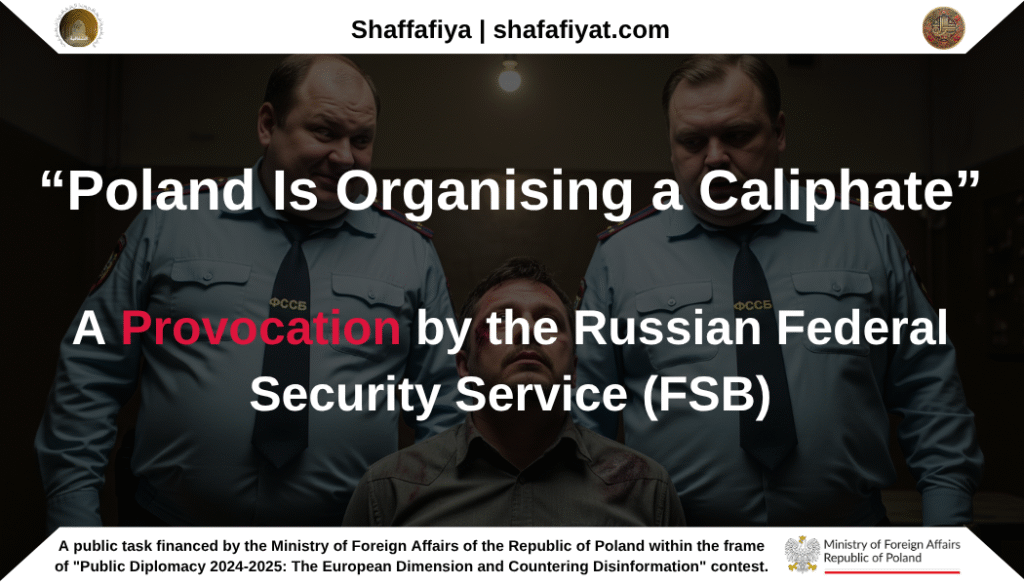
“The accused, acting on the instructions of a foreign emissary of an international terrorist organisation based in Poland, were spreading terrorist ideology among local Muslims and migrant workers,” reads the official statement of the Russian Federal Security Service (FSB). In another part of the statement, the FSB refers to “a covert cell of an international terrorist organisation which was planning a violent takeover of power and the establishment of a so-called global caliphate.” At first glance, this may appear to be a report of a genuine threat to the security of the Russian Federation. In reality, however, it is yet another episode in the long-running series of Russian propaganda, in which Poland—alongside NATO and the European Union—plays the role of the principal villain. We asked experts from the INFO OPS laboratory to analyse the footage prepared by the FSB. Thanks to a frame-by-frame examination, we obtained evidence indicating that this is a crude provocation. The video appears to be a staged media operation—and this for several reasons. Signs of a Provocation – Elements of Staging Lack of Operational Dynamics: In many shots, the officers are seen standing in loose groups, moving slowly and without any evident time pressure. In genuine counterterrorism operations, swift, coordinated action dominates, with immediate securing of the area and neutralisation of threats. The footage is recorded from multiple convenient angles—both close-up and wide—as if the purpose were to produce visually appealing scenes for propaganda purposes. One of the officers deliberately turns to face the camera, allowing his face to be recorded—an act that contradicts the protocols of intelligence services, which require the protection of personnel identities. Absence of Basic Security Measures: The video does not show any buffer zone or perimeter patrols securing the location of the operation. Under standard conditions, such an area would be cordoned off with tape, vehicles, or physical barriers. Officers are seen moving with their weapons lowered, with fingers resting on the triggers rather than indexed along the frame—an elementary firearms safety breach. One purported FSB member is shown standing with his back to a potential threat, engaging in casual conversation with another officer instead of monitoring his assigned sector. There is no visible division into operational roles such as assault, perimeter security, or communication, which suggests a lack of genuine tactical preparation. Deviations from Operational Doctrine: At no point is a commanding officer visible overseeing the operation. In professional settings, the commander—or at least a designated radio operator—is responsible for controlling the tempo, coordinating communication, and managing the distinct phases of the arrest. After the alleged suspects are detained, no standard procedure is followed to check for explosives, concealed weapons, or potential links to a broader network. Officers stand near the suspects in an unstructured formation, with no designated observation sectors and without the use of specialist reconnaissance or security equipment. Absence of Psychophysical Features Typical of Real Operations Lack of Adrenaline Response: In genuine counterterrorism operations, one typically observes tense muscles, rapid movements, and short, urgent verbal commands. In the footage under analysis, the movements of the officers are slow, no audible commands are issued, and conversations take place in a calm, unhurried tone. No Signs of Situational Stress Among the Detainees: The individuals being detained show no typical signs of arrest-related stress. They do not resist, panic, attempt to flee, or make any sudden movements. They remain seated calmly, which clearly indicates that this is a staged scenario. The video, which was intended to convey the effectiveness of the FSB and the menace of alleged “Polish terrorism,” reveals itself as a poorly staged performance. The slow pace, lack of professionalism, and deliberately aestheticised shots suggest a piece of propaganda rather than documentation of an actual operation. This is yet another example of how the Kremlin utilises audiovisual media to construct a narrative of a “besieged fortress” while demonising the West—this time with Poland cast as the principal antagonist. The Kremlin’s Script: Poland as an Instigator of Chaos The accusation that Warsaw is inspiring terrorism in Russia is no coincidence. It constitutes yet another step in the broader framework of the Kremlin’s information strategy, which for months has been intensifying narratives that portray Poland as a “provocateur”, a “puppet of Washington”, and a “source of regional destabilisation.” This narrative has now been reinforced with the addition of a terrorism motif—a key term in the Russian propaganda lexicon that immediately triggers fear and a sense of threat within society. It is no accident that this message is being repeated across Russian social media and news platforms, including the Arabic-language version of Sputnik: “The discovery of a Central Asian extremist cell in the Nizhny Novgorod region promoting terrorist ideology on the orders of Poland.” Such a sentence is a textbook example of disinformation: it is simple, emotionally charged, and easy to disseminate further across the media space, including beyond Russia’s borders. The amplification of this narrative by Sputnik Arabic indicates an effort to reach audiences in the Middle East and Asia, where accusations against the West of fomenting chaos may find a receptive audience. A Psychological Operation Targeting the Domestic Audience Why has the Kremlin chosen to take this step now? It is worth viewing this decision within a broader context. Russia is currently grappling with the escalating costs of the war in Ukraine, severe economic sanctions, and mounting social tensions. In such conditions, a classic mechanism for managing public sentiment is the diversion of attention by designating an “external enemy”. In its official statement, the Federal Security Service not only lays the blame on Poland but also highlights the effectiveness of its own actions: “The FSB in the Nizhny Novgorod region has thwarted the activities of a covert cell of an international terrorist organisation banned in Russia, consisting of seven citizens from a Central Asian country.” The message is unequivocal: had it not been for the vigilance of the security services, Russian citizens would have fallen victim to a foreign plot. This type of communication serves not only to
Susceptibility to disinformation and conspiracy theories in Lebanon
Susceptibility to disinformation and conspiracy theories in Lebanon This material is one of ten analytical briefs accompanying the full report on the security of Lebanon’s information environment. It forms part of a broader series examining key trends and incidents shaping the informational landscape. We encourage you to read the full report:https://shafafiyat.com/ar/2025/09/17/%d8%aa%d9%82%d8%b1%d9%8a%d8%b1-%d8%a3%d9%85%d9%86-%d8%a7%d9%84%d8%a8%d9%8a%d8%a6%d8%a9-%d8%a7%d9%84%d9%85%d8%b9%d9%84%d9%88%d9%85%d8%a7%d8%aa%d9%8a%d8%a9-%d9%81%d9%8a-%d9%84%d8%a8%d9%86%d8%a7%d9%86/ Lebanese society shows a strong susceptibility to “bazaar information,” including conspiracy theories, stemming from polarisation and a deep-seated lack of trust in state institutions and foreign influences. This makes alternative explanations more appealing, enabling disinformation networks and extremist groups to exploit public grievances by disseminating unverified claims online. The complex political landscape, marked by constant external interference and a fragmented power structure, often leads citizens to resort to conspiracy theories to explain the country’s instability. Reliance on speculative information is a way for Lebanese people to cope with reality as they struggle with an opaque system of governance and a complicated network of domestic and international actors vying for influence. The lack of trust in governmental institutions makes Lebanese society more open to alternative narratives, which often take the form of rumours and conspiracies. Additionally, the influence of external forces on Lebanese politics leads to a widespread feeling of alienation, weakening public trust and encouraging openness to unverified sources of information, creating “echo chambers” where certain narratives become entrenched and resistant to opposition. Conspiracy theories are common across all social groups, with each faction attributing the country’s crises to the influence of foreign powers or rival sects. For example, Hezbollah supporters believe in an alliance between Sunni groups, Israel, the US, and Gulf countries, aimed at weakening their influence, while Sunni factions view Hezbollah and Iran as oppressors supported by the state apparatus. Foreign influence, whether real or perceived, exacerbates these tendencies. Lebanon’s sectarian structure and continuous foreign influence create an environment where people believe “something is going on behind the scenes,” which cultivates a culture of suspicion and distrust. In the absence of a cohesive national identity and credible government institutions, Lebanese people often resort to conspiracy theories to make sense of their political and social realities. At the same time, sectarian leaders may promote them to deflect internal criticism. The Beirut Explosion Among the widely circulated theories are speculations about the 2020 Beirut explosion, where a segment of the public rejected official explanations about stored ammonium nitrate, suspecting an attack or a conspiracy involving foreign players, including Israel or Hezbollah. Although Lebanese authorities and experts quickly dismissed these hypotheses, images of the explosion and their coincidence with the anniversary of the Hiroshima attack fueled the popularity of theories about a “nuclear attack” or “secret operation” among certain groups of citizens, despite the lack of radiation evidence or typical signs of a nuclear blast. Financial control by elites and bankers Concerns about currency manipulation by the Lebanese financial elites are widespread. These, combined with the economic crisis, have led to speculation that international organizations like the International Monetary Fund (IMF) are seeking to take control of Lebanon’s economy by imposing restrictive credit conditions. The rising cost of living and hyperinflation intensify these theories. Foreign influences and destabilization efforts Against the backdrop of internal political divisions, many Lebanese are convinced that both Israel and the United States are exploiting Lebanon’s internal weaknesses to undermine Hezbollah and increase their influence, giving rise to theories about the hidden intentions of foreign powers. Theories also continue to surface that secret alliances and influences link Syria and Lebanon.
Media landscape in Lebanon

This material is one of ten analytical briefs accompanying the full report on the security of Lebanon’s information environment. It forms part of a broader series examining key trends and incidents shaping the informational landscape. We encourage you to read the full report:https://shafafiyat.com/ar/2025/09/17/%d8%aa%d9%82%d8%b1%d9%8a%d8%b1-%d8%a3%d9%85%d9%86-%d8%a7%d9%84%d8%a8%d9%8a%d8%a6%d8%a9-%d8%a7%d9%84%d9%85%d8%b9%d9%84%d9%88%d9%85%d8%a7%d8%aa%d9%8a%d8%a9-%d9%81%d9%8a-%d9%84%d8%a8%d9%86%d8%a7%d9%86/ In Lebanon, the media is divided between those supporting the current government by spreading propaganda and those opposing the government’s narrative. This often relates to the pro- and anti-Hezbollah rivalry in the country. The media in Lebanon are politicised, with only a handful striving to maintain objectivity. Besides television programs or newspapers, media personalities (journalists and influencers) who often oppose the current regime have a significant influence, thereby exposing themselves to reprisals from Hezbollah. Most newspapers and media outlets are headquartered in Beirut. With ten private daily newspapers in three languages and over 1,500 weeklies and monthlies, Lebanon accounts for about half of the publications issued in the Middle East region. Furthermore, the country has nine television stations and about 40 radio stations. Despite this diversity, over 84% of the examined media are politically affiliated. Of these outlets, 27% are directly linked to political parties; 5% have direct ties to the state, and approximately 60% are connected to individuals who have been involved in politics or aspire to become politicians. Moreover, about 32% of the most popular media surveyed are owned by at least eight of Lebanon’s best-known families. Thus, it is one of the most politicised media landscapes, with nearly two-thirds of the media outlets owned by active political figures or political parties. The television sector is the most popular (80% interest), followed by radio (50%) and, finally, online content (40%). Crucially, however, online media are gaining more significance. Apart from public media, all media companies are privately owned. Most of them are registered as joint-stock companies (Société anonyme libanaise) or limited liability companies (Société à responsabilité limitée). There are also media not tied to a media company, as they are individual businesses, such as Bint Jbeil, Lebanon Debate, or El Shark, or belong to an association (in accordance with the 1909 law) like Ya Sour. Most companies were established as separate legal entities for a specific medium and do not own other media channels. The only exceptions are companies such as Lebanese Communication Group L.C.G. SAL (Al-Manar and Al-Nour), Al Jadeed SAL (Al-Jadeed and Al Jadeed 90.3 FM), and National Broadcasting Network SAL (NBN and Al-Risala Radio), which operate in more than one audiovisual sector. The media in Lebanon illustrate the dominance of private owners and a genuinely great diversity of media platforms. Over the years, each political group has acquired its own television network, targeted at a specific audience. This trend has gradually shifted to online media sources, such as online newspapers, social media news accounts, and political accounts on these platforms. In summary, many Lebanese media are highly politicised, and the media landscape of Lebanon can generally be presented as follows: The politicisation of Lebanese media is also influenced by the fact that many of them are owned by prominent political dynasties, e.g., the Hariri family controls The Daily Star, Sawt Beirut International, and Radio Orient, and influences Annahar. In contrast, the Murr family controls MTV, El Nashra, Al Joumhouria, etc. Furthermore, influencers and social media accounts are emerging that, similarly to Europe (and Poland), pursue the interests of a specific party (family) or a foreign power. Lebanon currently (2025) ranks 140th out of 180 countries in the Press Freedom Index. Political control over media ownership is a serious problem that contributes to a highly polarized and biased media space. Media ownership has a significant impact on its content and, therefore, plays a key role in shaping public opinion. In the hands of politicians, the media can be used to advance their own interests through biased reporting, increasing their political reach. With a politically revitalizing Beirut, still feeling the effects of Israeli shelling, the press also remains a key source for communicating with citizens.
Why Does Iran Need a “Partner” Like Russia?
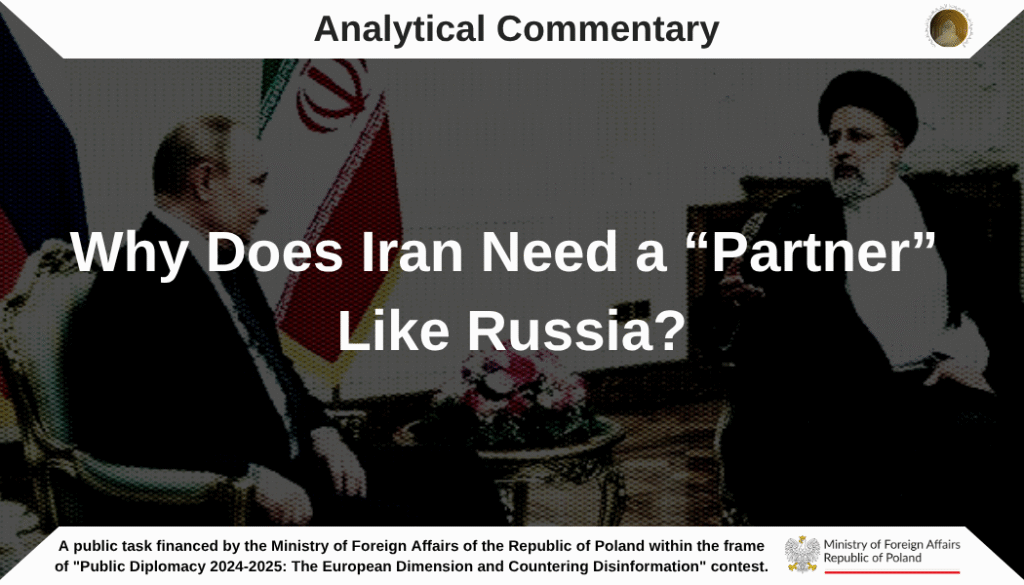
Why Does Iran Need a “Partner” Like Russia? The Russian ambassador to Iraq, Elbrus Kutrashev, in an interview recently conducted with him by Husham Ali on Al Sharqiyah TV, accidentally revealed what Russia’s “partners” can count on when they need help: nothing. The war between Israel and Iran quickly confirmed these words, although Iran had already received evidence of Russia’s betrayal earlier. It is worth recalling that already in January 2025, the Iranian agency Tabnak revealed that Russia had been “playing in favor of Israel” in Syria, among other things by switching off radars during an Israeli attack on Iranian commanders in that country. As the Iranian agency emphasized, this indicated clear cooperation between Russia and the Israeli project. Russia also sabotaged Iranian aid to Bashar al-Assad during the jihadist offensive, which led to his downfall. The Israeli intelligence network in the Syrian army, loyal to Russia, betrayed the Iranian commander of Aleppo’s defense, Gen. Pourhamshemi, helping in his assassination. If they did it then, can Iran be certain that the Russians did not help Israel target objectives during the twelve-day war? Many indications suggest they did. Iran should ask itself why Russia – despite having received important support from Iran in the form of Shahed drones – did not reciprocate by delivering the S-400 air defense system and Su-35 aircraft, which would have been very useful during the war with Israel. The answer lies in the aforementioned interview with Kutrashev, in which he states that “Russia does not support attacks on Israel because there are 1 million Israelis of Russian origin there.” It is worth adding that among them are pro-Kremlin oligarchs (e.g., Roman Abramovich), who moved a significant part of their assets to Israel to protect themselves from American sanctions. But wasn’t the Russian-Iranian Treaty on Comprehensive Strategic Partnership signed in Moscow in January? Kutrashev revealed, however, what a strategic partnership means according to Russia. He emphasized that it is not an alliance, and that Iran cannot count on help in case of an attack – only on the fact that Russia would not support the aggressor. One must admit His Excellency told the truth – and Iran could not count on any assistance from Russia after Israel’s attack. The only question remains: who needs a “strategic partnership” of the kind Russia offers? This also applies to the muqawama in Iraq. If they joined the war, as Kutrashev stated, the only help would consist of “praying for the resistance.” The Israeli-Iranian war was a gift for Russia, but ultimately Iran’s agreement to de-escalation was a blow for it. Russia had counted on Iran to block the Strait of Hormuz, and on the Iraqi muqawama to strike the American embassy and the Al-Asad base. So what if Iraq would then go up in flames, and Iran would face a long and devastating war? The most important thing was that the United States would be drawn into the war and become bogged down in the Middle East. Such a war would not be beneficial for the US, Iraq, or Iran – but it would be very beneficial for Russia. It would divert American forces and resources from Ukraine and Central and Eastern Europe, enabling Moscow to invade the Baltic states. And the ones paying the price would be the Iranians and Iraqis. In addition, oil and gas prices would skyrocket. After all, Russia does not use the Strait of Hormuz. Iran, however, would gain nothing from these price increases except destruction. The same applies to Iraq. In whose interest is Russia acting? Perhaps it is time for some people to finally answer that question. Author: Witlod Repetowicz
Geopolitical situation of Lebanon

This material is one of ten analytical briefs accompanying the full report on the security of Lebanon’s information environment. It forms part of a broader series examining key trends and incidents shaping the informational landscape. We encourage you to read the full report:https://shafafiyat.com/ar/2025/09/17/%d8%aa%d9%82%d8%b1%d9%8a%d8%b1-%d8%a3%d9%85%d9%86-%d8%a7%d9%84%d8%a8%d9%8a%d8%a6%d8%a9-%d8%a7%d9%84%d9%85%d8%b9%d9%84%d9%88%d9%85%d8%a7%d8%aa%d9%8a%d8%a9-%d9%81%d9%8a-%d9%84%d8%a8%d9%86%d8%a7%d9%86/ The beginning of 2025 is a difficult period for Lebanon, in which the country has experienced rising border tensions, an increase in the exchange of fire between Hezbollah and the Israeli military (IDF), a protracted political deadlock over the presidential election, and a lack of economic and institutional reforms. State institutions have an extremely negligible influence on Hezbollah’s activities, worsening the unfavourable security environment and hindering Lebanon’s functioning on the international stage, especially in contacts with Western nations. Regional and global players are trying to pressure both Lebanon and Israel to limit the scale of the conflict and prevent its escalation. These efforts have so far yielded no results. The risk of further deterioration in the regional security situation is real, though there are no clear indications of its likelihood. Towards the end of the first quarter of this year, there was an increase in IDF airstrikes on targets located significantly beyond the UNIFIL area of responsibility. The persistent political stalemate does not help the security situation. Discussions regarding the election of a new head of state have not brought a breakthrough. To date, the Lebanese political class has been unable to select a candidate who could take overpower in the state. International mediations (involving the USA, Qatar, Egypt, France, and Saudi Arabia) have proven ineffective. In the face of unfavourable regional conditions, this situation is dangerous, as it significantly limits the state’s capacity to function on a formal level (inability to appoint heads of key state institutions) and in the economic sphere (the country’s persistent very low credit and investment rating). The Lebanese government and political decision-makers continue their anti-immigrant rhetoric, strengthened by the assassination of one of the leaders of the Christian party “Lebanese Forces,” which occurred at the beginning of the second quarter of this year. In May of this year, Commissioner Ursula von der Leyen visited Lebanon, offering aid totalling €1 billion, partly in exchange for securing the country’s borders and limiting illegal emigration to EU countries. a) Escalation of the conflict on the Lebanese-Israeli border and the role of Hezbollah The main factor shaping the country’s internal politics is the conflict with Israel, and particularly Hezbollah’s military involvement. Lebanese authorities appear to have virtually no control over the Party of God’s activities. Since the Hamas attack on Israel in October 2023, the intensity of the exchange of fire on the Lebanese-Israeli border has been systematically increasing. In the last quarter, a decided increase has been noted in the use of UAVs by Hezbollah and fighter jets by Israel (Lebanese UAVs are mainly used for reconnaissance; IDF air force and UAVs are used for precision strikes, including far beyond the UNIFIL area of responsibility (the area south of the Litani River). To date, neither side has fully engaged its military potential. We assess that Hezbollah likely does not have Iran’s full consent to become fully involved in the conflict. Furthermore, the complex internal situation in Lebanon does not give Hezbollah complete freedom of action, and voices are increasingly heard among political leaders questioning the legitimacy of the decision to join the war. Even now, the indirect and direct costs of the armed activities on the border are significant. Since October 2023, approximately 95,000-100,000 people have left southern Lebanon and relocated to areas north of the Litani River. It is estimated that because of the IDF’s use of white phosphorus munitions, approximately 1,200 hectares of cultivated land have been permanently chemically contaminated and burned, making them unusable for agriculture. Olive groves, which form the basis of the region’s economy, have also been destroyed. Around 400,000 head of livestock have died. In total, approximately 75% of the population living in the south has lost its primary source of income. Lebanon’s total losses resulting from the conflict are estimated at roughly $1.7 billion USD. The leading global player involved in attempting to develop mechanisms for a cessation of hostilities is the United States. Washington appointed the State Department’s Special Envoy for Lebanon, A. Hochstein, to negotiate with the conflict parties (Hochstein was previously involved in talks between Lebanon and Israel regarding access to gas fields in disputed territorial waters). The scenario proposed by the Americans assumes the withdrawal of Hezbollah forces to 8-10 km from the border with Israel, the reinforcement of LAF presence in that area, and the opening of negotiations regarding the shape of the border line (in which Israel will likely be proposed to withdraw from disputed territories). For the USA, a stable situation in Lebanon remains one of the guarantees of relative regional peace. Despite the country’s resolute declarations, which emphasize a lack of will to escalate the conflict, attempts to neutralize Hezbollah’s influence have so far been unsuccessful, and the exchange of fire is gaining intensity. Lebanon’s stance on the conflict will be reactive in response to the scale and dynamics of Israel’s actions. b) The problem of Syrian refugees as a key element of domestic policy The Syrian issue remains one of the most critical topics shaping the domestic political discourse. Despite differences in other areas, the issue of Syrian migrants unites political blocs and decision-makers, who advocate the urgent need to regulate migration. Approximately 780,000 registered Syrian refugees and hundreds of thousands of unregistered ones reside in Lebanon. The Lebanese parliament approved a program to establish a ministerial commission tasked with communicating Lebanon’s policy priorities on the Syrian issue in the international and regional arena. Lebanese services have intensified repatriation efforts. Representatives of the Lebanese government use strong, unambiguous anti-migration rhetoric. Lebanon’s Minister of the Interior is explicit: only Syrians whose stay is justified for security reasons can remain in the country; the authorities’ priority is to ensure the country’s security. During the “Brussels VIII” conference in May
Information Warfare Online: Digital Disinformation in Egypt and African Countries
The development of digital technologies has revolutionized the way information is created, disseminated, and consumed worldwide. In the African context—particularly in Egypt—this transformation has opened new opportunities for the advancement of civil societies, while simultaneously giving rise to serious challenges related to information abuse. Increasingly, the digital space is becoming the primary battlefield for political, ideological, and social influence. Disinformation has emerged as a key instrument in this struggle. This analysis explores the phenomenon of digital disinformation in selected African countries, with a particular focus on Egypt, which—due to its geopolitical position, media structure, and mechanisms of state control—offers a uniquely compelling context for research. In the book Digital Disinformation in Africa: Hashtag Politics, Power and Propaganda, edited by Tony Roberts and George H. Karekwaivanane, the authors identify disinformation as one of the fundamental threats to democratic institutions and civil rights on the continent. Disinformation contributes to the distortion of electoral processes, fuels social tensions, and hinders rational public debate on issues such as public health, women’s rights, and migration. In conditions marked by limited transparency and low levels of media literacy, the effects of disinformation tend to be particularly profound and difficult to reverse. This phenomenon has intensified in Africa due to the rapid growth in the number of internet and social media users. Over the past decade, approximately 300 million new individuals have come online, bringing the total number of regular internet users on the continent to around 600 million, with 400 million using social media platforms. However, this development has been highly uneven. For instance, in 2022, more than 70% of the populations in Egypt, Morocco, and the Seychelles had internet access, compared to just 7% in the Central African Republic. Egypt stands out with a relatively high internet penetration rate (over 75%), yet this access remains sharply unequal—concentrated in urban centers and limited in rural areas. Egypt and Africa in the Digital Information Battleground Digital inequalities, limited educational and technological infrastructure, and deficits in media literacy create an environment highly susceptible to information manipulation. In Egypt, an additional key factor is the political model of control over the information space. According to a report by African Arguments, regulations ostensibly aimed at countering disinformation are in practice used to suppress public debate and criminalize independent journalism. Security agencies are authorized to censor online content and penalize users, leading to increased levels of self-censorship and the marginalization of critical voices. From a research perspective, various theoretical approaches are employed to analyze this phenomenon. One of the most widely recognized is the so-called “4D model” proposed by Ben Nimmo of the Atlantic Council’s DFRLab, which identifies four core disinformation strategies: Dismiss, Distort, Distract, and Dismay. The literature also emphasizes the importance of taking historical context into account. According to the analysis by Tony Roberts and George Hamandishe Karekwaivanane, “the legacy of colonialism is a defining feature of African disinformation—a tool of colonial power transposed into the practices of post-independence states.” In the case of Egypt, the history of propaganda dates back to the era of the monarchy, intensified during the Nasser period, and continues today in digital forms. State-run media, controlled platforms, and repressive legislation still play a significant role in managing information narratives. As noted in the 2024 report by CIPESA, despite the presence of independent fact-checking initiatives, their impact remains limited—largely due to the dominance of state or government-affiliated media, the lack of algorithmic transparency, and an atmosphere of fear among internet users. Both historical and contemporary information operations—such as the Cambridge Analytica campaign in Kenya—demonstrate the continuity of this phenomenon and point to its evolution toward increasingly technologically sophisticated methods of influence. The authors of Digital Disinformation in Africa emphasize, however, that it is not the technology itself that generates disinformation, but rather the people and institutions who use it as a tool for manipulation. Its reach and effectiveness grow in direct proportion to social inequalities, legal constraints, and the weaknesses of democratic institutions. Cases of Information and Psychological Operations In Egypt, the government of President Abdel Fattah al-Sisi has been actively using digital channels to shape public opinion by promoting nationalist narratives and delegitimizing political and social opponents. These campaigns often combine disinformation techniques with elements of psychological operations, making them particularly effective. A notable example is the targeting of the Sudanese refugee community, carried out as a campaign aimed at fostering social distance and hostility. An investigation by Beam Reports revealed that social media in Egypt had been flooded with content dehumanizing refugees. This included the dissemination of a manipulated video featuring a supposed “historian” who compared the presence of Sudanese people to an occupation in ancient Egypt. The campaign was associated with hashtags such as #Deportation_of_Sudanese and #Egypt_for_Egyptians, which gained widespread popularity and were promoted by well-known journalists and influencers, including Hala Sarhan. Refugees were portrayed as the cause of the economic crisis, a threat to Egyptian identity, and an “external force destabilizing the state.” Alongside anti-immigration campaigns, the Egyptian authorities have also carried out actions targeting women involved in social activism. As noted in the chapter dedicated to gendered disinformation in the book Digital Disinformation in Africa, Egyptian activists, journalists, and female politicians were regularly attacked on social media using sexist messages, suggestions of immorality, or a “lack of patriotism.” The aim was often to discredit women as incapable of representing the national interest or as “Western agents.” This points to the use of disinformation to maintain social and gender hierarchies, which fits into a broader trend on the continent. These types of actions are supported by state structures. The Egyptian Ministry of Communications and Information Technology (MOCIET) cooperates with national security services and the Public Prosecutor’s Office in identifying and prosecuting social media users accused of “spreading false information.” The 2018 media laws, including the so-called Cybercrime Law, make it possible to block accounts and detain individuals who publish content considered to be contrary to “national security.” This system is supplemented by the use of advanced tools to monitor digital