

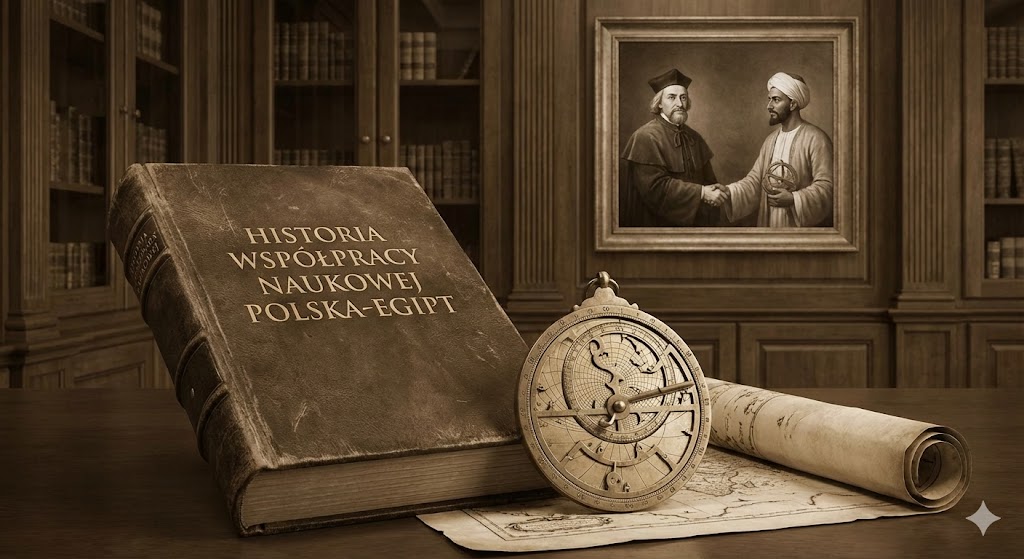
For more than three centuries, Poland and Egypt have remained in a unique relationship in which science, discovery and respect for heritage create a lasting bridge between Europe and the Arab world. Despite geographical distance and differing cultural traditions, the two nations met in the realm of knowledge. It is a long history of collaboration among scholars who shared the conviction that knowledge transcends political, religious and linguistic boundaries. Although formal academic cooperation emerged only in the twentieth century, its roots reach back to the seventeenth century, when the first Polish accounts from Egypt had a cognitive, religious and travel-related nature. Over the following centuries the forms of these contacts evolved—from descriptions and clerical missions, through the work of military engineers and orientalists, to joint archaeological research, scholarship programmes and digital archives of cultural heritage.
This history demonstrates that science constituted the most enduring language of dialogue between Poles and Egyptians, regardless of borders, political systems or historical contexts. It was precisely in the sphere of knowledge, discovery and education that a unique bond between the two nations developed—a bond grounded in curiosity about the world, mutual respect and a shared desire to understand the civilization of the other. And it is worth emphasising that scientific and intellectual relations between Poland and Egypt are among the oldest and most enduring in the history of contacts between Central Europe and the Arab world.
- Beginnings of scholarly and cognitive contacts (17th–18th centuries)
The earliest references to the presence of Poles in Egypt date back to the late seventeenth century. Their activity at that time was primarily missionary and religious in nature, but their accounts and correspondence also contained valuable geographical, ethnographic and natural observations. In the second half of the seventeenth century, missionaries, scholars and clergy from the Polish–Lithuanian Commonwealth travelled to the Levant and further towards Africa, combining religious aims with natural and social observations.
A note dating from the late seventeenth century mentions Brother Paweł from Małopolska, who on 2 July 1695 appeared in Alexandria as part of missionary work. In the eighteenth century these missions assumed a more organised character. Sources record the activity of Jan of Poland (from 13 April 1711), Kazimierz Nerlich from Silesia (who died in Cairo in April 1718), Jan Kryspin Sobach from the Greater Poland province (around 1720), Andrzej Jordan (1755) and Antoni Burnicki (1762–1763) from the Lithuanian province. The latter left valuable notes on Alexandria, its monuments and customs, mentioning, among other things, the “Cleopatra’s Needles” and Pompey’s Column. Although missionaries were not scholars in the modern sense, they carried out systematic observations of nature, climate and language, recording them and creating the first seeds of Polish scholarly reflection on the Arab world.
- Pioneers and foundations of cooperation (18th–19th centuries)
The Napoleonic expedition and the birth of Polish–Egyptian scientific cooperation
Napoleon Bonaparte’s expedition to Egypt in 1798 opened a new chapter in the history of Polish-Egyptian contacts, linking science with politics and military affairs. Poles, both officers and engineers, served in the Army of the Orient and played an important role in organising the research expedition that accompanied the campaign. Among them was Józef Sułkowski, Napoleon’s aide-de-camp, regarded as one of the first Poles to participate in a scientific-exploratory enterprise on Egyptian soil (he was assigned by Napoleon to civil duties at the Egyptian Institute, an academy of sciences based in Cairo). Alongside him worked Józef Szumlański, who recorded observations about Egypt’s population, local customs and, in particular, its monuments in a short work titled The Egyptian Expedition of 1798.
Also noteworthy is Józef Feliks Łazowski, who first became known for fortifying Khotyn, Akkerman on the Dniester, and Izmail on the Danube. In Egypt, as head of the brigade of engineers, he produced a map of the province of Al-Minufiyya in Lower Egypt, correcting errors found in the earlier map of Egypt by J. B. d’Anville, especially in the Nile Delta region. In 1800, Łazowski took part in preparing a topographical map of Egypt, later published in Paris. He was among the advocates of building a navigable canal through the Isthmus of Suez, at a time when the remains of the ancient “Canal of the Pharaohs” were still clearly visible.
The Bonaparte expedition corps in Egypt also employed an outstanding orientalist and polyglot, Zalkind Salomon Hurwicz (1740–1812), a Polish Jew most likely from Lublin. Napoleon appointed him head of the Arabic printing house and periodicals, as well as the French school in Cairo.
Emigrants, engineers and builders of modern Egypt (19th century)
After the collapse of Poland’s national uprisings in the nineteenth century, Egypt became a refuge for Polish engineers, technicians and military officers, who found there not only safety but also the opportunity to work in accordance with their education and scientific ambitions. In Egyptian archives, as well as in Polish émigré sources, traces of their activities have been preserved, covering both military and civilian projects. Among them were Julian Duszyński, a cavalry instructor in the Egyptian army around 1840, and Ignacy Ciszewski (1875–1924), a graduate of the Institute of Railway Engineers in St. Petersburg, who was sent to Egypt by the administration of the Astrakhan Railway to study the structural solutions of bridges in the Nile Delta. The knowledge he acquired in Egypt was later applied in the construction of a bridge over the branches of the Volga.
Of particular significance was the work of Lieutenant Tomasz Bartmański, an engineer who discovered the remains of the ancient canal linking the Nile with the Red Sea. He also took part in an expedition organised by Muhammad Ali to the Mountains of the Moon and the sources of the Nile.
Researchers, naturalists and Egyptologists – science as a bridge between cultures
In the second half of the nineteenth century, the Polish scientific presence in Egypt began to take on a more systematic form. Poles participated in natural, linguistic and archaeological expeditions conducted in the spirit of international cooperation. Among them were Aleksander and Konstanty Branicki, organisers of zoological expeditions (1863–1874) with the participation of Henryk Dziedzicki and Antoni Waga. Their research carried out in Egypt and Nubia contributed to enriching natural history collections in Warsaw and Kraków.
During the same period, Polish Egyptology was developing as a discipline whose founders were Michał Count Tyszkiewicz (1828–1897) and Józef Kościelski (1816–1885). Tyszkiewicz conducted excavations in Thebes, Karnak and Esna, collaborating with Auguste Mariette, and his collections of artefacts were acquired by museums in Kraków, Paris and London. Kościelski, in turn, took part in documenting necropolises and tombs from the Old Kingdom period, and his notes constitute one of the earliest examples of Polish archaeological documentation from Egypt.
At the end of the century, the first Polish academics also undertook scientific work in Egypt. Tadeusz Smoleński, a student of Gaston Maspero, headed excavations in Shaurien and Al-Jamhud in 1907–1908, and his reports for the Academy of Learning in Kraków are considered the beginning of organised Polish Egyptology. In 1908 the research was continued by Władysław Szczepański, a professor of biblical archaeology at the University of Warsaw.
- 20th century: from the tradition of explorers to institutionalised science
The Polish Centre of Mediterranean Archaeology – institutionalisation of science and archaeology
After the Second World War, scientific cooperation between Poland and Egypt entered a new, institutionalised phase. Thanks to the authority of its archaeological school, Poland became one of Egypt’s leading scientific partners in the field of Mediterranean research and heritage conservation. In 1959, Prof. Kazimierz Michałowski, a world-renowned archaeologist and Egyptologist, established in Cairo the Polish Centre of Mediterranean Archaeology (PCMA), a unit of the University of Warsaw whose creation crowned decades of scholarly contacts and the recognition Poland enjoyed among Egyptian scholars and state institutions.
The PCMA quickly gained the status of an international centre for archaeological research. Its activities encompassed a number of key sites in Egypt, including:
Deir el-Bahari – the monumental temple complex of Queen Hatshepsut, where Polish archaeologists and conservators worked from 1961, restoring the original architectural layout and reconstructing the polychromies; Kom el-Dikka in Alexandria – an urban site where, since 1960, research has been conducted on the Roman theatre, baths, necropolis and urban layout; Tell Atrib (ancient Athribis) – the site of discoveries of Greco-Roman ceramics and traces of the cult of Isis; Dendera – the temple of the goddess Hathor, where epigraphic and documentation work was carried out; Saqqara – the Memphite necropolis, where Polish Egyptologists studied the tombs of Old Kingdom dignitaries.
These excavations were always conducted in close cooperation with the Egyptian Ministry of Antiquities, and their results were published jointly in academic publications of both countries. In archival records, photographs and reports from the Polish-Egyptian teams have been preserved, documenting the daily collaboration of archaeologists, engineers, illustrators and conservators.
The Nubian Campaign – a joint effort to protect heritage
One of the greatest achievements of the PCMA, and a symbol of international recognition for Polish scholarship, was the Nubian Campaign organised under the auspices of UNESCO between 1960 and 1970. Its goal was to save the monuments of Nubia threatened with submersion by the waters of the emerging Lake Nasser following the construction of the Aswan High Dam.
As part of this initiative, the expedition led by Prof. Michałowski discovered in Faras (ancient Pachoras) a cathedral dating from the 8th–14th centuries, whose walls were adorned with unique Christian paintings of immense artistic and historical value. Polish conservators, working in cooperation with Egyptian specialists, carried out a pioneering operation of dismantling, conserving and relocating the frescoes. Ultimately, 67 paintings were transferred to the National Museum in Warsaw, and around 50 to the National Museum in Khartoum, which became one of the greatest successes in the history of global rescue archaeology.
The Nubian Campaign not only strengthened Poland’s position within UNESCO, but also opened a new stage of scientific cooperation between Cairo and Warsaw. It built lasting trust that resulted in further joint conservation and research projects in Alexandria, Luxor and Saqqara. During this period, the first long-term agreements on the exchange of scholars, conservators and archaeology students were also established.
Development of research and the exchange of academic personel
Since the 1960s, the PCMA has become a centre of Polish-Egyptian academic exchange. Each year Polish archaeologists, conservators and architects travelled to Egypt, while in parallel Egyptian students were trained in Poland in conservation, history and engineering. Universities in Warsaw, Kraków and Wrocław offered Polish-language courses and specialised archaeological training. During the same period, exhibitions, seminars and joint scientific conferences were organised in Cairo and Alexandria, bringing the academic communities of both countries closer together.
Many Egyptian scholars, including those from Cairo University and Alexandria University, took part in PCMA projects as co-directors of field missions. However, this cooperation was not limited to archaeology alone. Poland and Egypt launched joint programmes in heritage protection, technical education and industrial training. Polish specialists participated in trainings on stone and pigment conservation, while Egyptians completed internships in Polish conservation laboratories.
Modern fields of cooperation – science, technology and education
Parallel to archaeological activities, other areas of scientific and technical cooperation were developing. In the 1960s and 1970s, Poland actively contributed to the modernisation of the Egyptian economy through the export of technology and know-how. The company CEKOP carried out contracts for the construction of industrial and chemical plants; Ursus supplied agricultural machinery and tractors; and Autosan provided city buses and transport vehicles for Cairo and Alexandria. Polish engineers cooperated in the modernisation of the Suez Canal ports, the inland navigation system and aviation infrastructure.
At the same time, educational exchange flourished. Hundreds of Egyptian students studied in Poland (mainly in technical, engineering and medical fields), creating a lasting foundation of social and professional ties. Conversely, Polish researchers carried out internships and research projects in Egypt in the fields of archaeology, architecture and heritage conservation.
- 21st century: digital science and shared heritage
In the twenty-first century, contemporary scientific relations between Poland and Egypt have entered a stage defined by the integration of digital technologies, intercultural education and heritage protection under global conditions of risk. Cooperation, which in the twentieth century focused primarily on archaeology and conservation, has expanded to include fields such as digital humanities, research informatisation, heritage data management and information security in the cultural sector.
At the centre of these activities is the Polish–Egyptian Heritage Digital Hub, initiated by the Polish Centre of Mediterranean Archaeology (PCMA) of the University of Warsaw, the Egyptian Ministry of Culture and the Bibliotheca Alexandrina. The aim of the project is to digitise and make accessible the documentation collected over more than sixty years of Polish missions in Egypt. A joint Polish–Egyptian team is developing digital archives containing thousands of photographs, drawings, plans and descriptions of archaeological sites from Alexandria to Aswan. The platform is open-access, serving scholars, students and museum professionals alike, and enabling international access to research results.
This project also serves as a model of modern cultural diplomacy, in which technology becomes a tool for the joint protection of heritage. Poland, with extensive experience in digitising museum and conservation collections, contributes know-how in archiving and 3D visualisation methods, while the Egyptian side provides resources, access to original field materials and the developed scientific infrastructure of the Bibliotheca Alexandrina. As a result, the first joint Polish–Egyptian cultural heritage information system has been created, one that not only organises historical data but also supports the protection of archaeological resources under conditions of climate and urbanisation-related threats.
New areas of scientific and technological cooperation
The twenty-first century has also brought an expansion of cooperation into other scientific fields. Polish academic and technical institutions collaborate with Egyptian universities (Cairo University, Alexandria University, the Bibliotheca Alexandrina and the National Museum of Egyptian Civilization) in joint programmes covering research on heritage conservation, spatial data modelling, digital-era heritage management and the analysis of archaeological materials using chemical and photogrammetric methods. One of the important directions of development is the digital reconstruction of historical objects and virtual archaeological education, which makes it possible to popularise knowledge about Egypt and about Poland’s role in its study. The PCMA participates in projects developing interactive site maps and virtual 3D models of monuments.
In parallel, research projects in the field of cybersecurity for cultural heritage protection are being carried out, bringing together experts from Poland and Egypt. Joint training sessions and workshops co-organised with UNESCO and the ICCROM–ATHAR Regional Conservation Centre in Sharjah address issues such as the digital security of museums, the protection of archaeological databases and counteracting cyber threats targeting cultural institutions. Polish specialists share expertise in digital forensics and critical infrastructure protection, while Egyptian partners contribute practical knowledge on data security within large state institutions.
Education, society and the humanities of cooperation
Today, academic and cultural cooperation also includes a social dimension. Based on intergovernmental agreements and university partnership programmes, joint postgraduate studies, student exchanges and research internships are conducted in fields such as archaeology, art history, conservation, as well as journalism and the social sciences. Polish and Egyptian researchers carry out projects concerning intangible heritage, social memory and cultural identity, using digital methods and field research. Joint initiatives in heritage protection during crisis situations are also continued, including trainings organised by the PCMA, the Polish National Centre for Culture and the Egyptian Ministry of Culture, focusing on the protection of historic objects in the context of armed conflicts, natural disasters and climate change. Conservators, archaeologists, IT specialists and emergency service personnel take part in these programmes.
In summary, it should be noted that the more than three-hundred-year history of scientific cooperation between Poland and Egypt forms a unique “community of knowledge.” From the seventeenth-century Bernardines and Napoleonic engineers, through the nineteenth-century naturalists and Egyptologists, to the twenty-first-century archaeologists and IT specialists, successive generations of scholars have demonstrated that science can transcend political and linguistic boundaries.
The legacy of this cooperation remains alive: the Polish Centre of Mediterranean Archaeology in Cairo and the digital projects with the Bibliotheca Alexandrina testify that the bridges built over the Nile and the Vistula are made of knowledge, trust and a shared passion for discovery.