

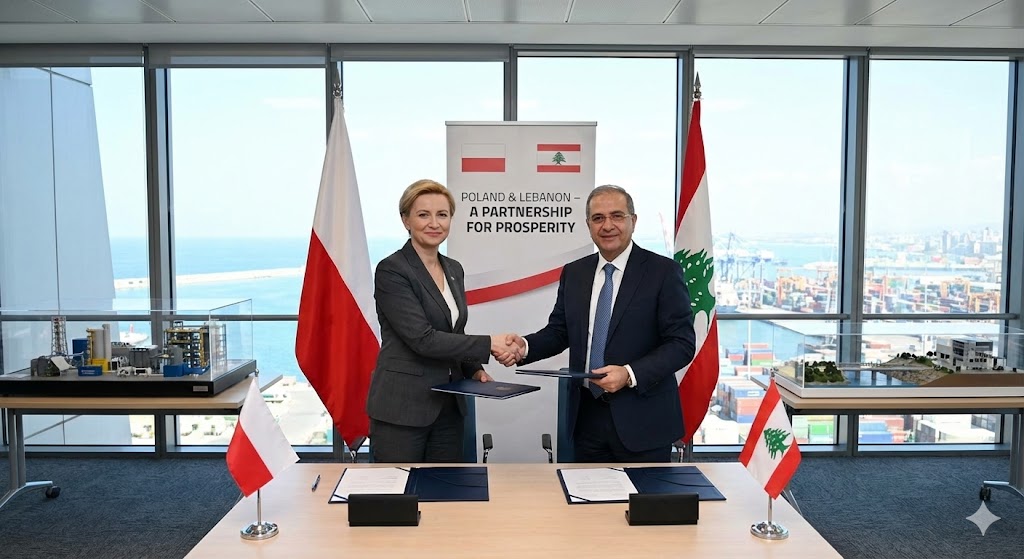
At the end of 2025, economic relations between Poland and Lebanon can be described as partnership-based and steadily developing. Although the two countries are separated by geographical distance, they are connected by a rich history of contacts and growing cooperation – from humanitarian activities to trade and investment. These relations are built on pragmatism, mutual benefits and trust, which give them a stable and long-term character.
Beginnings of diplomatic and economic relations
The history of official contacts between Poland and Lebanon dates back to the interwar period. From 1 November 1933, consular agents of the Republic of Poland operated in Beirut, responsible for trade and maritime affairs in the territory of Lebanon and Syria. This was the first permanent Polish representative body in the region, established primarily to support economic exchange and protect the interests of Polish enterprises. Other administrative and civil matters at the time remained under the jurisdiction of the Polish Consulate in Marseille.
With the growing importance of Beirut as a centre of trade and maritime communication, in 1939 a Vice-Consulate of the Republic of Poland was established in the Lebanese capital, and on 1 April 1940 it was transformed into the Consulate General of the Republic of Poland. On 15 December 1943, the Polish Consul General in Beirut simultaneously obtained accreditation to the government of Lebanon as a diplomatic agent of the Polish government-in-exile in London, with the rank of Minister Plenipotentiary. The formal establishment of diplomatic relations between Poland and Lebanon took place on 1 August 1944, marking the culmination of a long process of building Poland’s presence in the region. It is worth emphasising that the activity of the Polish consular service in Beirut from the 1930s onward focused not only on diplomatic issues but also on economic matters, supporting maritime trade, the export of goods and the development of business contacts between the two countries.
Trade – from Polish apples to Lebanese olive oil
Economic cooperation between Poland and Lebanon has clearly revived in recent years. After a period of stagnation linked to Lebanon’s economic crisis, trade has regained momentum. In 2018, for the first time in a decade, trade turnover exceeded USD 100 million, and in 2024 Polish exports reached nearly USD 96 million, confirming the stable potential of the market despite difficult macroeconomic conditions.
Poland exports to Lebanon a diversified range of goods: from machinery, equipment and household appliances to agri-food products, industrial goods and construction materials. Among the most significant items are gas turbines, tyres, cheeses, meat, cereals and live cattle. Lebanon, in turn, exports far less to Poland—its exports in 2019 amounted to around USD 13 million—but they are specialised, high-quality products such as natural casings for the meat industry, electrical cables, olive oil, wines and fresh fruit. The trade exchange is asymmetric, with Poland maintaining a positive balance for years. At the same time, cooperation is developing in a spirit of mutual benefit. Poland, known for its exports of food, furniture and construction materials, finds in Lebanon an absorptive market, particularly in the food sector. Due to limited agricultural land, Lebanon imports most of its food, creating a stable demand for Polish apples, dairy, meat, cereals and processed agricultural products.
There is also cooperation potential in the construction and energy sectors. Lebanon’s reconstruction and infrastructure modernisation programmes following periods of crisis open opportunities for Polish producers of ceramics, fixtures, building joinery and thermal-insulation technologies. Poland, with experience in energy efficiency, can support Lebanon’s efforts toward energy savings and sustainable construction.
Trade between both countries is becoming increasingly two-directional. Poles are beginning to appreciate Lebanese products and cuisine, as evidenced by the growing number of Lebanese restaurants in Polish cities. Lebanese food products—especially wines, olive oil, spices and fresh fruit—are appearing more frequently on the Polish market. It is precisely in the latter category that particular potential lies: Lebanese strawberries, figs, grapes and citrus fruit, which ripen almost year-round, could reach Poland outside the domestic harvest season. Such an expansion of imports not only enriches the offer for Polish consumers but also supports Lebanese agriculture, making trade cooperation beneficial both economically and socially.
Investments and business – capital flows in both directions
Not only trade but also investments today build a bridge between Warsaw and Beirut. Although before 2020 Polish direct investments in Lebanon were symbolic (only around USD 0.1 million at the end of 2018), which resulted from business caution toward the region’s instability, Lebanese capital had long been seeking opportunities abroad—traditionally in Francophone countries, the USA or the Gulf, but part of these funds also reached Poland. Lebanese investments in Poland, though modest (around USD 15 million in 2018), are concentrated in the agri-food sector (e.g., food processing, trade in exotic products), the paper industry, and even hospitality and gastronomy. In Polish cities one can come across restaurants run by Lebanese entrepreneurs, tempting with the aroma of roasted lamb and spices from the Middle East. These are small but vivid accents of Lebanese business presence along the Vistula.
One of the success stories is Technica, a family-owned Lebanese company producing modern industrial lines for global brands. In 2019 Technica decided to open its European headquarters precisely in Poland. Why? “We chose Poland because you have truly competent people with business intuition here. Compared with other European countries, Poland is cost-attractive and is located in the centre of the continent,” explains Cynthia Abou Khater from Technica’s management board. This investment is an example of the interpenetration of capital and know-how. The Lebanese company benefits from Poland’s location and workforce, creating jobs for Poles, while at the same time contributing its international experience and network of contacts.
Such examples show that the potential for investment cooperation is only beginning to unfold. With an improvement of the situation in Lebanon in the future, one may expect greater interest from Polish companies in participating in infrastructure projects in the country, whether in rebuilding the power grid or modernising the water management system. Already in 2018, during the donors’ conference, Poland pledged USD 10 million to support the construction of modular homes for Syrian refugees in Lebanon. These funds were used, among other things, to create a residential settlement for around 1,000 Syrian families, which simultaneously involved Polish companies supplying modular housing technology. This is a humanitarian investment that also became a business stimulus.
Solidarity in difficult times: Polish assistance to Lebanon
Recent years have been a period of exceptional challenges for Lebanon. The economic crisis lasting since 2019, rapid inflation and the 2020 explosion at the port of Beirut severely weakened the foundations of the state and its economy. An additional blow came from the consequences of wars in the region. The conflict in Syria led to the influx of more than one million refugees, and the escalation of fighting in the Gaza Strip and southern Lebanon—where shelling and border violations by Israel occur regularly—caused destruction and internal displacement. These factors, combined with the collapse of the Lebanese currency and the breakdown of the banking sector, created a situation of deep socio-economic crisis felt by all inhabitants of the country.
In the face of these challenges, Poland, guided by the principle of solidarity and shared interests, responded with comprehensive humanitarian and development assistance, delivered both through governmental measures and initiatives of non-governmental organisations. The aim of Polish support is not only to address the consequences of disasters and conflicts but also to strengthen Lebanon’s economic resilience, rebuild its infrastructure and create conditions for social stability.
Polish engagement is long-term. Since 2018, Lebanon has been among the priority countries of Polish Development Aid, which means increased funding for projects supporting economic recovery and improving living conditions. A key role in these efforts is played by the Polish Center for International Aid (PCPM), active in Lebanon since 2012. PCPM implements projects in the fields of infrastructure, agriculture and energy, which have a direct impact on the local economy. The rebuilding of roads and bridges, cleaning of riverbeds and modernisation of irrigation systems have enabled agriculture to return to areas previously flooded or cut off from transport.
Polish assistance also focuses on sustainable energy development. Solar panels are being installed in mountain villages, ensuring stable electricity supplies that allow small workshops and farms to operate. Vocational training is also supported, enabling residents to acquire new skills and find employment in reconstruction and service sectors.
This practical, economy-oriented assistance brings long-term effects: it creates jobs, rebuilds infrastructure and restores agricultural production, while at the same time mitigating the social consequences of the crisis. A stable and developing Lebanon is also an economic partner with whom Poland can pursue shared goals, from food security to restoring the region’s trade potential.
Shared values and development prospects
Polish–Lebanese relations are not only a story of assistance and solidarity but also a partnership based on shared experience in overcoming crises and building a state under difficult conditions. Both countries are connected by pragmatism and the conviction that economic stability is the foundation of sovereignty. Poland, which has undergone a successful transformation in recent decades, can today share with Lebanon its experience in financial reforms, institutional reconstruction and support for entrepreneurship. Academic cooperation and student exchange strengthen mutual understanding and facilitate the transfer of knowledge, which is already yielding benefits in economic relations.
The highest priority for the future remains economic stabilisation and infrastructure reconstruction. Poland can play an important role in modernising Lebanon’s energy sector, including projects in renewable energy and energy efficiency. Joint investments in agriculture and food security are another realistic direction for cooperation. Technology transfer, development of irrigation systems and support for small farmers would help reduce unemployment and increase local production.
In the social and cultural sphere, tourism and people-to-people exchange are gaining significance. Direct flight connections and joint initiatives promoting culture and heritage contribute to better understanding and the building of lasting ties, which in the long run should also translate into economic outcomes.
In the coming years, Poland and Lebanon can jointly create a model of cooperation linking development assistance with investment, science with economic practice, and solidarity with effectiveness. A partnership based on mutual respect and shared interests provides real foundations for Polish–Lebanese relations to acquire a new, lasting dimension in the decade ahead.