

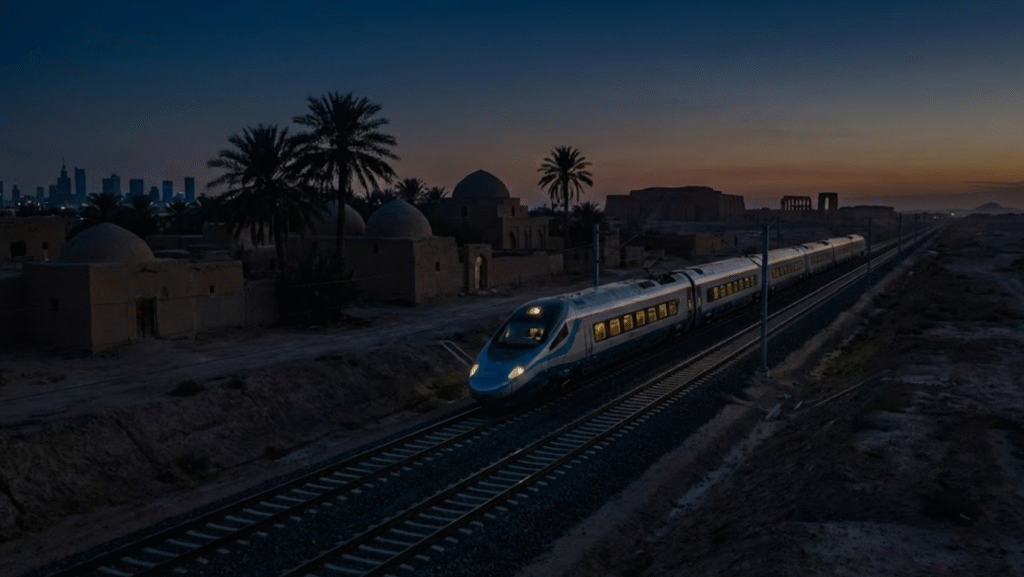
Poland has extensive experience in modernizing its rail network as well as expanding public transport in cities and Iraq’s needs in this area are immense. Public transport is based almost exclusively on shared taxis and minibuses; there is no metro or trams, and the only operational railway line, connecting Basra with Baghdad, is outdated.
The expansion of the public transport network in Baghdad would not only solve the issue of gigantic traffic jams hindering movement but would also contribute to improving air quality and, consequently, public health. The 8-million-strong Baghdad, which is currently undergoing dynamic development and expansion, cannot afford to continue functioning without a metro, trams, and buses. Poland, in turn, possesses both the know-how in urban transport planning and the construction of rolling stock and transport infrastructure.
Poland can therefore play a key role in designing the metro network in Baghdad, Mosul, Erbil, and other cities, as it has recent experience in this area. In particular, it can share the expertise of companies like Metroprojekt, which was the main designer of the Warsaw Metro. This experience is recent, as the Warsaw Metro is under continuous expansion. Furthermore, the design of the metro in Warsaw takes into account complex underground conditions and is being implemented in a highly built-up area with heavy traffic. It is precisely this kind of experience that Iraq needs to realize its metro construction plans.
Poland can also help reform the entire public transport system in Baghdad and other Iraqi cities and introduce city buses and trams. Poland also has very great planning and design experience in this field. Specifically, Poland can offer advice on creating modern public transport authorities that are independent of local government and responsible for fare and timetable integration (buses, trams, metro). The offer may also include training for engineers and planners on optimizing the transport network and implementing passenger information systems (display boards, applications), as well as launching student and engineer exchange programs with the Warsaw University of Technology and the Cracow University of Technology to train local specialists in metro construction, tunneling, and traffic management.
Poland can also present a broad offer in the field of supplying modern rolling stock that is competitively priced and adapted to difficult conditions. Poland is a leader in this area. This includes Solaris buses, which is a leading city bus manufacturer in Europe and has introduced low-floor buses to cities in Poland and Europe. Solaris is also a leader in the segment of electric and hydrogen buses, which corresponds to global trends. The number of electric vehicles is also growing rapidly in Iraq. The Polish bus offer includes both city and intercity buses, with other manufacturers being Autosan and NesoBus. The former, besides city buses, also offers medium-sized intercity buses, ideal for short routes. NesoBus, in turn, offers modern hydrogen buses.
Iraq should also consider introducing trams to its cities. Although this means of transport is not very popular in the Middle East, some countries, such as Turkey, Qatar, and the United Arab Emirates, have been expanding their tram lines in cities for many years. It is worth noting that at the end of the 20th century, there was a trend considering the tram as an outdated means of transport, and many lines were liquidated. This happened both in Poland and Iraq. However, for more than a dozen years, the opposite trend has prevailed, and many tram sections in Poland that were liquidated just a dozen years earlier have been rebuilt, and new ones have also been created. Currently, the length of tram lines in Poland is over 2400 km, and the tram network in Warsaw and the Katowice agglomeration are among the largest and most modern in Europe.
Poland can therefore present a very broad offer in this case as well. Warsaw can share its experiences with Baghdad in the construction of modern lines in the city center, including underground sections and interchanges, such as the line currently being built connecting the West Station (Dworzec Zachodni) with the center. Polish companies Modertrans and Pesa can offer the most modern tram rolling stock, which can now be seen in many European cities, including Germany, Romania, Bulgaria, Hungary, Ukraine, Estonia, and Slovakia. Polish companies also have extensive experience in the construction of tram tracks and accompanying infrastructure and have carried out contracts in this regard in Germany, Lithuania, Slovakia, and Latvia, among others.
An urgent need for Iraq is also the modernization and expansion of the railway network. Currently, the only active railway line connects Basra with Baghdad, but it requires urgent modernization. A 100 km section from Baghdad to Ramadi has also been operating for a year. Meanwhile, the ambitious Iraqi Development Road project, which is to connect the new Grand Faw Port on the Persian Gulf with Europe via Turkey, requires the creation of a modern railway line. Turkey has been expanding and modernizing its railway network for many years, and only a 150-kilometer section from Kurtalan needs to be built to connect it to the Iraqi border. However, Iraq must rebuild its railway network, especially from Baghdad to Mosul, and then build a new section to the border with Turkey. This, however, is only the first step, as it is also necessary to connect other cities in Iraq, including the Kurdistan Region, with the railway network. It is also known that the Iraqi authorities attach great importance to this, and in June 2025, World Bank financing of $930 million was announced for the Iraq Railways Extension and Modernization (IREM) project, which will modernize the Mosul – Umm Qasr line, totaling 1047 km.
Poland is an ideal partner for the implementation of this project, as it has vast experience in modernizing railway lines and capabilities in the production of railway rolling stock and the construction of infrastructure, including traction and trackage, as well as modern railway stations. Over the last 10 years, Poland has allocated about $25 billion to the modernization of approximately 9,000 km of tracks, resulting in reduced travel times, e.g., the 320-kilometer route from Gdańsk to Warsaw from 3.5 hours to 2.5 hours. Further stages of modernization, related to the High-Speed Rail project, are expected to shorten the 350-kilometer route from Warsaw to Wrocław to 96 minutes, for example.
Two Polish companies, Pesa and Newag, are giants in the railway rolling stock market and are increasingly expanding into foreign markets. Their offer is the ideal solution for Iraq. Pesa, based in Bydgoszcz, produces, among others, the elegant Pesa Dart long-distance trains, often called the “Polish Pendolino,” as well as Elf trains (Electric Multiple Units), which are popular in regional transport. Pesa is a pioneer of hydrogen technology in this part of Europe, producing a hydrogen locomotive (SM42-6Dn). Pesa has supplied Link trains to the German Deutsche Bahn, and has also won gigantic contracts in Romania (for over 60 trains) and the Czech Republic. Newag, from Nowy Sącz, focuses on reliability, engineering, and high availability of rolling stock. For years, this company has built a leading position in the electric locomotive segment. Among its flagship products are: Impuls regional trains; the heavy, 6-axle Dragon freight locomotive – a Polish export and technical hit, ideal for hauling heavy coal or aggregate trains; and the fast Griffin passenger locomotive (reaching 200 km/h).
Polish construction companies have also carried out many orders in recent years for laying tracks and setting up traction networks, both in Poland and abroad. For example, Cracow-based ZUE S.A. is active in the German (Deutsche Bahn) and Slovak markets, and Trakcja S.A. is very active in Lithuania, where it carries out huge contracts as part of the Rail Baltica project (construction of new railway lines that will connect Poland with the Baltic countries in the future). Meanwhile, the Polish construction giant Budimex won a prestigious contract for the construction of the Rail Baltica section in Latvia/Estonia. This company is also increasingly entering the Czech, Slovak, and German markets, targeting large infrastructural projects. In turn, Polska Grupa Zbrojeniowa (PGZ), as the owner of H. Cegielski – FPS, can supply railway carriages.
Poland has already played a key role in building the transport network in Iraq once, and both sides were satisfied with it. It is time to return to the roots. Iraq has needs, and Poland has capabilities and experience.