

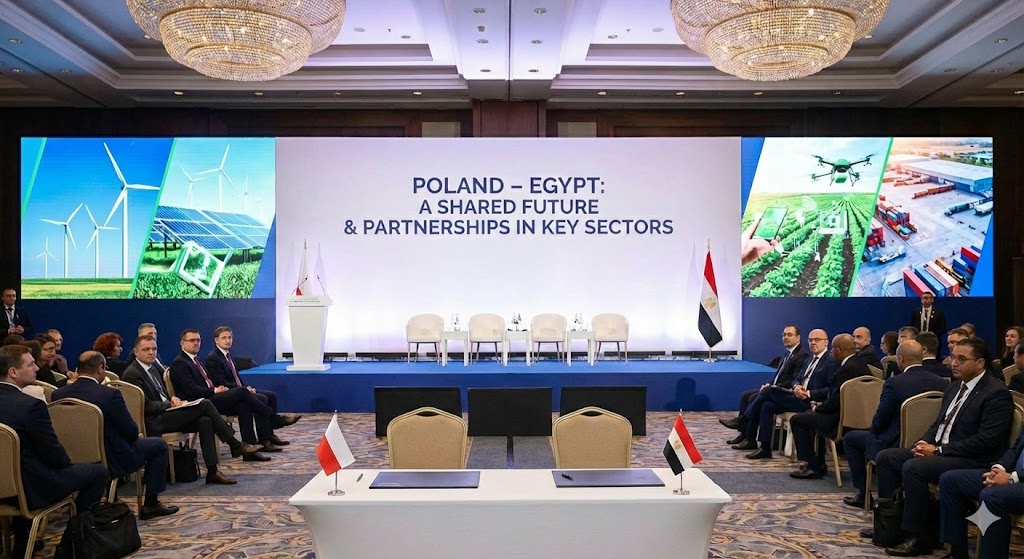
Poland and Egypt are linked by long-standing, friendly relations whose beginnings date back to the establishment of diplomatic ties in 1927. Egypt is considered a key partner for Poland in the Arab world, both politically and economically. In recent years, intensive high-level contacts have given this cooperation a new dynamism. Faced with global challenges, both countries are jointly seeking new areas of cooperation that will bring tangible benefits to their societies and support the stability of the region. Below we present the prospects for developing partnership in key sectors.
Economic and trade cooperation
A growing scale of economic cooperation – with potential for more: In recent years, trade between Poland and Egypt has increased significantly, surpassing USD 900 million in 2022. The structure of this exchange, relatively balanced and complementary, provides a solid foundation for further intensification. Poland offers Egypt machinery, equipment, food products and industrial components, meeting the growing consumption and modernisation needs of a 110-million-strong market. Egypt, in turn, supplies Poland with high-quality textiles, cotton and agricultural and tropical products that the Polish market does not produce in sufficient quantity. Strengthening logistical links, investment and supply chains—also within cooperation with the Egyptian Suez Canal Economic Zone (SCZone)—may in the coming years transform trade relations into a lasting industrial partnership based on investment and joint processing.
Investment as a lever of development partnership: The resumption, after 30 years, of the Polish–Egyptian Joint Commission for Economic Cooperation marked a new phase in investment relations. Sixteen priority sectors were identified – from ICT and green energy to smart cities – giving the cooperation a strategic direction. An example of this new quality is the investment by Feerum in a factory for grain storage and drying equipment in the Port Said economic zone. This project not only strengthens Poland’s industrial presence in Egypt but also supports Cairo’s key goal of increasing food security, serving as a model for possible Polish specialisation in agricultural technologies supporting Egypt’s food-sector transformation.
In the coming years, the development of joint projects within Egypt’s mega-infrastructure initiatives, such as the new administrative capital or the modernisation of the railways, as well as the creation of lasting institutional links (including cooperation between economic zones), will make it possible to transform Polish–Egyptian relations from transactional to systemic. Egypt gains a partner from the EU; Poland gains a gateway to the Middle East and Africa.
Economic development as a shared strategic platform: Both sides see significant potential in further expanding trade and investment, with the emphasis shifting from the exchange of goods to the building of durable sectoral linkages. Egypt plans to increase exports of strategic raw materials (fertilisers, petrochemicals, building materials), responding to the needs of Polish industry and price stability. Poland, as a supplier of advanced agricultural technologies, machinery and food products, fits naturally into Egypt’s plans to enhance food security and develop processing within the “1.5 million feddans” programme. In July 2025, discussions took place between the Ambassador of the Republic of Poland and Egyptian officials responsible for this project, during which concrete areas of cooperation were examined, including mechanisation, smart agriculture and processing. Poland can support this process not only with equipment but also through the transfer of know-how, the creation of research and implementation centres and the training of specialists.
Trade and investment missions in sectors such as modern construction, infrastructure, rail transport, digital technologies and logistics will be crucial. In the longer strategic horizon, Poland may become for Egypt a technological and food-security partner, while Egypt may serve as a distribution platform for Poland in Africa and the MENA region.
New technologies and cybersecurity
Digital transformation as an impulse for technological cooperation: Poland and Egypt view digitalisation as a strategic pillar of their economic modernisation. Egypt is implementing ambitious digital projects, for example building 14 fourth-generation cities, including the New Administrative Capital, and developing e-government services and intelligent transport systems. Poland, with advanced competencies in digital administration and cybersecurity, agreed during the visit of the President of the Republic of Poland in 2022 to intensify the exchange of experience in this field.
Potential areas of cooperation also include the localisation of Polish technologies in Egypt, the development of joint IT projects and support in creating infrastructure for digital services. Polish ICT companies, such as Comarch, are already expanding in Middle Eastern markets, and Egypt—being a large market with a growing demand for smart-city and e-government solutions—is becoming a natural next direction for this expansion. Cooperation in this sector has long-term potential, encompassing technology transfer, workforce training and the creation of an innovation ecosystem supporting the digital transformation of both countries.
Cybersecurity as a shared strategic priority: As Poland and Egypt develop their digital economies, they are increasingly focusing on challenges related to critical infrastructure security, data protection and countering disinformation. With the growing digitalisation of public, financial and healthcare services, cooperation in this area is gaining strategic significance. Poland, as an active participant in EU and NATO initiatives, has well-developed competencies in building national cybersecurity strategies, responding to incidents and implementing data protection standards. Egypt, in turn, is expanding its institutional and legal capacities and seeking partners for knowledge exchange and workforce development.
In the future, deeper cooperation is possible within training programmes, expert consultations and academic and research projects, covering areas such as artificial intelligence, cryptography and the security of public administration systems. Investing in this cooperation today is not only an element of shared digital security but also a catalyst for developing a modern technological sector within Polish–Egyptian relations.
Defence and security cooperation
A partnership for stability: Poland and Egypt consistently build their image as pillars of stability in their respective regions — Central and Eastern Europe and the Middle East. Shared interests in security, counterterrorism, combating extremism and preventing the destabilisation of neighbouring regions will, in the future, require deeper operational and political cooperation. Egypt, which plays a key role in the eastern Mediterranean and is active in stabilisation efforts in the Sahel region, remains a strategic point of reference for Poland in the south. Poland, in turn, contributes to the relationship its experience in systemic transformation, Euro-Atlantic integration and the development of security structures, which may form the basis for future training and advisory cooperation.
Both states advocate within the United Nations for the peaceful resolution of conflicts and respect for international law. These shared values create the foundations for developing a permanent strategic dialogue which, in the face of global tensions, may gain new momentum and significance for the entire space stretching from Europe to North Africa.
Counterterrorism as an area of future cooperation: Egypt has for years conducted operations against terrorist organisations, especially in the Sinai Peninsula, relying on a comprehensive strategy that includes both military action and blocking the financing of extremism, as well as eliminating spaces of tolerance for radical groups. Poland values these efforts and supports Cairo in international forums, including within the EU and the UN. In the future, operational cooperation can be intensified, particularly in countering extremist propaganda, protecting critical infrastructure, identifying the financing of terrorism and developing techniques for stabilising high-risk areas.
Poland, drawing on its NATO and EU experience, can offer joint expert training, participation of Egyptian officers in courses at Polish military academies, or partnership in anti-terrorism exercises. Such initiatives could strengthen interoperability and trust, and form a foundation for long-term cooperation in regional security.
Defence-industry cooperation: The development of Poland–Egypt economic relations also extends into the defence-industrial sector. Poland, which in recent years has modernised its production capacities and entered export markets with selected categories of military equipment, sees strong potential for cooperation with Egypt, one of the largest purchasers of armaments in Africa and the Middle East. Egyptian delegations regularly participate in the International Defence Industry Exhibition (MSPO) in Kielce, familiarising themselves with Polish offerings in areas such as armoured vehicles, electronic systems and ammunition.
Although Egypt traditionally sources equipment from the United States, France and South Korea, the growing importance of diversification opens space for medium-scale contracts and technological cooperation, particularly in the modernisation of equipment, reconnaissance systems or tactical drones. Joint projects in shipbuilding are also possible, given that the Egyptian Navy is rapidly expanding its patrol fleet and Polish shipyards have experience in building vessels of this class.
In the medium term, cooperation could take the form of a permanent presence of PGZ and partner companies on the Egyptian market, provided that political and economic conditions are met. Such a presence would align with both countries’ aims to strengthen defence sovereignty and develop strategic industries.
Humanitarian aid and migration issues
Reducing migration pressure: Poland and Egypt share the conviction that the key to limiting irregular migration to Europe is the stabilisation of the Middle East and North Africa. Egypt already plays a central role, as since 2016 it has effectively stopped illegal migrant boats from departing its territory, and more than six million migrants and refugees have found shelter there. Cairo’s actions, appreciated by Poland, demonstrate that local support mechanisms can produce lasting results.
Looking ahead, Egypt’s importance as Europe’s partner in managing migration at its source is increasing, and Warsaw consistently supports this approach, advocating within the EU for directing greater development funds to social, educational and infrastructure projects in Egypt. Such cooperation opens space for Polish companies and institutions to engage in projects financed by EU instruments. In the longer term, joint actions by Poland and Egypt can strengthen the stability of the entire region and reduce forced migration by creating real prospects for development on the ground.
Humanitarian aid and crisis response: This is an area of growing importance in Polish–Egyptian relations, with potential already demonstrated through joint actions. During the crisis in the Gaza Strip, both sides effectively coordinated assistance — Egypt as a key transit and negotiating country, and Poland as an active donor and organiser of evacuations. Warsaw provided medical aid to hospitals in Egypt treating the wounded from Gaza, and Polish experts supported logistical and medical operations within the WHO mission. These efforts showed that there is both operational capacity and a clear willingness to cooperate.
In the future, this cooperation could take on a more institutionalised form, for example through joint rapid-response mechanisms, the exchange of crisis-logistics expertise or training programmes for emergency services. Both countries possess well-established diplomatic contacts and operational experience (such as Poland’s involvement in the UNEF mission), which creates a real basis for deepening cooperation also within partnerships with the EU, the UN or humanitarian organisations. In this way, Poland and Egypt can jointly strengthen regional resilience to crises.
Building long-term solutions: Poland and Egypt recognise that crisis response must go hand in hand with development efforts. Within frameworks such as Polish Aid and through its partnership with the EU, Poland may in the future engage in concrete initiatives supporting refugees and local communities in Egypt — for example by participating in educational, healthcare or employment-support projects implemented jointly with international and local organisations. Egypt, which provides shelter to millions of migrants, has valuable experience in their integration and in combating human trafficking. This creates opportunities for knowledge exchange and joint action.
Both countries support an approach in which humanitarian assistance should lead to lasting improvements in living conditions on the ground. Although the scale of Poland’s engagement does not match that of the largest donors, there are real foundations for jointly strengthening local resilience to crises and addressing the root causes of forced migration. In this context, a strategic partnership between Poland and Egypt may help transform migration into a conscious choice rather than a necessity driven by poverty or destabilisation.
Energy security
Diversification of energy sources: Poland and Egypt have complementary interests in the energy sector, creating real opportunities for cooperation in the coming years. Poland, building independence from traditional supply routes, is developing LNG infrastructure and seeking flexible gas sources, including through spot purchases. Egypt, although facing growing domestic demand, remains an active regional player with experience in LNG exports and advanced liquefaction infrastructure.
In the future, cooperation may focus on occasional LNG deliveries during peak demand periods, as well as broader energy partnerships — for example in liquefaction technology, infrastructure management or joint training projects. A scenario involving long-term contracts would require stabilisation of Egypt’s energy balance and competitive pricing conditions, yet the communication channel and political foundations already exist. In a volatile geopolitical environment, the energy sector may become one of the tangible and pragmatic pillars of bilateral cooperation.
Oil and infrastructure: Egypt remains an important player in the global oil supply chain — both as a producer and processor — as well as a transit country with critical infrastructure such as the Suez Canal and the SUMED pipeline. Poland, consistently diversifying its supply sources after moving away from Russian crude, increasingly relies on deliveries from the Middle East and North Africa. In this context, Egypt is becoming a natural infrastructure and information partner.
In the coming years, technological and operational cooperation between Poland’s Orlen and Egyptian partners is feasible, for example in fuel storage, refinery infrastructure modernisation or joint analyses of transit-route stability. The framework for dialogue already exists: Poland is an active member of the International Energy Agency, while Egypt participates in the OPEC+ format (though it is not a member). These channels can support not only information exchange but also facilitate concrete bilateral projects if geopolitical and commercial conditions are favourable. The potential is real, particularly in areas of shared infrastructural interests and energy security.
Renewable energy and green hydrogen: The energy transition is becoming one of the most promising avenues of Polish–Egyptian cooperation. Egypt, with some of the best global conditions for solar and wind energy production, is developing ambitious renewable-energy projects, including the giant Benban photovoltaic complex (the largest in Africa and one of the largest in the world) and plans for mass production of green hydrogen and ammonia for export. Poland, in turn, is modernising its energy mix by investing in wind and solar farms and developing competencies in energy storage, grid automation and hydrogen technologies.
Cooperation has already begun. The company Netcable from Legnica participated in the construction of Benban, and Hynfra is planning an investment worth over USD 10 billion in an Egyptian installation for producing green ammonia. In the coming years, additional projects are possible in which Polish companies will offer renewable-energy technologies, grid solutions or components for hydrogen production, while Egypt may serve as a pilot market for advanced Polish energy solutions. If current trends continue and appropriate institutional support is ensured, the clean-energy sector may become one of the strategic pillars of Polish–Egyptian relations in the coming decade.
Climate cooperation and environmental partnership
A joint climate front as a strategic dimension of partnership: Poland and Egypt are building the foundations of long-term cooperation in climate policy, treating it not only as an environmental challenge but also as a geostrategic and developmental one. Both countries have experience as hosts of global COP climate summits and use this position to strengthen their role in the international debate on the future of the energy transition. In the coming years, concrete formats of cooperation are possible: joint initiatives within the UNFCCC and COP frameworks, the exchange of know-how on just transition (e.g., Poland’s experience with coal-region restructuring), adaptation projects in Egypt (water, agriculture, urban environments), as well as joint advocacy efforts for greater fairness in the distribution of climate-transition costs.
The basis of this partnership is agreement on one key point: climate action must strengthen rather than weaken socio-economic stability. A joint voice from Warsaw and Cairo in the global debate can increase pressure for more effective financial mechanisms (e.g., the Loss and Damage Fund) and open space for projects supported by the EU, the World Bank or UNDP. As a result, climate policy becomes not only a challenge but also one of the forward-looking areas of synergy between Poland and Egypt.
Water management as a future pillar of technological cooperation: In the face of deepening climate change, Poland and Egypt gain a shared platform for cooperation in the protection of water resources. For Egypt, this is an existential issue: declining Nile flows, increasing desertification and growing demographic demand require the development of advanced technologies for desalination, automated irrigation and water recovery. Poland, although operating in different climatic conditions, is increasingly confronted with water deficits and the need to optimise water-resource management.
Poland has a growing technological potential in the field of water management, which in the future may find application in projects in markets such as Egypt. Companies such as Nanoseen (nanotechnology-based filtration) and SEEN Holding (water treatment and purification systems) offer scalable solutions that address the challenges of the MENA region, from water scarcity to decentralised infrastructure. Their technological profile makes them natural candidates for participation in investments related to desalination, retention and smart irrigation.
Egypt treats the development of water infrastructure as a priority and is opening its market to foreign partners. Cooperation can develop both in the form of public–private partnerships and within multilateral instruments (e.g., EU programmes or World Bank projects). Scenarios also include the creation of joint training centres, technology pilots and know-how transfer. Such initiatives can strengthen Egypt’s resilience to water crises while at the same time opening a pathway for Polish companies to expand into MENA and sub-Saharan African markets.
Education and cultural exchange
Academic cooperation as an investment in the future: Growing interest among young Egyptians in studying in Poland — particularly in medicine, engineering and IT — is creating durable foundations for long-term people-to-people links. Poland is increasingly seen as an affordable, high-quality educational alternative, while the presence of Polish language courses at Ain Shams University and the steady flow of Polish students and researchers to Egypt (archaeology, Arabic studies, history) shows that the exchange runs in both directions.
In the coming years this cooperation can expand substantially. Both governments are working on updating the bilateral agreement on scientific and educational cooperation and are developing support instruments such as scholarships, mobility programmes and visa facilitation. Joint research initiatives are being prepared in strategic fields relevant to both countries, including tropical medicine, energy, climate change and cultural studies.
Strengthening this academic infrastructure will create a stable channel for the transfer of knowledge and skills and build a pool of experts who can support future economic, technological and cultural projects between Poland and Egypt.
Culture and tourism as carriers of soft power and relational capital: Poland has long been among the leading European countries generating tourism flows to Egypt; in 2024 it ranked as the fifth largest market in the EU. In the coming years the importance of this channel will continue to grow, particularly in the context of direct flight connections and the rising interest in Egypt as a year-round destination. For the Polish market this is not only a matter of leisure, but also of an expanding potential for related services such as travel medicine, cultural education and specialised tour operating.
At the same time, Egypt benefits from the presence of Polish archaeologists and academic institutions (such as the PCMA of the University of Warsaw), which strengthens its profile as a centre of research on antiquity and increases the international value of its cultural heritage. The planned continuation and digitalisation of archaeological projects, joint exhibitions and the development of educational tourism (for example, programmes for students of history and heritage conservation) have the potential to intensify cooperation.
Parallel activities by embassies and cultural institutes (such as Polish film weeks, exhibitions or musical events) create space for expanding programmes of artist exchange, festivals and youth initiatives. In the coming years, the cultural component may acquire a more systemic character, for instance through the establishment of a Polish–Egyptian Council for Cultural Cooperation or a fund supporting the mobility of creators and the promotion of heritage in both countries.
Poland–Egypt: A future-oriented partnership with a strategic dimension
The analysis shows that relations between Poland and Egypt are entering a new phase: moving from occasional cooperation and commodity exchange towards a durable, sector-based partnership grounded in complementary resources, shared interests and converging modernisation ambitions. Egypt, as the largest economy in North Africa and one of the key actors in the MENA region, is opening its markets and infrastructure to partners willing to engage over the long term. Poland, drawing on its transformation experience, EU membership and expanding technological potential, is seeking stable points of anchoring beyond Europe.
At the economic level, the foundations of cooperation are steadily growing. Egypt is becoming a market for Polish technologies in areas such as food production, infrastructure, digitalisation and renewable energy, while at the same time offering opportunities for Polish manufacturing investments in sectors of strategic relevance (food, energy, logistics). Egypt, for its part, sees Poland as a provider not only of goods, but also of institutional and technological solutions, particularly in fields linked to food security, digital transformation and water management. The future of relations will depend on both sides’ ability to move from project-based contacts to permanent cooperation mechanisms, such as joint research centres, localised production or regional PPP partnerships.
Security and migration constitute another dimension of interdependence. Poland and Egypt recognise that stabilising the southern neighbourhood requires locally embedded responses supported by long-term partners, not only crisis management. Hence the growing importance of joint humanitarian projects, cooperation in countering extremism and developing social infrastructure. Egypt is becoming an EU partner in managing migration at its source, while Poland positions itself as a promoter of institutional cooperation and long-term support.
Cooperation in education, culture and science provides the essential backbone for intergenerational ties and builds relational capital. The sustained presence of students, researchers, archaeologists and artists on both sides strengthens social understanding and creates networks of trust which, over time, may translate into economic and political cooperation.
In sum, Poland and Egypt have the potential to build a relationship based on mutual benefit, sectoral interoperability and long-term commitment. The realisation of this scenario will depend on maintaining political determination, effective project coordination and the development of joint institutions that give the partnership a lasting structure. The current trajectory is clear: the foundations are already in place, what is needed now is the architecture.