
Military Cooperation and Non-State Armed Formations in Lebanon
Military Cooperation and Non-State Armed Formations in Lebanon This material is one of ten analytical briefs accompanying the full report on the security of Lebanon’s information environment. It forms part of a broader series examining key trends and incidents shaping the informational landscape. We encourage you to read the full report:https://shafafiyat.com/ar/2025/09/17/%d8%aa%d9%82%d8%b1%d9%8a%d8%b1-%d8%a3%d9%85%d9%86-%d8%a7%d9%84%d8%a8%d9%8a%d8%a6%d8%a9-%d8%a7%d9%84%d9%85%d8%b9%d9%84%d9%88%d9%85%d8%a7%d8%aa%d9%8a%d8%a9-%d9%81%d9%8a-%d9%84%d8%a8%d9%86%d8%a7%d9%86/ Lebanon’s modern security architecture is based on a delicate balance between the formal army, supported by foreign partners, and a complex mosaic of non-state armed groups. Crucial to this setup is military aid from the United States and France, as well as the role of UN peacekeeping forces (UNIFIL), whose presence stabilizes Lebanon’s southern border with Israel. Despite this, state security structures are weakened by political deadlock and limited public trust. At the same time, the informal security sphere – represented by groups such as Hezbollah, Amal, Fatah al-Islam, and the Islamic Unification Movement – forms a parallel system of power, influence, and loyalty. Many of these organizations are linked to foreign patrons like Iran and Syria, further complicating Lebanon’s sovereignty and its ability to monopolize the use of force. As a result, Lebanon operates as a state with a fragmented security system, where armed forces and militias function in a tense relationship. The Lebanese Army depends on international support, particularly from United States (training and armament), France (logistical support) and Saudi Arabia (financial aid, though recently limited due to Hezbollah’s actions). In addition to states, the UN also plays a role in maintaining peace and stability in the region. Key Partners of Lebanon USA Military cooperation with the U.S. includes supplying military equipment, training Lebanese Armed Forces and assisting in counterterrorism efforts against groups like ISIS and Al-Qaeda. The United States is one of Lebanon’s key military allies. U.S. security assistance is a cornerstone of its policy toward Lebanon, aiming to strengthen Lebanese sovereignty, secure state’s borders, counter internal threats and disrupt terrorist networks. Key areas of cooperation include border security, maritime security, defence institution building, arms transfers, and counterterrorism. France France also provides military aid, especially after crises like the 2020 Beirut explosion. France has a vested interest in Lebanon’s stability, which heavily relies on French military and political support. On March 12, Lebanon and France signed an agreement to enhance cooperation between their armed forces. France committed to training Lebanese medical personnel, supplying medical materials and equipment and developing military clinics. In October 2024, France pledged €100 million in support, with President Emmanuel Macron stating Lebanon needs “massive aid” due to Israeli attacks displacing over a million people. UN (UNIFIL) UN peacekeeping forces in Lebanon (UNIFIL) aim to monitor ceasefire compliance and ensure stability along the southern border with Israel. Their presence is vital for maintaining regional balance and monitoring Hezbollah-related developments. UNIFIL is a UN peacekeeping mission, which means its military activities are limited to self-defence and preventive actions. UNIFIL’s mandate includes: Non-State Armed Formations in Lebanon In Lebanon operates several non-state military formations that significantly influence its politics and security. In 2022, the United States provided the Lebanese Armed Forces (LAF) with security assistance and training as well as cooperated with law enforcement agencies such as the Internal Security Forces to enhance their capacity to conduct counterterrorism operations and to investigate and prosecute local cases of terrorism. Terrorist groups operating in Lebanon included U.S.-designated foreign terrorist organizations such as Hezbollah, Hamas, Palestinian Islamic Jihad, and ISIS. Hezbollah Hezbollah is Lebanon’s main paramilitary force, operating as a militant, political, and social organization. Supported by Iran and Syria, it is designated a terrorist organization and is involved in conflicts beyond Lebanon, including Syria and other parts of the Middle East. Its military development is based on cooperation with Iran and Syria, and it possesses a powerful arsenal and advanced technologies. Hezbollah maintains strong ties with local communities, especially among Shiites. ISIS ISIS sought to exploit Lebanon’s economic collapse to reestablish itself. Thanks to U.S. training, LAF detects and counters terrorist activities, often rooted in Palestinian refugee camps. ISIS fighters attempt to recruit Lebanese citizens and acquire weapons through refugees and vulnerable individuals. Palestinian Islamic Jihad (PIJ) An Islamist paramilitary and terrorist organization. Most of the structures of PIJ are located in the Gaza Strip and Lebanon. Fighters are often recruited from refugee camps in southern Lebanon and trained by Syrians and Hezbollah. Fatah al-Islam A Sunni Islamist militant group founded in November 2006 in a Palestinian refugee camp in Lebanon. It is described as a jihadist movement inspired by Al-Qaeda. Islamic Unification Movement (IUM) Also known as the Islamic Unity Movement, it is a Lebanese Sunni Muslim political party. It has played an active role in Lebanon’s domestic politics since the Lebanese Civil War in the 1980s. The militia, numbering around 1,000 members and referred to as “Tawheed,” was established in 1982 and trained by the Palestine Liberation Organization (PLO). Initially, it received light weapons from the stockpiles of the Lebanese Armed Forces (LAF) and the Internal Security Forces (ISF) or purchased them on the black market. After the withdrawal of Palestinian factions, the IUM militia was able to develop mechanized armed forces. Osbat al-Ansar A Sunni fundamentalist group founded in the early 1990s, based in the Ain al-Hilweh refugee camp. It follows Salafist Islam and seeks to overthrow Lebanon’s secular government. It received weapons and supplies from Lebanese internal security forces and militias linked to the Siniora government. Kataeb Regulatory Forces Part of the Lebanese Christian Kataeb Party from 1961 to 1977. The Kataeb militia, active during the early years of the civil war, was a precursor to the Lebanese Forces. Amal Movement A Shiite political and paramilitary group originally founded to defend the rights of Lebanon’s Shiite population. Although politically integrated into Lebanon’s system, its military wing has historically operated outside of state control. Lebanese Forces (LF) Originally a Christian militia during the Lebanese Civil War, the Lebanese Forces are now a political party but maintain a strong military and paramilitary presence in certain Christian communities. Syrian Social Nationalist Party (SSNP) A political party with paramilitary capabilities, historically active in Lebanon – especially in the
Social vulnerabilities

Social vulnerabilities This material is one of ten analytical briefs accompanying the full report on the security of Lebanon’s information environment. It forms part of a broader series examining key trends and incidents shaping the informational landscape. We encourage you to read the full report:https://shafafiyat.com/ar/2025/09/17/%d8%aa%d9%82%d8%b1%d9%8a%d8%b1-%d8%a3%d9%85%d9%86-%d8%a7%d9%84%d8%a8%d9%8a%d8%a6%d8%a9-%d8%a7%d9%84%d9%85%d8%b9%d9%84%d9%88%d9%85%d8%a7%d8%aa%d9%8a%d8%a9-%d9%81%d9%8a-%d9%84%d8%a8%d9%86%d8%a7%d9%86/ Lebanon, a country with an exceptionally complex socio-political structure, is currently in a state of profound crisis. The impact of sectarianism, ethnic tensions, extreme economic instability, and growing security threats creates a mosaic of social vulnerabilities that systematically undermine the foundations of statehood and national unity. In the absence of strong state institutions, religious identity and communal affiliation become the dominant frameworks for social and political life. Religious vulnerabilities The religious landscape of Lebanon is incredibly diverse. In 2023, the population was approximately 5.4 million, including 4.5 million citizens, about 1.5 million refugees, mainly from Syria and Iraq, and over 180 thousand from Palestine. Sunni Muslims dominate the migrant population, introducing additional religious divisions and intensifying social fragmentation. Although Lebanon has not conducted an official census since 1932, data from Statistics Lebanon indicate that 69.3% of citizens are Muslims (including 31.2% Sunni, 32% Shia, and 6.1% Alawites and Ismailis), while 30.7% are Christians, mainly Maronites and Greek Catholics. Additionally, the country is home to religious minorities such as Druze (5.5% of the population), Jews, Baha’is, and representatives of Buddhism and Hinduism (constituting less than 1% of the population), further enriching Lebanon’s religious mosaic. Religious identity in Lebanon plays a key role in shaping daily social practices, serving as an essential marker of belonging that, on the one hand, strengthens ties among members, but on the other, intensifies boundaries between communities and often leads to a sense of exclusion. The diversity of groups also significantly affects access to basic services such as education, healthcare, and social support, leading to inequality and creating a system where individuals rely on their religious communities for aid and resources. This dependence fosters patron-client relationships, in which loyalty to religious sects becomes more important than national allegiance. As a result, communal identities become stronger, and broader social cohesion is weakened. These mechanisms make it difficult to build a national identity in Lebanon, with citizens often seeing themselves primarily as members of their groups rather than united citizens of a state. Consequently, Lebanese society struggles to forge lasting solidarity, limiting inter-sectarian trust and impeding the construction of a common, national unity. Sectarianism and ethno-sectarianism Sectarianism and ethno-sectarianism in Lebanon have deep historical roots, dating back to the Ottoman and colonial eras, which shaped religious and political divisions. The consociational system, introduced in the 20th century, institutionalised these divisions, allocating power and resources based on religious affiliation. Under this structure, the highest political positions, such as the President, Prime Minister, and Speaker of Parliament, are assigned to specific religious groups to ensure balance among the sects. However, this division, stemming from historical difficulties in integrating diverse communities, leads to persistent tensions and impedes the development of a cohesive national identity. The Taif Agreement of 1989, which ended the civil war, changed the power-sharing formula that underpinned governance in Lebanon under the 1943 National Pact. The terms for Lebanon’s political reconstruction, enshrined in the Taif Agreement, modified the structure to reflect Lebanon’s contemporary demographic realities. Several key provisions of the National Pact were changed: most presidential powers were transferred to the Parliament and the Council of Ministers, leaving the Maronite Christian president with only a symbolic role. Important public offices, including those in Parliament, the Council of Ministers, and first-grade positions, were redistributed equally between Muslims and Christians, thus disrupting the traditional six-to-five ratio that favoured Christians under the National Pact. These divisions are significantly reflected in Lebanese society and politics. An example is the inability to elect a president, which has led to political impasses and weakened citizen trust in state institutions. Lebanon struggles with effective governance because group interests dominate over a unified approach to state affairs. Similarly, the political system limits the possibility of implementing broad economic reforms, maintaining social loyalties to religious leaders instead of building national unity. Political-religious groups, such as Hezbollah and Amal, further reinforce these divisions by controlling specific regions of Lebanon and selectively providing social services exclusively to their supporters. In times of crisis, when citizens seek a sense of security, their loyalty to their communities deepens social divisions, which in turn hampers cooperation between different groups and heightens tensions. Despite these difficulties, there is a possibility for the gradual weakening of sectarian influence in Lebanese politics. According to the provisions of the Lebanese Constitution and the National Reconciliation Pact, proposed reforms aim to include the establishment of a Senate representing religious communities, the rotation of the highest state offices among sects, and the gradual transformation of the political system toward more cross-sectarian representation in Parliament. These actions are intended not only to lessen the impact of sectarianism but also to build a more united society that is resilient to internal divisions and external pressures. The current difficult migratory situation in the country, linked to the Israeli campaign against Hezbollah, has the potential to unite people across divides through mutual aid for those fleeing the most affected areas. An example of this behaviour is Marjayoun, a predominantly Christian town in South Lebanon, which has opened its schools and church to accommodate dozens of people of various faiths fleeing Israeli attacks. Economic vulnerabilities Political instability protracted regional conflicts, and deeply entrenched corruption have led to a decline in GDP growth and the collapse of key economic sectors, such as banking and tourism, which are particularly vulnerable to the country’s security situation. In 2017, the debt-to-GDP ratio reached an alarming 152.8%, indicating severe financial instability, compounded by the dominance of political elites over the economy. In 2019, Lebanon was hit by one of the world’s worst economic crises. Food prices rose by over 1000%, and GDP fell by 70-75% compared to pre-crisis values. 80% of Lebanon’s population (over 3 million people) lived in poverty, and extreme poverty affected 36% of Lebanese (1.38 million). International efforts have been made to support Lebanon amid its difficult economic situation. The International Monetary
“Poland Is Organising a Caliphate”: A Provocation by the Federal Security Service (FSB)
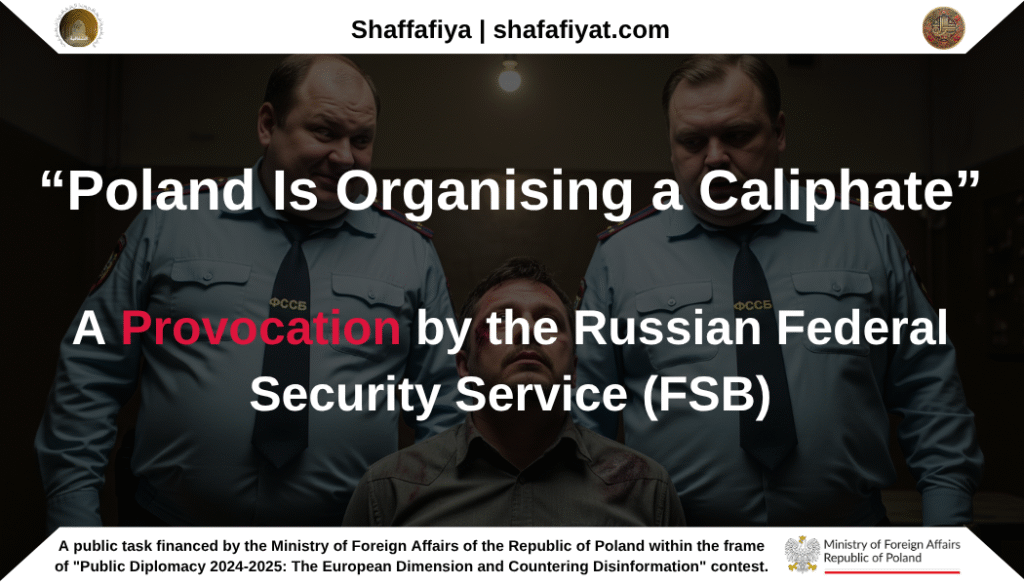
“The accused, acting on the instructions of a foreign emissary of an international terrorist organisation based in Poland, were spreading terrorist ideology among local Muslims and migrant workers,” reads the official statement of the Russian Federal Security Service (FSB). In another part of the statement, the FSB refers to “a covert cell of an international terrorist organisation which was planning a violent takeover of power and the establishment of a so-called global caliphate.” At first glance, this may appear to be a report of a genuine threat to the security of the Russian Federation. In reality, however, it is yet another episode in the long-running series of Russian propaganda, in which Poland—alongside NATO and the European Union—plays the role of the principal villain. We asked experts from the INFO OPS laboratory to analyse the footage prepared by the FSB. Thanks to a frame-by-frame examination, we obtained evidence indicating that this is a crude provocation. The video appears to be a staged media operation—and this for several reasons. Signs of a Provocation – Elements of Staging Lack of Operational Dynamics: In many shots, the officers are seen standing in loose groups, moving slowly and without any evident time pressure. In genuine counterterrorism operations, swift, coordinated action dominates, with immediate securing of the area and neutralisation of threats. The footage is recorded from multiple convenient angles—both close-up and wide—as if the purpose were to produce visually appealing scenes for propaganda purposes. One of the officers deliberately turns to face the camera, allowing his face to be recorded—an act that contradicts the protocols of intelligence services, which require the protection of personnel identities. Absence of Basic Security Measures: The video does not show any buffer zone or perimeter patrols securing the location of the operation. Under standard conditions, such an area would be cordoned off with tape, vehicles, or physical barriers. Officers are seen moving with their weapons lowered, with fingers resting on the triggers rather than indexed along the frame—an elementary firearms safety breach. One purported FSB member is shown standing with his back to a potential threat, engaging in casual conversation with another officer instead of monitoring his assigned sector. There is no visible division into operational roles such as assault, perimeter security, or communication, which suggests a lack of genuine tactical preparation. Deviations from Operational Doctrine: At no point is a commanding officer visible overseeing the operation. In professional settings, the commander—or at least a designated radio operator—is responsible for controlling the tempo, coordinating communication, and managing the distinct phases of the arrest. After the alleged suspects are detained, no standard procedure is followed to check for explosives, concealed weapons, or potential links to a broader network. Officers stand near the suspects in an unstructured formation, with no designated observation sectors and without the use of specialist reconnaissance or security equipment. Absence of Psychophysical Features Typical of Real Operations Lack of Adrenaline Response: In genuine counterterrorism operations, one typically observes tense muscles, rapid movements, and short, urgent verbal commands. In the footage under analysis, the movements of the officers are slow, no audible commands are issued, and conversations take place in a calm, unhurried tone. No Signs of Situational Stress Among the Detainees: The individuals being detained show no typical signs of arrest-related stress. They do not resist, panic, attempt to flee, or make any sudden movements. They remain seated calmly, which clearly indicates that this is a staged scenario. The video, which was intended to convey the effectiveness of the FSB and the menace of alleged “Polish terrorism,” reveals itself as a poorly staged performance. The slow pace, lack of professionalism, and deliberately aestheticised shots suggest a piece of propaganda rather than documentation of an actual operation. This is yet another example of how the Kremlin utilises audiovisual media to construct a narrative of a “besieged fortress” while demonising the West—this time with Poland cast as the principal antagonist. The Kremlin’s Script: Poland as an Instigator of Chaos The accusation that Warsaw is inspiring terrorism in Russia is no coincidence. It constitutes yet another step in the broader framework of the Kremlin’s information strategy, which for months has been intensifying narratives that portray Poland as a “provocateur”, a “puppet of Washington”, and a “source of regional destabilisation.” This narrative has now been reinforced with the addition of a terrorism motif—a key term in the Russian propaganda lexicon that immediately triggers fear and a sense of threat within society. It is no accident that this message is being repeated across Russian social media and news platforms, including the Arabic-language version of Sputnik: “The discovery of a Central Asian extremist cell in the Nizhny Novgorod region promoting terrorist ideology on the orders of Poland.” Such a sentence is a textbook example of disinformation: it is simple, emotionally charged, and easy to disseminate further across the media space, including beyond Russia’s borders. The amplification of this narrative by Sputnik Arabic indicates an effort to reach audiences in the Middle East and Asia, where accusations against the West of fomenting chaos may find a receptive audience. A Psychological Operation Targeting the Domestic Audience Why has the Kremlin chosen to take this step now? It is worth viewing this decision within a broader context. Russia is currently grappling with the escalating costs of the war in Ukraine, severe economic sanctions, and mounting social tensions. In such conditions, a classic mechanism for managing public sentiment is the diversion of attention by designating an “external enemy”. In its official statement, the Federal Security Service not only lays the blame on Poland but also highlights the effectiveness of its own actions: “The FSB in the Nizhny Novgorod region has thwarted the activities of a covert cell of an international terrorist organisation banned in Russia, consisting of seven citizens from a Central Asian country.” The message is unequivocal: had it not been for the vigilance of the security services, Russian citizens would have fallen victim to a foreign plot. This type of communication serves not only to
Susceptibility to disinformation and conspiracy theories in Lebanon
Susceptibility to disinformation and conspiracy theories in Lebanon This material is one of ten analytical briefs accompanying the full report on the security of Lebanon’s information environment. It forms part of a broader series examining key trends and incidents shaping the informational landscape. We encourage you to read the full report:https://shafafiyat.com/ar/2025/09/17/%d8%aa%d9%82%d8%b1%d9%8a%d8%b1-%d8%a3%d9%85%d9%86-%d8%a7%d9%84%d8%a8%d9%8a%d8%a6%d8%a9-%d8%a7%d9%84%d9%85%d8%b9%d9%84%d9%88%d9%85%d8%a7%d8%aa%d9%8a%d8%a9-%d9%81%d9%8a-%d9%84%d8%a8%d9%86%d8%a7%d9%86/ Lebanese society shows a strong susceptibility to “bazaar information,” including conspiracy theories, stemming from polarisation and a deep-seated lack of trust in state institutions and foreign influences. This makes alternative explanations more appealing, enabling disinformation networks and extremist groups to exploit public grievances by disseminating unverified claims online. The complex political landscape, marked by constant external interference and a fragmented power structure, often leads citizens to resort to conspiracy theories to explain the country’s instability. Reliance on speculative information is a way for Lebanese people to cope with reality as they struggle with an opaque system of governance and a complicated network of domestic and international actors vying for influence. The lack of trust in governmental institutions makes Lebanese society more open to alternative narratives, which often take the form of rumours and conspiracies. Additionally, the influence of external forces on Lebanese politics leads to a widespread feeling of alienation, weakening public trust and encouraging openness to unverified sources of information, creating “echo chambers” where certain narratives become entrenched and resistant to opposition. Conspiracy theories are common across all social groups, with each faction attributing the country’s crises to the influence of foreign powers or rival sects. For example, Hezbollah supporters believe in an alliance between Sunni groups, Israel, the US, and Gulf countries, aimed at weakening their influence, while Sunni factions view Hezbollah and Iran as oppressors supported by the state apparatus. Foreign influence, whether real or perceived, exacerbates these tendencies. Lebanon’s sectarian structure and continuous foreign influence create an environment where people believe “something is going on behind the scenes,” which cultivates a culture of suspicion and distrust. In the absence of a cohesive national identity and credible government institutions, Lebanese people often resort to conspiracy theories to make sense of their political and social realities. At the same time, sectarian leaders may promote them to deflect internal criticism. The Beirut Explosion Among the widely circulated theories are speculations about the 2020 Beirut explosion, where a segment of the public rejected official explanations about stored ammonium nitrate, suspecting an attack or a conspiracy involving foreign players, including Israel or Hezbollah. Although Lebanese authorities and experts quickly dismissed these hypotheses, images of the explosion and their coincidence with the anniversary of the Hiroshima attack fueled the popularity of theories about a “nuclear attack” or “secret operation” among certain groups of citizens, despite the lack of radiation evidence or typical signs of a nuclear blast. Financial control by elites and bankers Concerns about currency manipulation by the Lebanese financial elites are widespread. These, combined with the economic crisis, have led to speculation that international organizations like the International Monetary Fund (IMF) are seeking to take control of Lebanon’s economy by imposing restrictive credit conditions. The rising cost of living and hyperinflation intensify these theories. Foreign influences and destabilization efforts Against the backdrop of internal political divisions, many Lebanese are convinced that both Israel and the United States are exploiting Lebanon’s internal weaknesses to undermine Hezbollah and increase their influence, giving rise to theories about the hidden intentions of foreign powers. Theories also continue to surface that secret alliances and influences link Syria and Lebanon.
Viewership and perception of state media
Viewership and perception of state media This material is one of ten analytical briefs accompanying the full report on the security of Lebanon’s information environment. It forms part of a broader series examining key trends and incidents shaping the informational landscape. We encourage you to read the full report:https://shafafiyat.com/ar/2025/09/17/%d8%aa%d9%82%d8%b1%d9%8a%d8%b1-%d8%a3%d9%85%d9%86-%d8%a7%d9%84%d8%a8%d9%8a%d8%a6%d8%a9-%d8%a7%d9%84%d9%85%d8%b9%d9%84%d9%88%d9%85%d8%a7%d8%aa%d9%8a%d8%a9-%d9%81%d9%8a-%d9%84%d8%a8%d9%86%d8%a7%d9%86/ Lebanese state media, primarily represented by Télé Liban (managed by the Ministry of Information) and Al-Manar (managed by Hezbollah), occupies a specific yet complex position in the country’s highly polarised media landscape. Together, they attract a moderate share of the audience, 11.6% for Télé Liban and 6.4% for Al-Manar, which, compared to the much larger audiences of more popular private channels, indicates a limited overall reach. State channels are often viewed through a political lens, with viewers choosing them based on their political affiliations. Despite attempts to maintain accuracy and neutrality, these channels are ultimately perceived as aligned with specific political and sectarian groups, stemming from the complicated history of Lebanese political divisions and media development under the influence of powerful political parties and movements. Télé Liban Lebanon’s public television, managed by the Ministry of Information, provides national news and entertainment. Télé Liban’s viewership share is about 11.6%. On YouTube, they have 175,000 subscriptions, though most videos do not exceed a few thousand views. During the 2022 parliamentary elections, an EU EOM report found that 31% of the general news coverage focused on the Hezbollah party, followed by 19% on the Lebanese Forces. This suggests that individuals from these two political circles are the primary audience for Télé Liban. Al-Manar A Lebanese satellite television station owned by the political party Hezbollah, Al-Manar, serves as Hezbollah’s official media organ. Al-Manar’s viewership share is 6.4%. The audience for Al-Manar content is mainly individuals who are pro-Hezbollah or affiliated with the movement. Viewership and perception of non-state media,including partisan and sectarian/religious media Lebanese non-state media emerged in the 1980s as a counterpoint to the state-controlled Télé-Liban, with a rapid proliferation of politically affiliated channels following the introduction of the Audiovisual Law in 1994. Today, these media play a crucial role in shaping public opinion, distributing information, and representing diverse views. Approximately 97% of Lebanese adults use these media, underscoring strong social engagement with these sources. However, like state media, these non-state outlets are often perceived as less credible due to overt political ties. Major television stations are aligned with political factions, religious groups, or foreign interests (nine major TV stations are linked to pro-Western or pro-Iranian groups), creating an environment in which professional standards often give way to political agendas. Non-state newspapers and radio stations face a similar dynamic. Historically abundant, Lebanese print media is currently declining due to the financial crisis and reduced foreign funding, affecting titles such as An-Nahar and Al-Mustaqbal. The radio sector, which even boasted 180 illegal stations after the civil war, is also constrained by economic and regulatory challenges. Despite these challenges, newspapers and radio stations continue to reflect Lebanon’s political spectrum, maintaining their role in political discourse. Lebanese society has a mixed relationship with non-state media. On one hand, these outlets are valued for giving voice to diverse political opinions, which is vital in a pluralistic society. On the other hand, the strong partisan influence raises scepticism about their objectivity. Viewers often approach media consumption with caution, aware that coverage can vary significantly across channels and their political or sectarian affiliations. Despite concerns about bias, non-state media remain essential for sharing information, especially in the absence of a broadly trusted public institution. Limited press freedoms and the reliance on non-state platforms for up-to-date news on protests, elections, and social movements reinforce their role in political communication and public discourse. Private Media MTV Lebanon: With about 64% market share, MTV is one of Lebanon’s most popular stations. Its broad programming includes news, entertainment, and reality shows. High viewership is due to modern production and popularity among a younger audience. Despite this, MTV is sometimes criticised for its centrist and right-leaning approach, which attracts viewers with moderate views, especially in cities like Beirut. LBCI: With a viewership of about 18.5%, LBCI maintains a strong position as the country’s first private TV station. The channel is popular for its high-quality news programs and series. Although it has a smaller share than MTV, LBCI is valued for its professionalism and relatively balanced reporting. The station maintains historical links with the Lebanese Forces, which influences its editorial line. Al-Jadeed: With a share of about 25.3%, Al-Jadeed is known for its bold investigative journalism and tackling controversial topics, attracting viewers critical of the political elite. The station’s focus on fighting corruption meets the expectations of viewers seeking change, particularly the younger generation. Despite pressure from the authorities, Al-Jadeed maintains significant viewership thanks to its courageous reporting. OTV: This station, with about 12.4% viewership, is associated with the Free Patriotic Movement (FPM), founded by former President Michel Aoun. Due to its clear political ties, it attracts viewers sympathetic to the FPM, especially among Christians who identify with the party’s ideology. OTV places a strong emphasis on covering FPM activities, which creates a niche but loyal audience base. NBN: A television station closely associated with the Amal movement, which represents the political interests of Shiites in Lebanon. The channel concentrates on news, informative, and political programs that support narratives consistent with Amal’s ideology, and its content is often directed at viewers from the South and areas where the Shiite community resides. NBN’s viewership is typically lower than that of mainstream channels like MTV or LBCI, due to the specific nature of its content and its limited appeal to a broader audience. Despite this, it has a constant audience base, mainly among Amal sympathisers and rural residents, where access to commercial media may be limited. Partisan Media Radio Liban: Radio Liban is the national radio broadcaster, funded by the Lebanese government and operating under the Ministry of Information. It plays a crucial role as an information channel, providing news, cultural broadcasts, and educational and musical programs. As a public medium, it is not directly dependent on viewership or listenership, making its market position stable yet less competitive than that of commercial stations. Due to its governmental nature,
Media landscape in Lebanon

This material is one of ten analytical briefs accompanying the full report on the security of Lebanon’s information environment. It forms part of a broader series examining key trends and incidents shaping the informational landscape. We encourage you to read the full report:https://shafafiyat.com/ar/2025/09/17/%d8%aa%d9%82%d8%b1%d9%8a%d8%b1-%d8%a3%d9%85%d9%86-%d8%a7%d9%84%d8%a8%d9%8a%d8%a6%d8%a9-%d8%a7%d9%84%d9%85%d8%b9%d9%84%d9%88%d9%85%d8%a7%d8%aa%d9%8a%d8%a9-%d9%81%d9%8a-%d9%84%d8%a8%d9%86%d8%a7%d9%86/ In Lebanon, the media is divided between those supporting the current government by spreading propaganda and those opposing the government’s narrative. This often relates to the pro- and anti-Hezbollah rivalry in the country. The media in Lebanon are politicised, with only a handful striving to maintain objectivity. Besides television programs or newspapers, media personalities (journalists and influencers) who often oppose the current regime have a significant influence, thereby exposing themselves to reprisals from Hezbollah. Most newspapers and media outlets are headquartered in Beirut. With ten private daily newspapers in three languages and over 1,500 weeklies and monthlies, Lebanon accounts for about half of the publications issued in the Middle East region. Furthermore, the country has nine television stations and about 40 radio stations. Despite this diversity, over 84% of the examined media are politically affiliated. Of these outlets, 27% are directly linked to political parties; 5% have direct ties to the state, and approximately 60% are connected to individuals who have been involved in politics or aspire to become politicians. Moreover, about 32% of the most popular media surveyed are owned by at least eight of Lebanon’s best-known families. Thus, it is one of the most politicised media landscapes, with nearly two-thirds of the media outlets owned by active political figures or political parties. The television sector is the most popular (80% interest), followed by radio (50%) and, finally, online content (40%). Crucially, however, online media are gaining more significance. Apart from public media, all media companies are privately owned. Most of them are registered as joint-stock companies (Société anonyme libanaise) or limited liability companies (Société à responsabilité limitée). There are also media not tied to a media company, as they are individual businesses, such as Bint Jbeil, Lebanon Debate, or El Shark, or belong to an association (in accordance with the 1909 law) like Ya Sour. Most companies were established as separate legal entities for a specific medium and do not own other media channels. The only exceptions are companies such as Lebanese Communication Group L.C.G. SAL (Al-Manar and Al-Nour), Al Jadeed SAL (Al-Jadeed and Al Jadeed 90.3 FM), and National Broadcasting Network SAL (NBN and Al-Risala Radio), which operate in more than one audiovisual sector. The media in Lebanon illustrate the dominance of private owners and a genuinely great diversity of media platforms. Over the years, each political group has acquired its own television network, targeted at a specific audience. This trend has gradually shifted to online media sources, such as online newspapers, social media news accounts, and political accounts on these platforms. In summary, many Lebanese media are highly politicised, and the media landscape of Lebanon can generally be presented as follows: The politicisation of Lebanese media is also influenced by the fact that many of them are owned by prominent political dynasties, e.g., the Hariri family controls The Daily Star, Sawt Beirut International, and Radio Orient, and influences Annahar. In contrast, the Murr family controls MTV, El Nashra, Al Joumhouria, etc. Furthermore, influencers and social media accounts are emerging that, similarly to Europe (and Poland), pursue the interests of a specific party (family) or a foreign power. Lebanon currently (2025) ranks 140th out of 180 countries in the Press Freedom Index. Political control over media ownership is a serious problem that contributes to a highly polarized and biased media space. Media ownership has a significant impact on its content and, therefore, plays a key role in shaping public opinion. In the hands of politicians, the media can be used to advance their own interests through biased reporting, increasing their political reach. With a politically revitalizing Beirut, still feeling the effects of Israeli shelling, the press also remains a key source for communicating with citizens.
Why Does Iran Need a “Partner” Like Russia?
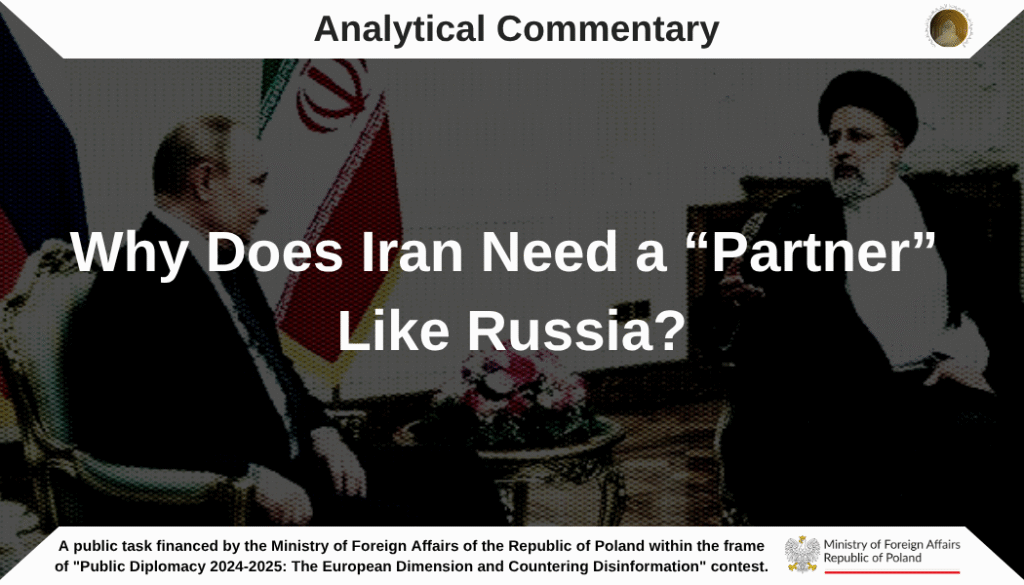
Why Does Iran Need a “Partner” Like Russia? The Russian ambassador to Iraq, Elbrus Kutrashev, in an interview recently conducted with him by Husham Ali on Al Sharqiyah TV, accidentally revealed what Russia’s “partners” can count on when they need help: nothing. The war between Israel and Iran quickly confirmed these words, although Iran had already received evidence of Russia’s betrayal earlier. It is worth recalling that already in January 2025, the Iranian agency Tabnak revealed that Russia had been “playing in favor of Israel” in Syria, among other things by switching off radars during an Israeli attack on Iranian commanders in that country. As the Iranian agency emphasized, this indicated clear cooperation between Russia and the Israeli project. Russia also sabotaged Iranian aid to Bashar al-Assad during the jihadist offensive, which led to his downfall. The Israeli intelligence network in the Syrian army, loyal to Russia, betrayed the Iranian commander of Aleppo’s defense, Gen. Pourhamshemi, helping in his assassination. If they did it then, can Iran be certain that the Russians did not help Israel target objectives during the twelve-day war? Many indications suggest they did. Iran should ask itself why Russia – despite having received important support from Iran in the form of Shahed drones – did not reciprocate by delivering the S-400 air defense system and Su-35 aircraft, which would have been very useful during the war with Israel. The answer lies in the aforementioned interview with Kutrashev, in which he states that “Russia does not support attacks on Israel because there are 1 million Israelis of Russian origin there.” It is worth adding that among them are pro-Kremlin oligarchs (e.g., Roman Abramovich), who moved a significant part of their assets to Israel to protect themselves from American sanctions. But wasn’t the Russian-Iranian Treaty on Comprehensive Strategic Partnership signed in Moscow in January? Kutrashev revealed, however, what a strategic partnership means according to Russia. He emphasized that it is not an alliance, and that Iran cannot count on help in case of an attack – only on the fact that Russia would not support the aggressor. One must admit His Excellency told the truth – and Iran could not count on any assistance from Russia after Israel’s attack. The only question remains: who needs a “strategic partnership” of the kind Russia offers? This also applies to the muqawama in Iraq. If they joined the war, as Kutrashev stated, the only help would consist of “praying for the resistance.” The Israeli-Iranian war was a gift for Russia, but ultimately Iran’s agreement to de-escalation was a blow for it. Russia had counted on Iran to block the Strait of Hormuz, and on the Iraqi muqawama to strike the American embassy and the Al-Asad base. So what if Iraq would then go up in flames, and Iran would face a long and devastating war? The most important thing was that the United States would be drawn into the war and become bogged down in the Middle East. Such a war would not be beneficial for the US, Iraq, or Iran – but it would be very beneficial for Russia. It would divert American forces and resources from Ukraine and Central and Eastern Europe, enabling Moscow to invade the Baltic states. And the ones paying the price would be the Iranians and Iraqis. In addition, oil and gas prices would skyrocket. After all, Russia does not use the Strait of Hormuz. Iran, however, would gain nothing from these price increases except destruction. The same applies to Iraq. In whose interest is Russia acting? Perhaps it is time for some people to finally answer that question. Author: Witlod Repetowicz
Geopolitical situation of Lebanon

This material is one of ten analytical briefs accompanying the full report on the security of Lebanon’s information environment. It forms part of a broader series examining key trends and incidents shaping the informational landscape. We encourage you to read the full report:https://shafafiyat.com/ar/2025/09/17/%d8%aa%d9%82%d8%b1%d9%8a%d8%b1-%d8%a3%d9%85%d9%86-%d8%a7%d9%84%d8%a8%d9%8a%d8%a6%d8%a9-%d8%a7%d9%84%d9%85%d8%b9%d9%84%d9%88%d9%85%d8%a7%d8%aa%d9%8a%d8%a9-%d9%81%d9%8a-%d9%84%d8%a8%d9%86%d8%a7%d9%86/ The beginning of 2025 is a difficult period for Lebanon, in which the country has experienced rising border tensions, an increase in the exchange of fire between Hezbollah and the Israeli military (IDF), a protracted political deadlock over the presidential election, and a lack of economic and institutional reforms. State institutions have an extremely negligible influence on Hezbollah’s activities, worsening the unfavourable security environment and hindering Lebanon’s functioning on the international stage, especially in contacts with Western nations. Regional and global players are trying to pressure both Lebanon and Israel to limit the scale of the conflict and prevent its escalation. These efforts have so far yielded no results. The risk of further deterioration in the regional security situation is real, though there are no clear indications of its likelihood. Towards the end of the first quarter of this year, there was an increase in IDF airstrikes on targets located significantly beyond the UNIFIL area of responsibility. The persistent political stalemate does not help the security situation. Discussions regarding the election of a new head of state have not brought a breakthrough. To date, the Lebanese political class has been unable to select a candidate who could take overpower in the state. International mediations (involving the USA, Qatar, Egypt, France, and Saudi Arabia) have proven ineffective. In the face of unfavourable regional conditions, this situation is dangerous, as it significantly limits the state’s capacity to function on a formal level (inability to appoint heads of key state institutions) and in the economic sphere (the country’s persistent very low credit and investment rating). The Lebanese government and political decision-makers continue their anti-immigrant rhetoric, strengthened by the assassination of one of the leaders of the Christian party “Lebanese Forces,” which occurred at the beginning of the second quarter of this year. In May of this year, Commissioner Ursula von der Leyen visited Lebanon, offering aid totalling €1 billion, partly in exchange for securing the country’s borders and limiting illegal emigration to EU countries. a) Escalation of the conflict on the Lebanese-Israeli border and the role of Hezbollah The main factor shaping the country’s internal politics is the conflict with Israel, and particularly Hezbollah’s military involvement. Lebanese authorities appear to have virtually no control over the Party of God’s activities. Since the Hamas attack on Israel in October 2023, the intensity of the exchange of fire on the Lebanese-Israeli border has been systematically increasing. In the last quarter, a decided increase has been noted in the use of UAVs by Hezbollah and fighter jets by Israel (Lebanese UAVs are mainly used for reconnaissance; IDF air force and UAVs are used for precision strikes, including far beyond the UNIFIL area of responsibility (the area south of the Litani River). To date, neither side has fully engaged its military potential. We assess that Hezbollah likely does not have Iran’s full consent to become fully involved in the conflict. Furthermore, the complex internal situation in Lebanon does not give Hezbollah complete freedom of action, and voices are increasingly heard among political leaders questioning the legitimacy of the decision to join the war. Even now, the indirect and direct costs of the armed activities on the border are significant. Since October 2023, approximately 95,000-100,000 people have left southern Lebanon and relocated to areas north of the Litani River. It is estimated that because of the IDF’s use of white phosphorus munitions, approximately 1,200 hectares of cultivated land have been permanently chemically contaminated and burned, making them unusable for agriculture. Olive groves, which form the basis of the region’s economy, have also been destroyed. Around 400,000 head of livestock have died. In total, approximately 75% of the population living in the south has lost its primary source of income. Lebanon’s total losses resulting from the conflict are estimated at roughly $1.7 billion USD. The leading global player involved in attempting to develop mechanisms for a cessation of hostilities is the United States. Washington appointed the State Department’s Special Envoy for Lebanon, A. Hochstein, to negotiate with the conflict parties (Hochstein was previously involved in talks between Lebanon and Israel regarding access to gas fields in disputed territorial waters). The scenario proposed by the Americans assumes the withdrawal of Hezbollah forces to 8-10 km from the border with Israel, the reinforcement of LAF presence in that area, and the opening of negotiations regarding the shape of the border line (in which Israel will likely be proposed to withdraw from disputed territories). For the USA, a stable situation in Lebanon remains one of the guarantees of relative regional peace. Despite the country’s resolute declarations, which emphasize a lack of will to escalate the conflict, attempts to neutralize Hezbollah’s influence have so far been unsuccessful, and the exchange of fire is gaining intensity. Lebanon’s stance on the conflict will be reactive in response to the scale and dynamics of Israel’s actions. b) The problem of Syrian refugees as a key element of domestic policy The Syrian issue remains one of the most critical topics shaping the domestic political discourse. Despite differences in other areas, the issue of Syrian migrants unites political blocs and decision-makers, who advocate the urgent need to regulate migration. Approximately 780,000 registered Syrian refugees and hundreds of thousands of unregistered ones reside in Lebanon. The Lebanese parliament approved a program to establish a ministerial commission tasked with communicating Lebanon’s policy priorities on the Syrian issue in the international and regional arena. Lebanese services have intensified repatriation efforts. Representatives of the Lebanese government use strong, unambiguous anti-migration rhetoric. Lebanon’s Minister of the Interior is explicit: only Syrians whose stay is justified for security reasons can remain in the country; the authorities’ priority is to ensure the country’s security. During the “Brussels VIII” conference in May
Information Warfare Online: Digital Disinformation in Egypt and African Countries
The development of digital technologies has revolutionized the way information is created, disseminated, and consumed worldwide. In the African context—particularly in Egypt—this transformation has opened new opportunities for the advancement of civil societies, while simultaneously giving rise to serious challenges related to information abuse. Increasingly, the digital space is becoming the primary battlefield for political, ideological, and social influence. Disinformation has emerged as a key instrument in this struggle. This analysis explores the phenomenon of digital disinformation in selected African countries, with a particular focus on Egypt, which—due to its geopolitical position, media structure, and mechanisms of state control—offers a uniquely compelling context for research. In the book Digital Disinformation in Africa: Hashtag Politics, Power and Propaganda, edited by Tony Roberts and George H. Karekwaivanane, the authors identify disinformation as one of the fundamental threats to democratic institutions and civil rights on the continent. Disinformation contributes to the distortion of electoral processes, fuels social tensions, and hinders rational public debate on issues such as public health, women’s rights, and migration. In conditions marked by limited transparency and low levels of media literacy, the effects of disinformation tend to be particularly profound and difficult to reverse. This phenomenon has intensified in Africa due to the rapid growth in the number of internet and social media users. Over the past decade, approximately 300 million new individuals have come online, bringing the total number of regular internet users on the continent to around 600 million, with 400 million using social media platforms. However, this development has been highly uneven. For instance, in 2022, more than 70% of the populations in Egypt, Morocco, and the Seychelles had internet access, compared to just 7% in the Central African Republic. Egypt stands out with a relatively high internet penetration rate (over 75%), yet this access remains sharply unequal—concentrated in urban centers and limited in rural areas. Egypt and Africa in the Digital Information Battleground Digital inequalities, limited educational and technological infrastructure, and deficits in media literacy create an environment highly susceptible to information manipulation. In Egypt, an additional key factor is the political model of control over the information space. According to a report by African Arguments, regulations ostensibly aimed at countering disinformation are in practice used to suppress public debate and criminalize independent journalism. Security agencies are authorized to censor online content and penalize users, leading to increased levels of self-censorship and the marginalization of critical voices. From a research perspective, various theoretical approaches are employed to analyze this phenomenon. One of the most widely recognized is the so-called “4D model” proposed by Ben Nimmo of the Atlantic Council’s DFRLab, which identifies four core disinformation strategies: Dismiss, Distort, Distract, and Dismay. The literature also emphasizes the importance of taking historical context into account. According to the analysis by Tony Roberts and George Hamandishe Karekwaivanane, “the legacy of colonialism is a defining feature of African disinformation—a tool of colonial power transposed into the practices of post-independence states.” In the case of Egypt, the history of propaganda dates back to the era of the monarchy, intensified during the Nasser period, and continues today in digital forms. State-run media, controlled platforms, and repressive legislation still play a significant role in managing information narratives. As noted in the 2024 report by CIPESA, despite the presence of independent fact-checking initiatives, their impact remains limited—largely due to the dominance of state or government-affiliated media, the lack of algorithmic transparency, and an atmosphere of fear among internet users. Both historical and contemporary information operations—such as the Cambridge Analytica campaign in Kenya—demonstrate the continuity of this phenomenon and point to its evolution toward increasingly technologically sophisticated methods of influence. The authors of Digital Disinformation in Africa emphasize, however, that it is not the technology itself that generates disinformation, but rather the people and institutions who use it as a tool for manipulation. Its reach and effectiveness grow in direct proportion to social inequalities, legal constraints, and the weaknesses of democratic institutions. Cases of Information and Psychological Operations In Egypt, the government of President Abdel Fattah al-Sisi has been actively using digital channels to shape public opinion by promoting nationalist narratives and delegitimizing political and social opponents. These campaigns often combine disinformation techniques with elements of psychological operations, making them particularly effective. A notable example is the targeting of the Sudanese refugee community, carried out as a campaign aimed at fostering social distance and hostility. An investigation by Beam Reports revealed that social media in Egypt had been flooded with content dehumanizing refugees. This included the dissemination of a manipulated video featuring a supposed “historian” who compared the presence of Sudanese people to an occupation in ancient Egypt. The campaign was associated with hashtags such as #Deportation_of_Sudanese and #Egypt_for_Egyptians, which gained widespread popularity and were promoted by well-known journalists and influencers, including Hala Sarhan. Refugees were portrayed as the cause of the economic crisis, a threat to Egyptian identity, and an “external force destabilizing the state.” Alongside anti-immigration campaigns, the Egyptian authorities have also carried out actions targeting women involved in social activism. As noted in the chapter dedicated to gendered disinformation in the book Digital Disinformation in Africa, Egyptian activists, journalists, and female politicians were regularly attacked on social media using sexist messages, suggestions of immorality, or a “lack of patriotism.” The aim was often to discredit women as incapable of representing the national interest or as “Western agents.” This points to the use of disinformation to maintain social and gender hierarchies, which fits into a broader trend on the continent. These types of actions are supported by state structures. The Egyptian Ministry of Communications and Information Technology (MOCIET) cooperates with national security services and the Public Prosecutor’s Office in identifying and prosecuting social media users accused of “spreading false information.” The 2018 media laws, including the so-called Cybercrime Law, make it possible to block accounts and detain individuals who publish content considered to be contrary to “national security.” This system is supplemented by the use of advanced tools to monitor digital
A Thousand-Year Conflict? Russia’s Historical Narrative as a Tool of Propaganda in the Arab World
The Russian documentary “Russia – Poland. A Conflict Lasting a Thousand Years” presents the history of Polish–Russian relations as an unbroken chain of hostility and conflict, stretching from the medieval era to the present day. Right from the start, the narrator emphasizes an alleged eternal enmity, stating that “Russians and Poles are two Slavic nations that have lived side by side for centuries… but since the 10th century, Poland and Russia have been in conflict.” This fatalistic claim is further developed by attributing the division between the two nations to religious differences: Poland, the narrator states, was “baptized by the Vatican,” while Russia was “baptized by Byzantium.” In doing so, the film immediately constructs a vision of a historical clash of civilizations—Catholic Western Europe represented by Poland, and Orthodox Eastern Europe embodied by Russia. However, this historical framing does not serve as a reliable analysis of the past; rather, it is part of a broader propaganda strategy. The Kremlin employs an emotionally charged and compelling historical narrative to influence the Arab information space. Historical references are carefully selected and interpreted in a way that resonates with the lived experiences and emotional sensitivities of audiences across the MENA region. Historical Narrative in the Service of Kremlin Propaganda The narrator employs a form of historical fatalism, presenting the conflict as inevitable and centuries-old. This framing is intended to suggest a simple conclusion to Arab viewers: that Poles and Russians have always been enemies, and therefore, current tensions are merely a natural continuation of an age-old war. Such a deterministic narrative leaves no room for alternative interpretations and ignores long periods of peaceful coexistence and cooperation between the two nations. Importantly, the very assumption of a “thousand-year” Polish–Russian neighborhood is historically inaccurate. Russian statehood in the Muscovite sense—commonly recognized as the direct predecessor of the modern Russian Federation—emerged only in the 14th century. Regular diplomatic relations and conflicts with Poland did not begin until the 15th or 16th century. The earlier history of Kievan Rus’ bears no direct connection to Moscow, either geographically or politically. Nevertheless, the film deliberately blurs the lines between Kievan Rus’, the Grand Duchy of Moscow, the Tsardom of Russia, the Soviet Union, and today’s Russian Federation—treating them as a single, continuous political and geopolitical entity. This narrative device is designed to create the illusion that Russia has always existed as a unified actor on the European stage. In reality, this is a deeply misleading oversimplification. To the uninformed viewer in the Arab world, unfamiliar with the intricacies of Eastern European history, this storyline may appear coherent and convincing. But in fact, it is one of the most insidious distortions used to conceal the truth: that Russia, as an imperial structure, entered the European political landscape centuries after the establishment of the Kingdom of Poland. Moreover, from its very first minutes, the documentary deliberately blends historical narrative with current political messaging. Contemporary Poland is portrayed as “the vanguard of NATO aimed at Russia”—a country portrayed as blindly hostile toward Russia, allegedly due to Western propaganda. The narrator claims that “Poland is now one of the most hostile countries toward Russia,” a country on whose territory military bases were established after World War II, and where American forces are now stationed. The film even cites a specific figure—over 100 military bases—which the United States is allegedly planning to deploy in Poland in the coming years. Such exaggerated claims are intended to give Arab viewers the impression that Poland is heavily militarized and poses a direct threat to Russia. As the narrator concludes, “the Russian people see this as a serious threat coming from Poland—a threat backed by the United States.” This portrayal of Poland—as a puppet of the West and a forward operating base for an anti-Russian offensive—deliberately taps into themes that are deeply familiar to audiences in the Arab world. The emphasis on NATO and “overseas partners” (namely, the U.S.) resonates with widespread anti-Western sentiment and suspicion of foreign intervention across the MENA region. Many Arab viewers, shaped by their own historical experiences with Western interference, are likely to interpret this narrative as a modern analogue to imperial policy—casting NATO as a contemporary colonizer and Poland as its local proxy. In this way, the Kremlin’s messaging cleverly exploits existing stereotypes and lingering resentments: if NATO and the U.S. are seen as destabilizing forces, then any country hosting their bases—such as Poland—is, by association, suspect. This implied association may trigger an instinctive aversion toward Poland among Arab audiences, even before they are exposed to any factual or balanced information. It is worth noting that Russian historical propaganda does not avoid invoking the theme of “brotherly nations.” The film, despite its overall antagonistic tone, does mention that Poles and Russians share many characteristics as Slavs. However, this motif of brotherhood is immediately contrasted with scenes of conflict. This contrast is likely intentional: in the Middle East, stories of feuding brothers are deeply familiar. Despite shared language and religion, the Arab world has also experienced divisions and internal wars. Arab viewers may subconsciously relate the Catholic-Orthodox Slavic split to their own lived experiences—such as rivalries between Arab states or conflicts rooted in sectarian divisions. These kinds of cultural references, particularly those involving “fraternal” disputes, make the Russian narrative more relatable and seemingly credible to a MENA audience. History is thus used here as a universal parable, with a moral drawn from the Kremlin’s perspective—crafted to guide the viewer toward certain political conclusions. In summary, the Kremlin is consciously rewriting history for a specific audience. It employs a calculated blend of facts, half-truths, and emotionally resonant interpretations to produce a compelling narrative. The objective is clear: to generate among Arab viewers a sense of understanding—or even justification—for Russia’s current stance toward Poland and the broader region, by framing it as the natural outcome of a thousand-year-old history. Before diving into concrete examples of such manipulation, it is important to examine the general mechanisms of disinformation deployed throughout the film. Mechanisms of Manipulation